Documents & Resources - Search Results
Search results
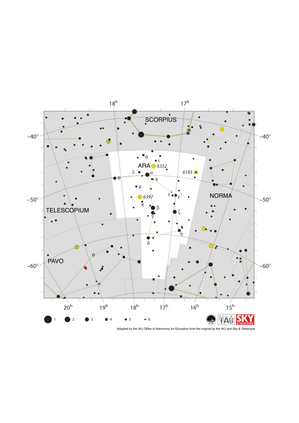
Ara Constellation Map
image
Caption: The constellation Ara along with its bright stars and surrounding constellations. Ara is surrounded by (going clockwise from the top): Scorpius, Norma, Triangulum Australe, Apus, Pavo, Telescopium and Corona Australis.
Ara is a southern constellation that is visible from the entire southern hemisphere at some point in the year and is visible from equatorial with parts of the constellation visible from some temperate parts of the northern hemisphere. It is best viewed in the evening in the northern hemisphere summer and southern hemisphere winter.
The globular clusters NGC 6352 and NGC 6397 lie in Ara. These are marked here with yellow circles with plus symbols superimposed on them. The open cluster NGC 6193 also lies in Ara, this is marked here with a yellow circle that is partially obscured by the dot marking the brightest member of the cluster which is visible to the naked eye under good conditions.
The y-axis of this diagram is in degrees of declination with north as up and the x-axis is in hours of right ascension with east to the left. The sizes of the stars marked here relate to the star's apparent magnitude, a measure of its apparent brightness. The larger dots represent brighter stars. The Greek letters mark the brightest stars in the constellation. These are ranked by brightness with the brightest star being labeled alpha, the second brightest beta, etc., although this ordering is not always followed exactly. The dotted boundary lines mark the IAU's boundaries of the constellations and the solid green lines mark one of the common forms used to represent the figures of the constellations. Neither the constellation boundaries, nor the lines joining the stars appear on the sky.
Credit: Adapted by the IAU Office of Astronomy for Education from the original by IAU/Sky & Telescope
Credit Link
Glossary Terms:
Apparent Magnitude , Celestial Coordinates , Constellation , Declination , Globular Cluster , Right Ascension (RA) , Scorpius , Open Cluster
Categories:
Naked Eye Astronomy
License: Creative Commons Attribution 4.0 International (CC BY 4.0) Creative Commons Attribution 4.0 International (CC BY 4.0) icons
File
( image
98.71 kB)
PDF File
(PDF file
166.33 kB)

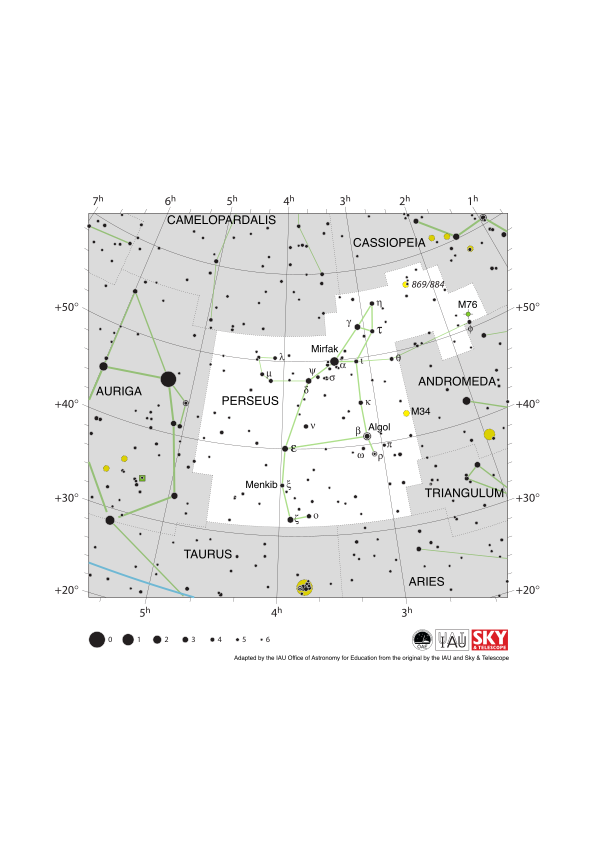
Perseus Constellation Map
image
Caption: The constellation Perseus with its bright stars and surrounding constellations. Perseus is surrounded by (going clockwise from the top): Camelopardalis, Cassiopeia, Andromeda, Triangulum, Aries, Taurus and Auriga. Perseus is home to the notable variable star Algol.
Perseus is a northern constellation and thus the whole constellation is visible at some point in the year throughout the northern hemisphere. The whole constellation is also visible to equatorial regions of the southern hemisphere with parts of the constellation visible to southern temperate regions. Perseus is best viewed in the evenings in the northern hemisphere winter and southern hemisphere summer.
The open clusters NGC 869 and NGC 884 (commonly known as the Double Cluster) lie in Perseus as does the open cluster M34. These are all marked with yellow circles. The brightest star in Perseus, Mirfak (alpha Persei), along with some of the surrounding stars are members of the Alpha Persei open cluster. The planetary nebula M76 also lies in Perseus, it is marked here with a green circle superimposed on a plus sign.
The y-axis of this diagram is in degrees of declination with north as up and the x-axis is in hours of right ascension with east to the left. The sizes of the stars marked here relate to the star's apparent magnitude, a measure of its apparent brightness. The larger dots represent brighter stars. The Greek letters mark the brightest stars in the constellation. These are ranked by brightness with the brightest star being labeled alpha, the second brightest beta, etc., although this ordering is not always followed exactly. The dot marking Algol is surrounded by a circle, showing it is a variable star. The dotted boundary lines mark the IAU's boundaries of the constellations and the solid green lines mark one of the common forms used to represent the figures of the constellations. The blue line at the bottom left of the diagram marks the ecliptic. Neither the constellation boundaries, nor the lines joining the stars, nor the ecliptic, appear on the sky.
Credit: Adapted by the IAU Office of Astronomy for Education from the original by the IAU and Sky & Telescope
Credit Link
Glossary Terms:
Apparent Magnitude , Celestial Coordinates , Constellation , Declination , Ecliptic , Planetary Nebula , Right Ascension (RA) , Open Cluster , Variable Star
Categories:
Naked Eye Astronomy
License: Creative Commons Attribution 4.0 International (CC BY 4.0) Creative Commons Attribution 4.0 International (CC BY 4.0) icons
File
( image
119.08 kB)
PDF File
(PDF file
189.39 kB)
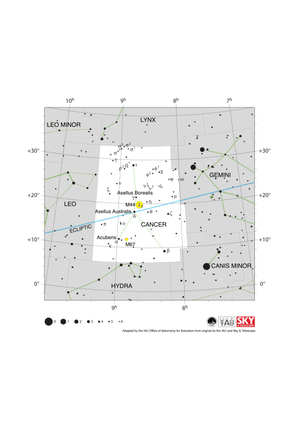
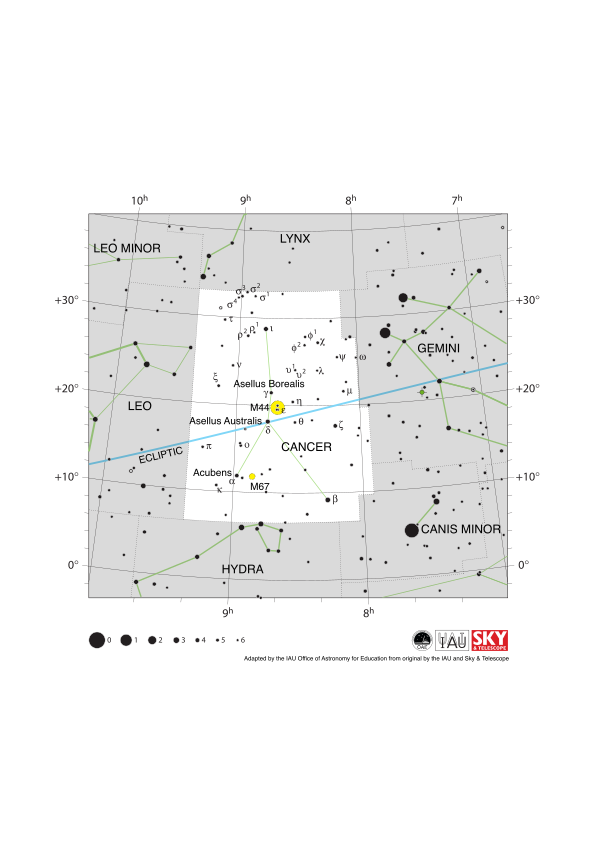
Cancer Constellation Map
image
Caption: The zodiac constellation Cancer and its surrounding constellations. Starting from the top of the diagram and going clockwise, these are Lynx, Gemini, Canis Minor, Hydra, Leo and Leo Minor. The ecliptic (shown here as a blue line) passes almost exactly through the middle of the constellation, this is the path the Sun appears to take across the sky over the course of a year. The Sun is in Cancer from late July to mid August. The other planets of the Solar System can often be found in Cancer.
Cancer lies just north of the celestial equator and is thus visible at some time in the year from all of planet Earth except for the most antarctic regions of the world. Cancer is most visible in the evenings in the northern hemisphere spring and southern hemisphere autumn.
Two star clusters are visible in Cancer: M44, an open cluster often called the Beehive Cluster, and M67, a denser open cluster with about four times more stars than M44. These clusters are indicated by yellow circles with a dotted border on the map.
The y-axis of this diagram is in degrees of declination with north as up and the x-axis is in hours of right ascension with east to the left. The sizes of the stars marked here relate to the star's apparent magnitude, a measure of its apparent brightness. The larger dots represent brighter stars. The Greek letters mark the brightest stars in the constellation. These are ranked by brightness with the brightest star being labelled alpha, the second brightest beta, etc., although this ordering is not always followed exactly. The dotted boundary lines mark the IAU's boundaries of the constellations and the solid green lines mark one of the common forms used to represent the figures of the constellations. Neither the constellation boundaries, nor the line marking the ecliptic, nor the lines joining the stars appear on the sky.
Credit: Adapted by the IAU Office of Astronomy for Education from the original by IAU/Sky & Telescope
Credit Link
Glossary Terms:
Apparent Magnitude , Celestial Coordinates , Constellation , Declination , Ecliptic , Gemini , Leo , Right Ascension (RA) , Zodiac , Cancer , Open Cluster
Categories:
Naked Eye Astronomy
License: Creative Commons Attribution 4.0 International (CC BY 4.0) Creative Commons Attribution 4.0 International (CC BY 4.0) icons
File
( image
103.00 kB)
PDF File
(PDF file
182.01 kB)

Norma Constellation Map
image
Caption: The constellation Norma with its brighter stars and surrounding constellations. Norma is surrounded by (going clockwise from the top): Scorpius, Lupus, Circinus, Triangulum Australe and Ara. Norma is a faint constellation with relatively few bright stars.
Norma is a southern constellation and thus the whole constellation is visible at some point in the year throughout the southern hemisphere. The whole constellation is also visible from equatorial regions of the northern hemisphere with parts of the constellation visible from some northern hemisphere temperate regions. Norma is best viewed in the evening in the northern hemisphere summer and southern hemisphere winter.
The open clusters NGC 6025 and NGC 6087 lie in Norma and are marked here with yellow circles.
The y-axis of this diagram is in degrees of declination with north as up and the x-axis is in hours of right ascension with east to the left. The sizes of the stars marked here relate to the star's apparent magnitude, a measure of its apparent brightness. The larger dots represent brighter stars. The Greek letters mark the brightest stars in the constellation. These are ranked by brightness with the brightest star being labeled alpha, the second brightest beta, etc., although this ordering is not always followed exactly. The dotted boundary lines mark the IAU's boundaries of the constellations and the solid green lines mark one of the common forms used to represent the figures of the constellations. Neither the constellation boundaries, nor the lines joining the stars appear on the sky.
Credit: Adapted by the IAU Office of Astronomy for Education from the original by the IAU and Sky & Telescope
Credit Link
Glossary Terms:
Apparent Magnitude , Celestial Coordinates , Constellation , Declination , Right Ascension (RA) , Scorpius , Open Cluster
Categories:
Naked Eye Astronomy
License: Creative Commons Attribution 4.0 International (CC BY 4.0) Creative Commons Attribution 4.0 International (CC BY 4.0) icons
File
( image
108.17 kB)
PDF File
(PDF file
166.47 kB)

Scutum Constellation Map
image
Caption: The constellation Scutum with its brighter stars and surrounding constellations. Scutum is surrounded by (going clockwise from the top): Serpens Cauda, Sagittarius and Aquila.
Scutum is a southern constellation and thus the whole constellation is visible at some point in the year throughout the southern hemisphere. The whole constellation is also visible from equatorial and temperate regions of the northern hemisphere with parts of the constellation visible from all but the most arctic regions.
Two open clusters lie in Scutum: M11, commonly known as the Wild Duck Cluster; and M26. Both of these are marked here with yellow circles.
The y-axis of this diagram is in degrees of declination with north as up and the x-axis is in hours of right ascension with east to the left. The sizes of the stars marked here relate to the star's apparent magnitude, a measure of its apparent brightness. The larger dots represent brighter stars. The Greek letters mark the brightest stars in the constellation. These are ranked by brightness with the brightest star being labeled alpha, the second brightest beta, etc., although this ordering is not always followed exactly. The dotted boundary lines mark the IAU's boundaries of the constellations and the solid green lines mark one of the common forms used to represent the figures of the constellations. The blue line at the bottom of the diagram marks the ecliptic. Neither the constellation boundaries, nor the lines joining the stars, nor the ecliptic, appear on the sky.
Credit: Adapted by the IAU Office of Astronomy for Education from the original by the IAU and Sky & Telescope
Credit Link
Glossary Terms:
Apparent Magnitude , Celestial Coordinates , Constellation , Declination , Right Ascension (RA) , Open Cluster
Categories:
Naked Eye Astronomy
License: Creative Commons Attribution 4.0 International (CC BY 4.0) Creative Commons Attribution 4.0 International (CC BY 4.0) icons
File
( image
96.44 kB)
PDF File
(PDF file
162.71 kB)