Documents & Resources - Search Results
Search results

Lepus Constellation Map
image
Caption: The constellation Lepus with its bright stars and surrounding constellations. Lepus is surrounded by (going clockwise from the top): Orion, Eridanus, Caelum, Columba, Canis Major and Monoceros.
Lepus is a southern constellation and thus the whole constellation can be viewed at some point in the year throughout the southern hemisphere. The whole constellation can also be viewed from temperate and equatorial regions of the northern hemisphere. Lepus is best viewed in the evening in the northern hemisphere winter and southern hemisphere summer.
The globular cluster M79 lies in Lepus. It is marked here with a yellow circle with a plus sign superimposed on it.
The y-axis of this diagram is in degrees of declination with north as up and the x-axis is in hours of right ascension with east to the left. The sizes of the stars marked here relate to the star's apparent magnitude, a measure of its apparent brightness. The larger dots represent brighter stars. The Greek letters mark the brightest stars in the constellation. These are ranked by brightness with the brightest star being labeled alpha, the second brightest beta, etc., although this ordering is not always followed exactly. The dotted boundary lines mark the IAU's boundaries of the constellations and the solid green lines mark one of the common forms used to represent the figures of the constellations. Neither the constellation boundaries, nor the lines joining the stars appear on the sky.
Credit: Adapted by the IAU Office of Astronomy for Education from the original by the IAU and Sky & Telescope
Credit Link
Glossary Terms:
Apparent Magnitude , Celestial Coordinates , Constellation , Declination , Right Ascension (RA)
Categories:
Naked Eye Astronomy
License: Creative Commons Attribution 4.0 International (CC BY 4.0) Creative Commons Attribution 4.0 International (CC BY 4.0) icons
File
( image
87.88 kB)
PDF File
(PDF file
163.08 kB)
Corona Australis Constellation Map
image
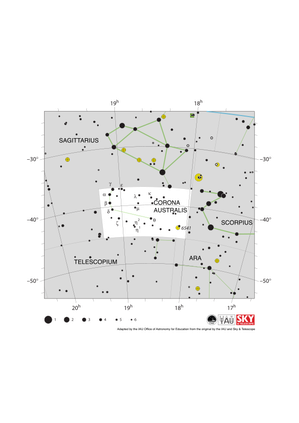
Caption: The constellation Corona Australis with its brighter stars and surrounding constellations. Corona Australis is surrounded by (going clockwise from the top): Sagittarius, Scorpius, Ara and Telescopium. This constellation has relatively few bright stars.
Corona Australis is a southern constellation and thus the whole constellation is visible in the southern hemisphere at some point in the year. The constellation can also be viewed from equatorial and some temperate regions of the northern hemisphere. The constellation is best viewed in the evening in the northern hemisphere summer and southern hemisphere winter.
The globular cluster NGC 6541 lies in Corona Australis and is marked here with a yellow circle with a plus sign superimposed on it.
The y-axis of this diagram is in degrees of declination with north as up and the x-axis is in hours of right ascension with east to the left. The sizes of the stars marked here relate to the star's apparent magnitude, a measure of its apparent brightness. The larger dots represent brighter stars. The Greek letters mark the brightest stars in the constellation. These are ranked by brightness with the brightest star being labeled alpha, the second brightest beta, etc., although this ordering is not always followed exactly. The dotted boundary lines mark the IAU's boundaries of the constellations and the solid green lines mark one of the common forms used to represent the figures of the constellations. Neither the constellation boundaries, nor the lines joining the stars appear on the sky. The blue line at the top right of the diagram marks the ecliptic.
Credit: Adapted by the IAU Office of Astronomy for Education from the original by the IAU and Sky & Telescope
Credit Link
Glossary Terms:
Apparent Magnitude , Celestial Coordinates , Constellation , Declination , Ecliptic , Globular Cluster , Right Ascension (RA) , Scorpius , Sagittarius
Categories:
Naked Eye Astronomy
License: Creative Commons Attribution 4.0 International (CC BY 4.0) Creative Commons Attribution 4.0 International (CC BY 4.0) icons
File
( image
88.22 kB)
PDF File
(PDF file
158.70 kB)

Musca Constellation Map
image
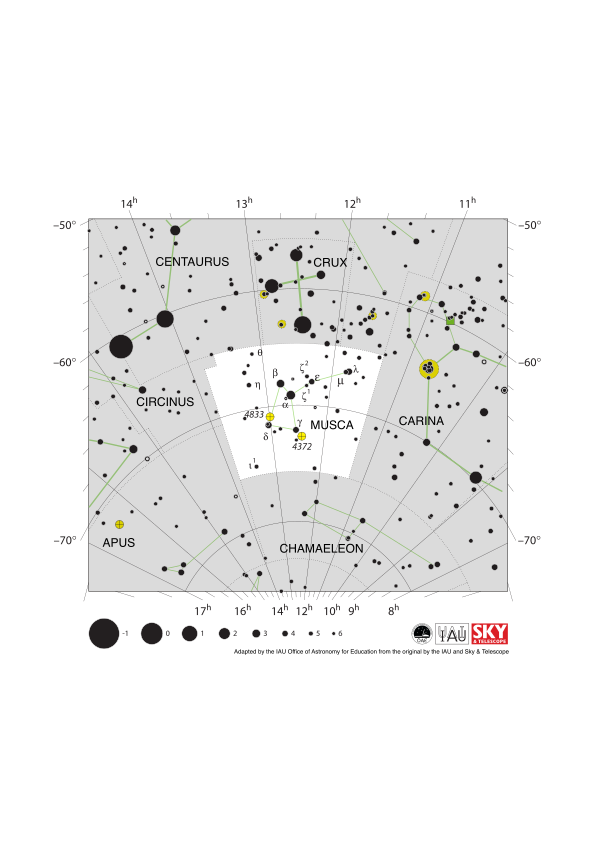
Caption: The constellation Musca with its bright stars and surrounding constellations. Musca is surrounded by (going clockwise from the top): Crux, Centaurus, Carina, Chamaeleon, Apus and Circinus.
Musca is a southern constellation and thus the whole constellation is visible at some point in the year throughout the southern hemisphere. The whole constellation is visible to a thin strip of the northern hemisphere near the equator with parts of the constellation visible to other northern equatorial regions. Musca is circumpolar in temperate and antarctic regions of the southern hemisphere. Musca is best viewed in the evening in the northern hemisphere late spring and southern hemisphere late autumn.
The globular clusters NGC 4372 and NGC 4833 lie in Musca and are marked here with yellow circles with plus signs superimposed on them.
The y-axis of this diagram is in degrees of declination with north as up and the x-axis is in hours of right ascension with east to the left. The sizes of the stars marked here relate to the star's apparent magnitude, a measure of its apparent brightness. The larger dots represent brighter stars. The Greek letters mark the brightest stars in the constellation. These are ranked by brightness with the brightest star being labeled alpha, the second brightest beta, etc., although this ordering is not always followed exactly. The dotted boundary lines mark the IAU's boundaries of the constellations and the solid green lines mark one of the common forms used to represent the figures of the constellations. Neither the constellation boundaries, nor the lines joining the stars appear on the sky.
Credit: Adapted by the IAU Office of Astronomy for Education from the original by the IAU and Sky & Telescope
Credit Link
Glossary Terms:
Apparent Magnitude , Celestial Coordinates , Circumpolar Stars , Constellation , Declination , Right Ascension (RA) , Southern Cross
Categories:
Naked Eye Astronomy
License: Creative Commons Attribution 4.0 International (CC BY 4.0) Creative Commons Attribution 4.0 International (CC BY 4.0) icons
File
( image
122.56 kB)
PDF File
(PDF file
177.89 kB)
Apus Constellation Map
image
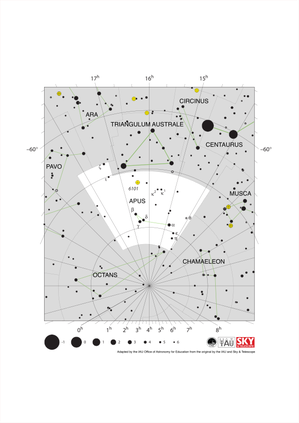
Caption: The constellation Apus with its bright stars and surrounding constellations. Apus is surrounded by (going clockwise from the top): Triangulum Australe, Circinus, Musca, Chamaeleon, Octans, Pavo and Ara.
Apus is a southern constellation lying close to the south celestial pole. As such it is visible at some point in the year from the entire southern hemisphere but is only visible from the most equatorial regions of the northern hemisphere. Apus is circumpolar for all temperate and antarctic regions of the southern hemisphere. It is most visible in the evenings in the northern hemisphere summer and southern hemisphere autumn.
The globular cluster NGC 6101 can be found in Apus. It is marked here with a yellow circle with a plus symbol superimposed on it.
This diagram maps an area around the south celestial pole. Here lines of constant right ascension converge. The right ascension values (in hours) of these lines are marked on the x-axis above and below the diagram. Lines of constant declination (in degrees) are marked on the y-axis. The sizes of the stars marked here relate to the star's apparent magnitude, a measure of its apparent brightness. The larger dots represent brighter stars. The Greek letters mark the brightest stars in the constellation. These are ranked by brightness with the brightest star being labeled alpha, the second brightest beta, etc., although this ordering is not always followed exactly. The dotted boundary lines mark the IAU's boundaries of the constellations and the solid green lines mark one of the common forms used to represent the figures of the constellations. Neither the constellation boundaries, nor the lines joining the stars appear on the sky.
Credit: Adapted by the IAU Office of Astronomy for Education from the original by IAU/Sky & Telescope
Credit Link
Glossary Terms:
Apparent Magnitude , Celestial Coordinates , Circumpolar Stars , Constellation , Declination , Right Ascension (RA) , South Celestial Pole (SCP)
Categories:
Naked Eye Astronomy
License: Creative Commons Attribution 4.0 International (CC BY 4.0) Creative Commons Attribution 4.0 International (CC BY 4.0) icons
File
( image
128.00 kB)
PDF File
(PDF file
174.09 kB)
Ara Constellation Map
image
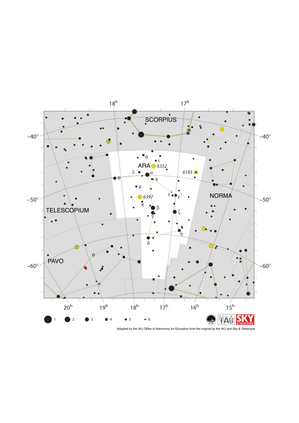
Caption: The constellation Ara along with its bright stars and surrounding constellations. Ara is surrounded by (going clockwise from the top): Scorpius, Norma, Triangulum Australe, Apus, Pavo, Telescopium and Corona Australis.
Ara is a southern constellation that is visible from the entire southern hemisphere at some point in the year and is visible from equatorial with parts of the constellation visible from some temperate parts of the northern hemisphere. It is best viewed in the evening in the northern hemisphere summer and southern hemisphere winter.
The globular clusters NGC 6352 and NGC 6397 lie in Ara. These are marked here with yellow circles with plus symbols superimposed on them. The open cluster NGC 6193 also lies in Ara, this is marked here with a yellow circle that is partially obscured by the dot marking the brightest member of the cluster which is visible to the naked eye under good conditions.
The y-axis of this diagram is in degrees of declination with north as up and the x-axis is in hours of right ascension with east to the left. The sizes of the stars marked here relate to the star's apparent magnitude, a measure of its apparent brightness. The larger dots represent brighter stars. The Greek letters mark the brightest stars in the constellation. These are ranked by brightness with the brightest star being labeled alpha, the second brightest beta, etc., although this ordering is not always followed exactly. The dotted boundary lines mark the IAU's boundaries of the constellations and the solid green lines mark one of the common forms used to represent the figures of the constellations. Neither the constellation boundaries, nor the lines joining the stars appear on the sky.
Credit: Adapted by the IAU Office of Astronomy for Education from the original by IAU/Sky & Telescope
Credit Link
Glossary Terms:
Apparent Magnitude , Celestial Coordinates , Constellation , Declination , Globular Cluster , Right Ascension (RA) , Scorpius , Open Cluster
Categories:
Naked Eye Astronomy
License: Creative Commons Attribution 4.0 International (CC BY 4.0) Creative Commons Attribution 4.0 International (CC BY 4.0) icons
File
( image
98.71 kB)
PDF File
(PDF file
166.33 kB)