Documents & Resources - Search Results
Search results

Crater Constellation Map
image
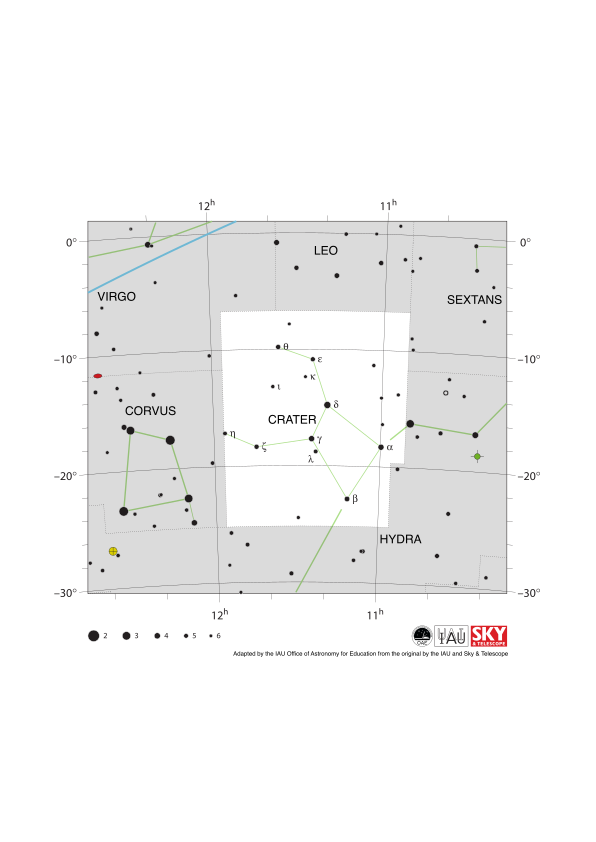
Caption: The constellation Crater with its bright stars and surrounding constellations. Crater is surrounded by (going clockwise from the top): Leo, Sextans, Hydra, Corvus and Virgo.
Crater is a southern constellation so the whole of the cluster is visible at some point in the year from the whole of the southern hemisphere.The whole constellation is also visible from temperate and equatorial regions of the northern hemisphere. The constellation is best viewed in the evening in the northern hemisphere spring and southern hemisphere autumn.
The y-axis of this diagram is in degrees of declination with north as up and the x-axis is in hours of right ascension with east to the left. The sizes of the stars marked here relate to the star's apparent magnitude, a measure of its apparent brightness. The larger dots represent brighter stars. The Greek letters mark the brightest stars in the constellation. These are ranked by brightness with the brightest star being labeled alpha, the second brightest beta, etc., although this ordering is not always followed exactly. The dotted boundary lines mark the IAU's boundaries of the constellations and the solid green lines mark one of the common forms used to represent the figures of the constellations. The blue line at the top left of the diagram marks the ecliptic. Neither the constellation boundaries, nor the line marking the ecliptic, nor the lines joining the stars appear on the sky.
Credit: Adapted by the IAU Office of Astronomy for Education from the original by the IAU and Sky & Telescope
Credit Link
Glossary Terms:
Apparent Magnitude , Celestial Coordinates , Constellation , Declination , Right Ascension (RA)
Categories:
Naked Eye Astronomy
License: Creative Commons Attribution 4.0 International (CC BY 4.0) Creative Commons Attribution 4.0 International (CC BY 4.0) icons
File
( image
66.17 kB)
PDF File
(PDF file
142.93 kB)

Grus Constellation Map
image
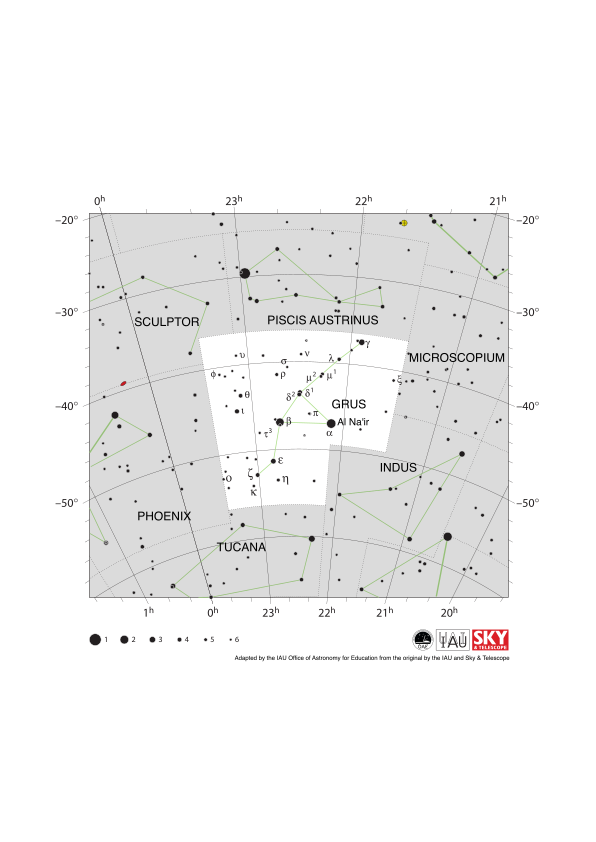
Caption: The constellation Grus with its bright stars and surrounding constellations. Grus is surrounded by (going clockwise from the top): Piscis Austrinus, Microscopium, Indus, Tucana, Phoenix and Sculptor.
Grus is a southern constellation and thus the whole constellation is visible at some point in the year from the whole southern hemisphere at some point in the year. The whole constellation is also visible from equatorial and some temperate regions of the northern hemisphere. Grus is best viewed in the evening in the northern hemisphere autumn and southern hemisphere spring.
The y-axis of this diagram is in degrees of declination with north as up and the x-axis is in hours of right ascension with east to the left. The sizes of the stars marked here relate to the star's apparent magnitude, a measure of its apparent brightness. The larger dots represent brighter stars. The Greek letters mark the brightest stars in the constellation. These are ranked by brightness with the brightest star being labeled alpha, the second brightest beta, etc., although this ordering is not always followed exactly. The dotted boundary lines mark the IAU's boundaries of the constellations and the solid green lines mark one of the common forms used to represent the figures of the constellations. Neither the constellation boundaries, nor the lines joining the stars appear on the sky.
Credit: Adapted by the IAU Office of Astronomy for Education from the original by the IAU and Sky & Telescope
Credit Link
Glossary Terms:
Apparent Magnitude , Celestial Coordinates , Constellation , Declination , Right Ascension (RA)
Categories:
Naked Eye Astronomy
License: Creative Commons Attribution 4.0 International (CC BY 4.0) Creative Commons Attribution 4.0 International (CC BY 4.0) icons
File
( image
105.07 kB)
PDF File
(PDF file
179.81 kB)

Lepus Constellation Map
image
Caption: The constellation Lepus with its bright stars and surrounding constellations. Lepus is surrounded by (going clockwise from the top): Orion, Eridanus, Caelum, Columba, Canis Major and Monoceros.
Lepus is a southern constellation and thus the whole constellation can be viewed at some point in the year throughout the southern hemisphere. The whole constellation can also be viewed from temperate and equatorial regions of the northern hemisphere. Lepus is best viewed in the evening in the northern hemisphere winter and southern hemisphere summer.
The globular cluster M79 lies in Lepus. It is marked here with a yellow circle with a plus sign superimposed on it.
The y-axis of this diagram is in degrees of declination with north as up and the x-axis is in hours of right ascension with east to the left. The sizes of the stars marked here relate to the star's apparent magnitude, a measure of its apparent brightness. The larger dots represent brighter stars. The Greek letters mark the brightest stars in the constellation. These are ranked by brightness with the brightest star being labeled alpha, the second brightest beta, etc., although this ordering is not always followed exactly. The dotted boundary lines mark the IAU's boundaries of the constellations and the solid green lines mark one of the common forms used to represent the figures of the constellations. Neither the constellation boundaries, nor the lines joining the stars appear on the sky.
Credit: Adapted by the IAU Office of Astronomy for Education from the original by the IAU and Sky & Telescope
Credit Link
Glossary Terms:
Apparent Magnitude , Celestial Coordinates , Constellation , Declination , Right Ascension (RA)
Categories:
Naked Eye Astronomy
License: Creative Commons Attribution 4.0 International (CC BY 4.0) Creative Commons Attribution 4.0 International (CC BY 4.0) icons
File
( image
87.88 kB)
PDF File
(PDF file
163.08 kB)

Phoenix Constellation Map
image
Caption: The constellation Phoenix with its bright stars and surrounding constellations. Phoenix is surrounded by (going clockwise from the top): Sculptor, Grus, Tucana, Hydrus, Eridanus and Fornax.
Phoenix is a southern constellation and thus the whole constellation is visible at some point in the year throughout the northern hemisphere. The whole constellation is also visible to equatorial regions of the southern hemisphere with parts of the constellation visible to most temperate northern regions. Phoenix is circumpolar in antarctic and some temperate regions of the southern hemisphere. The constellation is best viewed in the northern hemisphere late autumn and southern hemisphere late spring.
The y-axis of this diagram is in degrees of declination with north as up and the x-axis is in hours of right ascension with east to the left. The sizes of the stars marked here relate to the star's apparent magnitude, a measure of its apparent brightness. The larger dots represent brighter stars. The Greek letters mark the brightest stars in the constellation. These are ranked by brightness with the brightest star being labeled alpha, the second brightest beta, etc., although this ordering is not always followed exactly. The dotted boundary lines mark the IAU's boundaries of the constellations and the solid green lines mark one of the common forms used to represent the figures of the constellations. Neither the constellation boundaries, nor the lines joining the stars appear on the sky.
Credit: Adapted by the IAU Office of Astronomy for Education from the original by the IAU and Sky & Telescope
Credit Link
Glossary Terms:
Apparent Magnitude , Celestial Coordinates , Constellation , Declination , Right Ascension (RA)
Categories:
Naked Eye Astronomy
License: Creative Commons Attribution 4.0 International (CC BY 4.0) Creative Commons Attribution 4.0 International (CC BY 4.0) icons
File
( image
107.68 kB)
PDF File
(PDF file
176.94 kB)

Puppis Constellation Map
image
Caption: The constellation Puppis with its bright stars and surrounding constellations. Puppis is surrounded by (going clockwise from the top): Monoceros, Canis Major, Columba, Pictor, Carina, Vela, Pyxis and Hydra.
Puppis is a southern constellation and thus the whole constellation is visible at some point in the year throughout the southern hemisphere. The whole constellation is also visible to equatorial and some temperate regions of the northern hemisphere with parts of the constellation visible to all but the most arctic regions. Puppis is best viewed in the evenings in the northern hemisphere winter and southern hemisphere summer.
The open clusters M46, M93 and NGC 2477 lie in Puppis and are marked here with yellow circles. The globular cluster M47 also lies in Puppis and is marked here with a yellow circle with a cross superimposed on it.
The y-axis of this diagram is in degrees of declination with north as up and the x-axis is in hours of right ascension with east to the left. The sizes of the stars marked here relate to the star's apparent magnitude, a measure of its apparent brightness. The larger dots represent brighter stars. The Greek letters mark the brightest stars in the constellation. These are ranked by brightness with the brightest star being labeled alpha, the second brightest beta, etc., although this ordering is not always followed exactly. Puppis was previously part of the larger Argo Navis constellation along with Vela and Carina. As the letter designations for stars were created before this division took place, Greek letter designations are now divided between the three constellations with Puppis having stars designated epsilon and zeta but no alpha, beta, gamma or delta. The dotted boundary lines mark the IAU's boundaries of the constellations and the solid green lines mark one of the common forms used to represent the figures of the constellations. Neither the constellation boundaries, nor the lines joining the stars appear on the sky.
Credit: Adapted by the IAU Office of Astronomy for Education from the original by the IAU and Sky & Telescope
Credit Link
Glossary Terms:
Apparent Magnitude , Celestial Coordinates , Constellation , Declination , Right Ascension (RA)
Categories:
Naked Eye Astronomy
License: Creative Commons Attribution 4.0 International (CC BY 4.0) Creative Commons Attribution 4.0 International (CC BY 4.0) icons
File
( image
145.30 kB)
PDF File
(PDF file
218.05 kB)