Documents & Resources - Search Results
Search results
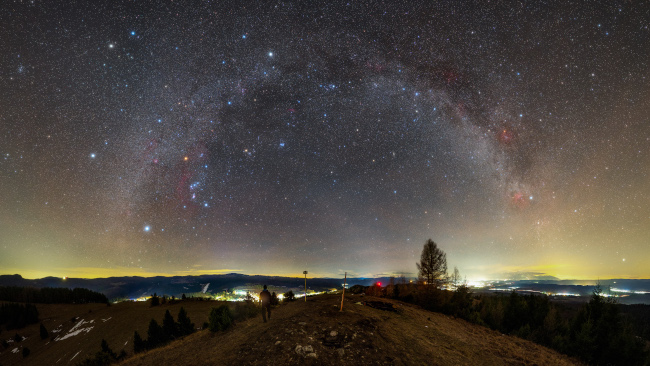
Warm Winter Night Over Spiš Region
image
Created for the OAE
Caption: Winner in the 2022 IAU OAE Astrophotography Contest, category Still images of celestial patterns.
This image, taken in Slovakia in January 2022, shows regions of the Milky Way and a rich variety of constellations. The summer constellations of the northern hemisphere are very low in the sky towards the bottom-right. The bright stars of Cygnus and Lyra shine through the artificial lights at the horizon. The huge array of northern winter and autumn constellations with many bright stars are associated with diverse cultural stories.
For the Lakota people in North America the belt of the Orion constellation represents the spine of a bison (“Tayamnicankh”). Orion, the Hunter of Greek mythology, is sometimes described chasing the Seven Sisters, the Pleiades. The Arabs transformed this view by considering the follower of the Pleiades only one star instead of a constellation. Aldebaran, the star in the right eye of Taurus, the Bull, comes from this interpretation, because the name Aldebaran derives from al-dabaran, The Follower.
At the bottom-right, on the horizon, we can see the milky lightcone of the Zodiacal light stretching from the constellation Pisces through Aries, almost reaching the Pleiades, indicating the path of the planets and the Moon in this area. The Pleiades and the Hyades together form a gate on this path, where the heavenly bodies occasionally pass before entering the Milky Way. The planets were considered sheep in ancient Babylon and the modern constellation Orion was considered the “True Shepherd” of the Sky, with his shepherd’s tool reaching the ecliptic. In Roman tradition, the bright white star above the Pleiades and the Milky Way is called Capella, the Goat, which can be traced back to an Egyptian constellation in this area.
Above the treetop in the middle-right part of the image, we see the autumn square, the Andromeda Galaxy and the W-shaped pattern of Cassiopeia. To the left of this group, in the central part of the visible Milky Way, is the constellation Perseus, with Cepheus in the dark area above Cassiopeia completing the celestial family. The Andromeda saga is a Greek story from the area that is now called Israel, and is rooted in Syrian traditions. The location of Andromeda was considered by the ancient Babylonians as the location of the goddess of sexual love, and by the Syrians as the location of the goddess of fertility. According to the saga, Andromeda was chained to a rock at the coast of Jaffa (Tel Aviv) in order to protect her land from a sea monster. The name of the hero who rescued her is Perseus, probably meaning “from Persia” (today’s Iran).
Noticeable in the valley are the lights from towns. The yellow light above the horizon indicates larger cities there, which are given away by their light pollution.
Credit: Robert Barsa/IAU OAE
Glossary Terms:
Constellation , Milky Way , Pisces , Taurus , Orion , Pleiades
Categories:
Milky Way and Interstellar Medium
, Naked Eye Astronomy
License: Creative Commons Attribution 4.0 International (CC BY 4.0) Creative Commons Attribution 4.0 International (CC BY 4.0) icons
This file on Zenodo ( image 37.27 MB)
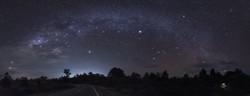
Most Brightest Stars of the Sky
image
Created for the OAE
Caption: Honourable mention in the 2022 IAU OAE Astrophotography Contest, category Still images of celestial patterns.
Taken in March 2016 in Bromo-Tengger-Semeru National Park, Java Island, Indonesia, this image shows the arch of the Milky Way and many prominent constellations, including many of the brightest stars in the night sky.
In the lower-left corner, we see Rigil Kentaurus and Hadar, the first one lower and the other higher up, both located in the large constellation Centaurus. As pointers they point towards Crux, the Southern Cross, whose long axis points towards the southern pole, which is located roughly at the horizon because the Island of Java is almost at the equator. Crux is almost entirely obscured by clouds, with only the four bright stars visible in the photograph. Confusingly, the asterism of the False Cross (consisting of stars in Argo, The Ship) is clearly prominent a bit further up the Milky Way.
The pinkish spot between the true and the False Cross is the Carina Nebula, located about 8500 light-years from Earth, in the constellation Carina, and invisible to the unaided eye. In Carina we can also find Canopus, the second-brightest star in the night sky, seen just below the Galaxy and above the road on the ground.
Even brighter is Sirius, the brightest star in the night sky. Sirius lies in the constellation Canis Major, The Great Dog, one of the dogs that follow Orion, the Hunter, who is depicted in the right half of this image, just above the clouds at the horizon. Orion’s Belt of three bright stars points to Sirius in the upper left and to Aldebaran in the lower right, just above the horizon.
Orion contains some of the brightest stars in the sky, making it the most colourful constellation as it hosts Rigel, the bright bluish star below the Galaxy toward the right, and Betelgeuse, the reddish bright star higher up and to the right of Rigel. Between them we find the three stars that comprise the belt of Orion, a famous asterism. Just next to the belt we find the Great Orion Nebula, a star-forming region whose bright centre is visible to the unaided eye and also in this image.
Above Betelgeuse but on the opposite side of the Galaxy, we see the bright star Procyon, whose name means literally “Before the Dog”. It is mythologically often considered a tiny one-star dog asterism accompanying Orion, and transformed into the modern constellation of Canis Minor.
In the upper-right corner, the Beehive Star Cluster in the constellation Cancer is easily recognisable. Below it, we find the constellation Gemini with the stars Pollux and Castor, which are not prominent in this image. In contrast, the bright white star Capella in the constellation Auriga, the Charioteer, shines through the clouds at the middle-right edge of the image.
Some light pollution is visible along the road.
Credit: Giorgia Hofer/IAU OAE
Glossary Terms:
Constellation , Gemini , Milky Way , Southern Cross , Cancer , Orion , Alpha Centauri
Categories:
Milky Way and Interstellar Medium
, Naked Eye Astronomy
License: Creative Commons Attribution 4.0 International (CC BY 4.0) Creative Commons Attribution 4.0 International (CC BY 4.0) icons
This file on Zenodo ( image 12.70 MB)

Cen-Lup-Cru-Panorama: Centaurus Carrying the Beast and Riding Along the Milky Way
image
Created for the OAE
Caption: Winner in the 2022 IAU OAE Astrophotography Contest, category Still images of celestial patterns.
This image was taken in February 2020 in the Coquimbo Region along the northern coast of Chile. It is one of the best places on Earth for astronomical observations, thanks to its clear skies, lack of light pollution and lack of precipitation, as it is close to the Atacama desert, one of the driest places on our planet. It is no coincidence that many of the most modern professional observatories are located here. The picture shows prominent patterns visible in the southern latitudes, containing rich cultural significance for various Indigenous groups of the southern world. In the bottom of the image towards the right, the Southern Cross is prominent. The orange star at the top of the Southern Cross is called Gacrux (gamma crux). The people in Chile celebrate the beginning of winter at the beginning of May when the constellation Crux is high up in the sky; for them it is a symbol of the start of the cold season. For the festival of the Cruz de Mayo (the Great Cross), they put candles next to crosses in their villages when the constellation Crux is high. As in Christianity, the four endpoints (stars) of the cross symbolise the cardinal virtues. For some indigenous Chileans, they represent the fundamental cultural principles: force, reciprocity, wisdom, and spirituality.
Unlike modern constellations that are arrangements of several stars, Indigenous peoples sometimes associate stories with individual stars. In the case of the Southern Cross for example, the Boorong, Djab Wurrung and Jardwadjali peoples of Australia refer to the star Gacrux as Bunya (the ring-tailed possum). From the Southern Cross to the left of the image are two bright stars, these are called the pointer stars (as they point to the Southern Cross). The Djab Wurrung and Jardwadjali people refer to the pointer stars as the Bram-bram-bult brothers, who hunted and killed the giant Emu Tchingal. Alpha Centauri, which is the brighter and whiter of the two pointer stars, is the closest star to the Sun that we can see with our eyes, located just over four light-years away. To the bottom left of the Southern Cross is a dark nebula, which the Indigenous Australians see as the head of the Emu Tchnigal (the Coalsack Nebula). The pointers are located on the neck of the Emu. The image also shows two other IAU constellations, Centaurus (The Centaur) and Lupus (The Wolf), and HII regions of the Eta Carina Nebula (seen in pink).
Credit: Uwe Reichert/IAU OAE
Glossary Terms:
Constellation , Milky Way , Southern Cross
Categories:
Milky Way and Interstellar Medium
, Naked Eye Astronomy
License: Creative Commons Attribution 4.0 International (CC BY 4.0) Creative Commons Attribution 4.0 International (CC BY 4.0) icons
This file on Zenodo ( image 24.14 MB)

Luminous Salar de Uyuni
image
Created for the OAE
Caption: Winner in the 2022 IAU OAE Astrophotography Contest, category Still images of celestial patterns.
This black and white image taken in February 2017 in Uyuni Salt Flat of southwest Bolivia, the biggest salt flat in the world, shows one of the most recognisable constellations, Orion the hunter, and the open star cluster of the Hyades directly above the clouds at the horizon. Various cultures have different stories associated with Orion. The Aymara in this area of the world (Bolivia and Northern Chile) consider Orion’s Belt to be a Sky Bridge (chacka cilitu) or a Stairway made out of dough. This stairway is rather obvious in this picture. It appears as if the stars in the sky are scattered like grains of salt on the ground — an amazing composition.
For the Aymara, who were Christianised by the Spanish conquistadores, Orion and the Stairway are connected to the November festivals of the dead ancestors and the souls. In contrast to the original Christian culture, for these people in the southern hemisphere these festivals mark the beginning of summer, not the beginning of winter. While in the north, the “ghosts” of the ancestors are represented by the foggy weather in November, the Aymara greet the ancestors with flowers. This photograph in the dry salt flat, in contrast, seems to show the unlivable loneliness where the photographer meets the souls of the deceased.
The Yolnu people of Arnhem Land in Australia’s Northern Territory have a rich culturally significant story associated with Orion that carries a lesson. It tells of the three brothers of the Kingfish clan and their canoe Djulpan. Owing to their lack of patience, the brothers ate the sacred Kingfish, angering the Sun woman Walu who created a waterspout that sent them into the sky. Looking at the constellation Orion, the three stars in Orion’s belt represent the three brothers, Orion’s sword is the fishing line, and the two dimmer stars Bellatrix and Saiph form the two ends of the canoe Djulpan.
Credit: Stephanie Ye Ziyi/IAU OAE
Glossary Terms:
Constellation , Orion
Categories:
Naked Eye Astronomy
, Stars
License: Creative Commons Attribution 4.0 International (CC BY 4.0) Creative Commons Attribution 4.0 International (CC BY 4.0) icons
This file on Zenodo ( image 4.81 MB)
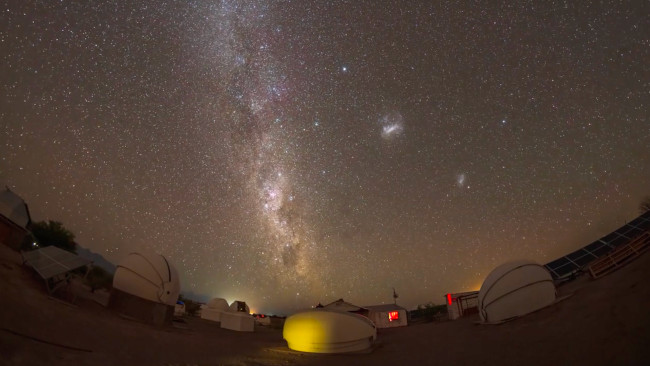
Chilean Nights
video
Created for the OAE
Caption: Honourable mention in the 2022 IAU OAE Astrophotography Contest, category Time lapses of celestial patterns.
Shot in December 2020, this time-lapse shows the sky from San Pedro de Atacama, Chile, in the southern hemisphere.
Right in the first frame we can see our home galaxy, the Milky Way, as well as both the Large and Small Magellanic clouds, two satellite galaxies orbiting the Milky Way. In the bottom of the image the bright stars Rigil Kentaurus and Hadar (also known as Alpha and Beta Centauri) are visible, both in the constellation Centaurus. Just above, we can also see the small constellation Crux, visible from the northern tropical circles southwards. It is important for navigation purposes because its longer axis indicates the direction of the celestial south pole. The bright whitish star in the top of the image and to the right of the Galaxy is Canopus, one of the brightest stars in the night sky, located in the constellation Carina. Canopus is the second brightest star in the sky, while Rigil Kentaurus is the third brightest.
In some of the next frames, Orion, the great hunter, appears clearly with its bright stars and its characteristic asterism, the belt, composed of three aligned bright stars. Since this video was taken from the southern hemisphere, the Greek hero from the northern hemisphere seems to be performing a headstand.
We can also see the planets Jupiter and Saturn in a close conjunction, even finding themselves in the significant beam of Zodiacal light setting down below the horizon. There are also a few meteors blinking in some of the frames, one of them with a long-lasting and developing trail. The very bright object rising from behind the volcanoes of the Andes, creating spectacular shadows and crepuscular rays, is the Moon. In the last frame we see the Moon next to Saturn and Jupiter.
Credit: Robert Barsa/IAU OAE
Glossary Terms:
Astronomical Observatory , Constellation , Milky Way , Orion , Large Magellanic Cloud (LMC) , Small Magellanic Cloud (SMC) , Alpha Centauri
Categories:
Galaxies
, Milky Way and Interstellar Medium
, Stars
, Telescopes, Instruments and Observatories
License: Creative Commons Attribution 4.0 International (CC BY 4.0) Creative Commons Attribution 4.0 International (CC BY 4.0) icons
This file on Zenodo ( video 114.03 MB)


