Documents & Resources - Search Results
Search results
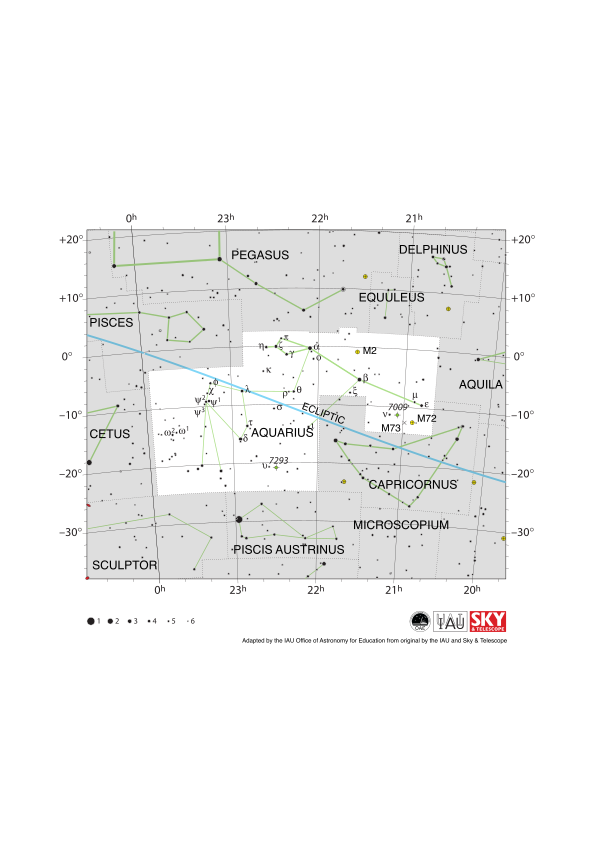
Aquarius Constellation Map
image
Caption: The constellation Aquarius along with its bright stars and surrounding constellations. Aquarius is surrounded by (going clockwise from the top) Pegasus, Equuleus, Aquila, Capricornus, Piscis Austrinus, Sculptor, Cetus and Pisces. Aquarius lies on the ecliptic (shown here as a blue line), this is the path the Sun appears to take across the sky over the course of a year. The Sun is in Aquarius from mid February to mid March. The other planets of the Solar System can often be found in Aquarius.
Aquarius spans the celestial equator and is thus visible at some time in the year from all of planet Earth. In the most arctic or antarctic regions of the world, some parts of the constellation may not be visible. Aquarius is most visible in the evenings in the northern hemisphere autumn and southern hemisphere spring.
The yellow circles with plus symbols superimposed on them mark the globular clusters M2 and M72. The green circles superimposed on plus symbols mark the planetary nebulae NGC 7293 (the Helix Nebula) and NGC 7002 (the Saturn Nebula). M73 (marked with an x symbol) is a coincident grouping of stars previously erroneously classified as an open cluster.
The y-axis of this diagram is in degrees of declination with north as up and the x-axis is in hours of right ascension with east to the left. The sizes of the stars marked here relate to the star's apparent magnitude, a measure of its apparent brightness. The larger dots represent brighter stars. The Greek letters mark the brightest stars in the constellation. These are ranked by brightness with the brightest star being labeled alpha, the second brightest beta, etc., although this ordering is not always followed exactly. The dotted boundary lines mark the IAU's boundaries of the constellations and the solid green lines mark one of the common forms used to represent the figures of the constellations. Neither the constellation boundaries, nor the line marking the ecliptic, nor the lines joining the stars appear on the sky.
Credit: Adapted by the IAU Office of Astronomy for Education from the original by IAU/Sky & Telescope
Credit Link
Glossary Terms:
Apparent Magnitude , Capricornus , Celestial Coordinates , Constellation , Declination , Ecliptic , Globular Cluster , Pisces , Planetary Nebula , Right Ascension (RA) , Zodiac , Aquarius , Open Cluster
Categories:
Naked Eye Astronomy
License: Creative Commons Attribution 4.0 International (CC BY 4.0) Creative Commons Attribution 4.0 International (CC BY 4.0) icons
File
( image
119.18 kB)
PDF File
(PDF file
215.13 kB)
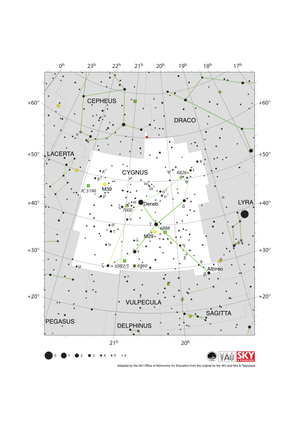
Cygnus Constellation Map
image
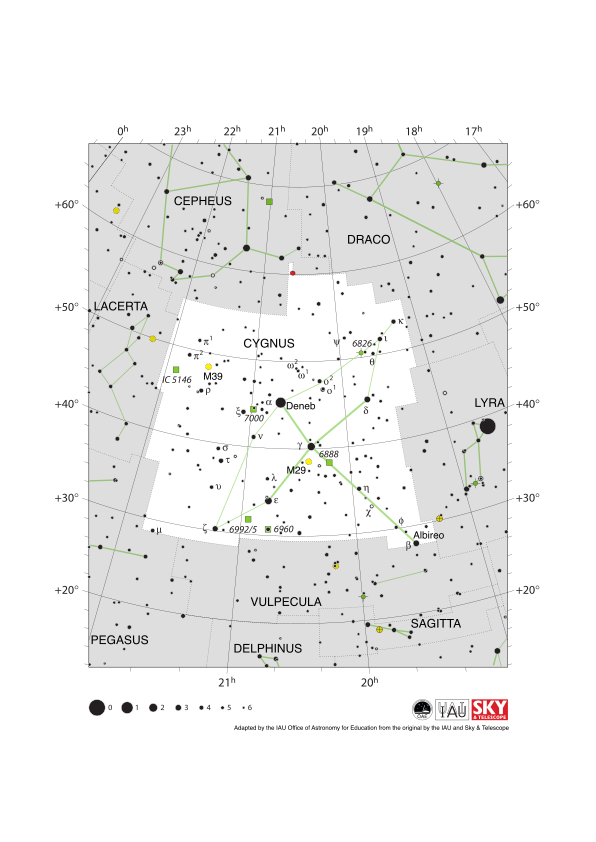
Caption: The constellation Cygnus with its bright stars and surrounding constellations. Cygnus is surrounded by (going clockwise from the top): Cepheus, Draco, Lyra, Vulpecula, Pegasus and Lacerta. Cygnus is notable for its brightest star Deneb. This forms one vertex of the prominent Summer Triangle asterism that is visible in northern hemisphere summer evenings.
Cygnus is a northern constellation and thus the whole of the constellation is visible at some point in the year in the whole northern hemisphere. The whole constellation is also visible from equatorial regions of the southern hemisphere with parts of the constellation visible from temperate southern regions.
The plane of the Milky Way runs through Cygnus and thus the constellation is rich in nebulae and star clusters. These include the North America Nebula (NGC 7000) and the Crescent Nebula (NGC 6888). The Veil Nebula is a huge supernova remnant, parts of which are marked here as NGC 6960 and NGC 6992/5. All of the previously-mentioned nebulae are marked with green squares. The planetary nebula NGC 6826 is marked here with a green circle superimposed on a plus sign. The open star clusters M29 and M39 are marked here with yellow circles.
The y-axis of this diagram is in degrees of declination with north as up and the x-axis is in hours of right ascension with east to the left. The sizes of the stars marked here relate to the star's apparent magnitude, a measure of its apparent brightness. The larger dots represent brighter stars. The Greek letters mark the brightest stars in the constellation. These are ranked by brightness with the brightest star being labeled alpha, the second brightest beta, etc., although this ordering is not always followed exactly. The dotted boundary lines mark the IAU's boundaries of the constellations and the solid green lines mark one of the common forms used to represent the figures of the constellations. Neither the constellation boundaries, nor the lines joining the stars appear on the sky.
Credit: Adapted by the IAU Office of Astronomy for Education from the original by the IAU and Sky & Telescope
Credit Link
Glossary Terms:
Apparent Magnitude , Celestial Coordinates , Constellation , Declination , Milky Way , Nebula , Planetary Nebula , Right Ascension (RA) , Asterism , Open Cluster , Supernova Remnant
Categories:
Naked Eye Astronomy
License: Creative Commons Attribution 4.0 International (CC BY 4.0) Creative Commons Attribution 4.0 International (CC BY 4.0) icons
File
( image
150.09 kB)
PDF File
(PDF file
216.56 kB)
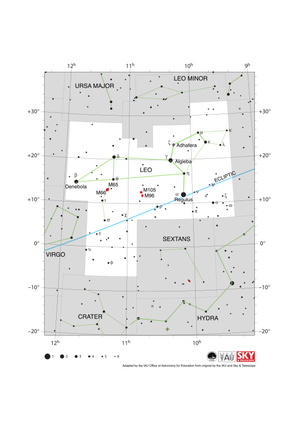
Leo Constellation Map
image
Caption: The zodiac constellation Leo and its surrounding constellations. Starting from the top of the diagram and going clockwise, these are Leo Minor, Cancer, Sextans, Hydra, Crater, Virgo and Ursa Major. The brightest star in Leo, Regulus, lies almost exactly on the ecliptic (shown here as a blue line): the path the Sun appears to take across the sky over the course of a year. The Sun spends the period from mid August to mid September in Leo. The other planets in the Solar System can often be found in Leo.
Leo spans the celestial equator and is thus part of it is visible at some time in the year from all of planet Earth with some of the constellation obscured for the most arctic and antarctic regions of the world. Leo is most visible in the evenings in the northern hemisphere spring and southern hemisphere autumn.
Several objects can be seen in Leo, including M65 and M66 – two galaxies in the Leo Triplet, a trio of galaxies including NGC 3628, not listed here. In addition, M96, a spiral galaxy, can be seen as a fuzzy object using a small telescope, and Messier 105, an elliptical galaxy. Each of these objects are labelled on the map as red ellipses.
The y-axis of this diagram is in degrees of declination with north as up and the x-axis is in hours of right ascension with east to the left. The sizes of the stars marked here relate to the star's apparent magnitude, a measure of its apparent brightness. The larger dots represent brighter stars. The Greek letters mark the brightest stars in the constellation. These are ranked by brightness with the brightest star being labelled alpha, the second brightest beta, etc., although this ordering is not always followed exactly. The dotted boundary lines mark the IAU's boundaries of the constellations and the solid green lines mark one of the common forms used to represent the figures of the constellations. Neither the constellation boundaries, nor the line marking the ecliptic, nor the lines joining the stars appear on the sky.
Credit: Adapted by the IAU Office of Astronomy for Education from the original by IAU/Sky & Telescope
Credit Link
Glossary Terms:
Apparent Magnitude , Celestial Coordinates , Constellation , Declination , Ecliptic , Elliptical Galaxy , Galaxy , Leo , Right Ascension (RA) , Spiral Galaxy , Zodiac , Cancer , Virgo
Categories:
Naked Eye Astronomy
License: Creative Commons Attribution 4.0 International (CC BY 4.0) Creative Commons Attribution 4.0 International (CC BY 4.0) icons
File
( image
114.25 kB)
PDF File
(PDF file
186.50 kB)
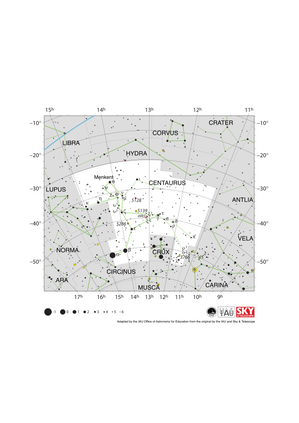
Centaurus Constellation Map
image
Caption: The constellation Centaurus with its bright stars and surrounding constellations. Centaurus is surrounded by (going clockwise from the top): Hydra, Antlia, Vela, Carina, Musca, Crux, Circinus, Lupus and Libra. Centaurus is a large constellation most notable for its brightest star Alpha Centauri. Alpha Centauri is a triple star system and is the nearest star system to the Solar System. When viewed with the naked eye, the two brightest components of Alpha Centauri appear as one star. The combined light from these two stars makes Alpha Centauri appear as the third brightest star in the night sky. The third component of the Alpha Centauri system Proxima Centauri, the nearest star to the Sun, is too faint to be viewed with the naked eye.
Centaurus is a southern constellation and thus the whole constellation is visible from the southern hemisphere at some point in the year. The whole constellation is also visible from equatorial regions of the northern hemisphere with parts of the constellation visible from temperate northern regions. The constellation is best viewed in the evening in the late northern hemisphere spring and late southern hemisphere autumn.
The globular cluster Omega Centauri, also known as NGC 5319, lies in Centaurus. Bright enough to be seen with the naked eye, this cluster was initially given a designation as a star in the constellation before its true nature was realised. It is marked here with a yellow circle with a plus sign superimposed on it. As is the globular cluster NGC 5286. The open cluster NGC 3766 is marked here with a yellow circle. NGC 5128, also known as Centaurus A, is the closest active galaxy to Earth. The supermassive black hole at the heart of this galaxy has launched two huge jets of matter which emit in many different wavelengths including x-ray and radio emission. NGC 5128 is marked with a red ellipse here, as is the edge-on spiral galaxy NGC 4945.
The y-axis of this diagram is in degrees of declination with north as up and the x-axis is in hours of right ascension with east to the left. The sizes of the stars marked here relate to the star's apparent magnitude, a measure of its apparent brightness. The larger dots represent brighter stars. The Greek letters mark the brightest stars in the constellation. These are ranked by brightness with the brightest star being labeled alpha, the second brightest beta, etc., although this ordering is not always followed exactly. The dotted boundary lines mark the IAU's boundaries of the constellations and the solid green lines mark one of the common forms used to represent the figures of the constellations. The blue line in the top left is the ecliptic. Neither the constellation boundaries, nor the line marking the ecliptic, nor the lines joining the stars appear on the sky.
Credit: Adapted by the IAU Office of Astronomy for Education from the original by the IAU and Sky & Telescope
Credit Link
Glossary Terms:
Apparent Magnitude , Celestial Coordinates , Constellation , Declination , Globular Cluster , Right Ascension (RA) , Open Cluster , Alpha Centauri
Categories:
Naked Eye Astronomy
License: Creative Commons Attribution 4.0 International (CC BY 4.0) Creative Commons Attribution 4.0 International (CC BY 4.0) icons
File
( image
152.88 kB)
PDF File
(PDF file
255.96 kB)
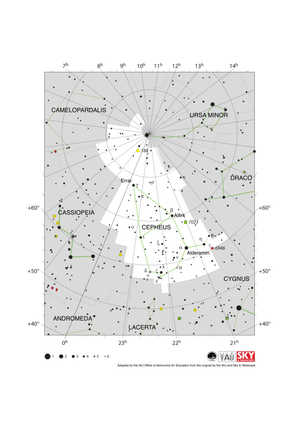
Cepheus Constellation Map
image
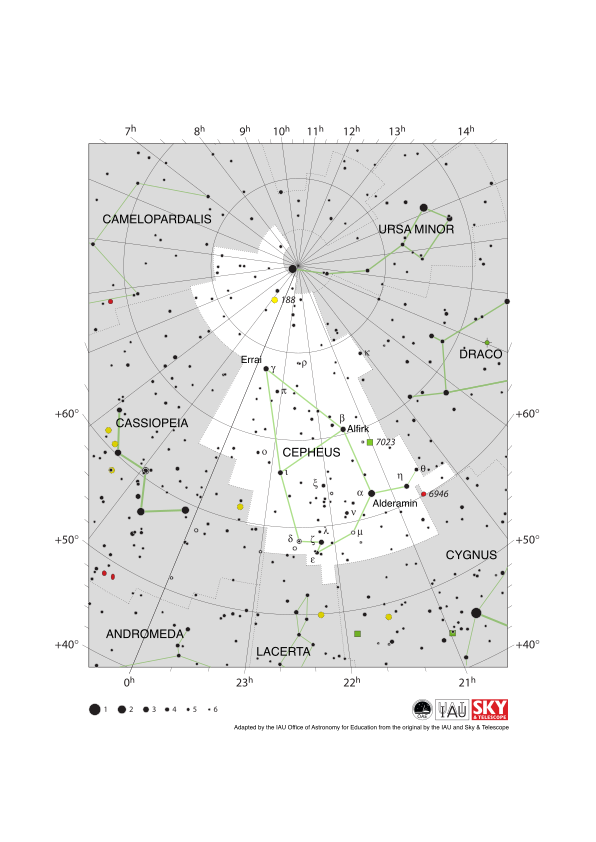
Caption: The constellation Cepheus along with its bright stars and surrounding constellations. Cepheus is surrounded by (going clockwise from the top): Camelopardalis, Ursa Minor, Draco, Cygnus, Lacerta and Cassiopeia. Cepheus is a large constellation. Its most notable star is Delta Cephei, the prototype for the class of variable stars known as Cepheid variables. These are variable stars which can be used to estimate distances both within our galaxy and to nearby galaxies.
Cepheus lies close to the north celestial pole. As such it is circumpolar for arctic and temperate regions of the northern hemisphere. The whole of the constellation is also visible at some point in the year in equatorial regions of the northern hemisphere with parts of it visible in equatorial regions of the southern hemisphere. It is best viewed in the evening in the northern hemisphere late autumn and southern hemisphere late spring.
The open cluster NGC 188 lies in Cepheus and is marked here with a yellow circle. The nebula NGC 7023 also lies in the constellation and is marked with a green square. The red ellipse in the lower right marks the position of the spiral galaxy NGC 6946.
This diagram maps an area around the north celestial pole. Here lines of constant right ascension converge. The right ascension values of these lines are marked on the x-axis above and below the diagram. Some of the lines of constant declination are marked on the y-axis. The sizes of the stars marked here relate to the star's apparent magnitude, a measure of its apparent brightness. The larger dots represent brighter stars. The Greek letters mark the brightest stars in the constellation. Delta Cephei is marked with a circle around a dot as it is a variable star. Mu Cephei is also a variable star marked here as an open circle. These are ranked by brightness with the brightest star being labeled alpha, the second brightest beta, etc., although this ordering is not always followed exactly. The dotted boundary lines mark the IAU's boundaries of the constellations and the solid green lines mark one of the common forms used to represent the figures of the constellations. Neither the constellation boundaries, nor the lines joining the stars appear on the sky.
Credit: Adapted by the IAU Office of Astronomy for Education from the original by the IAU and Sky & Telescope
Credit Link
Glossary Terms:
Apparent Magnitude , Celestial Coordinates , Circumpolar Stars , Constellation , Declination , Nebula , North Celestial Pole (NCP) , Right Ascension (RA) , Spiral Galaxy , Open Cluster
Categories:
Naked Eye Astronomy
License: Creative Commons Attribution 4.0 International (CC BY 4.0) Creative Commons Attribution 4.0 International (CC BY 4.0) icons
File
( image
162.00 kB)
PDF File
(PDF file
212.38 kB)