Documents & Resources - Search Results
Search results

The giant elliptical galaxy ESO 325-G004
image
Caption: The giant elliptical galaxy ESO 325-G004 sits in the Abell S0740 galaxy cluster. This huge galaxy has a mass of approximately a hundred billion solar masses. ESO 325-G004 is brightest in its core with its brightness decreasing further from its center. This galaxy has no visible spiral structure or dust lanes. ESO 325-G004 and many of the smaller galaxies around it are members of the galaxy cluster Abell S0740.
Credit: Cropped from the original by NASA, ESA, and The Hubble Heritage Team (STScI/AURA); J. Blakeslee (Washington State University)
Credit Link
Glossary Terms:
Elliptical Galaxy , Galaxy Cluster
Categories:
Galaxies
License: Public Domain Public Domain icons
File
( image
108.45 kB)
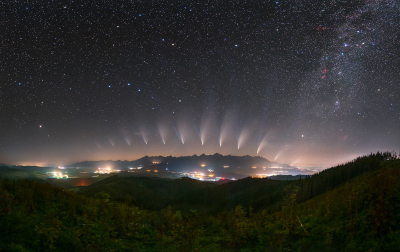
Neowise's metamorphosis, by Tomáš Slovinský and Petr Horálek, Slovakia
image
Created for the OAE
Caption: First place in the 2021 IAU OAE Astrophotography Contest, category Comets.
This image uses the chronophotography technique to capture the evolution of the comet C/2020 F3 (Neowise) over time, as it became visible in the northern skies in July 2020. Orbits of comets are extremely elliptical, which means that during part of their orbit they get close to the Sun. As a comet approaches the Sun, it gets heated, releases gas and dust creating an envelope or coma around the nucleus. The solar wind and photons (particles of electromagnetic radiation) interact with the coma producing the cometary tail, which can be seen clearly in this image. The tail of a comet always points away from the Sun, and extends as much as tens of millions of kilometres. This tail has two parts: the relatively straight bluish gas (ion or plasma) tail, which is made up of charged particles interacting with the magnetic fields of the solar wind; and the whitish dust tail compose of very small dust particles that are pushed by the radiation pressure from the Sun into a curve due to their slower speeds. Two regions in the Solar System are often associated with being “storehouses” of comets: the Kuiper Belt and the Oort Cloud. Comets with periods up to about two hundred years come from the Kuiper belt, a reservoir of cometary nuclei material with a disk-like shape located beyond Neptune. Longer period comets come from the Oort cloud, another huge reservoir of icy objects, with a spherical shape surrounding the Solar System. The outer limit of the Oort Cloud is not known as yet, but it could be as much as 10 thousand times the Sun-Earth distance, or even more. Due to gravitational disturbances, some of these cometary nuclei might be ejected towards the inner regions of the Solar System, sometimes approaching the Earth, offering some of the most spectacular views of a celestial body. The image also shows some prominent constellations and asterisms like the Big and Little Dippers, and also the North (Pole) Star – Polaris.
Credit: Tomáš Slovinský and Petr Horálek/IAU OAE
Glossary Terms:
Comet
Categories:
Naked Eye Astronomy
, Solar System
License: Creative Commons Attribution 4.0 International (CC BY 4.0) Creative Commons Attribution 4.0 International (CC BY 4.0) icons
This file on Zenodo ( image 19.53 MB)
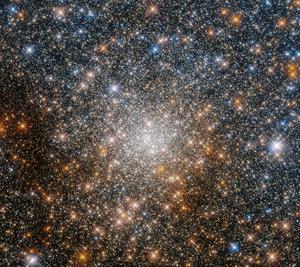
Stars in globular clusters near the heart of the Milky Way
image
Caption: This Hubble Space Telescope image presents a view of the interiors of the densely packed globular cluster Terzan 9 which consists of millions of stars located close to the heart of our Milky Way galaxy. This globular cluster sits within the central galatic bulge amidst interstellar dust, which obscures light from these star clusters. This image is a combination of light seen in the visible and infrared parts of the electromagnetic spectrum. Multi-wavelength imaging of the color and brightness of stars helps determine their age and in turn age of the parent star cluster.
Credit: ESA/Hubble & NASA, R. Cohen
Credit Link
Glossary Terms:
Cluster , Globular Cluster , Star Cluster
Categories:
Stars
License: Public Domain Public Domain icons
File
( image
403.47 kB)
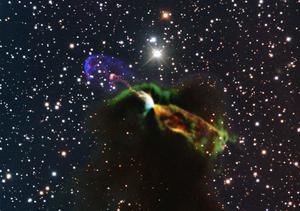
Witnessing the birth of a star
image
Caption: A combination of radio and visible light imaged with the Atacama Large Millimeter/submillimeter Array (ALMA) and European Southern Observatory's New Technology Telescope (NTT) revealing birth of a star forming the Herbig-Haro object HH 46/47. ALMA observations shown in orange and green unveil the energetic jet from the central protostar otherwise hidden at visible wavelength due to dust obscuration and dense gas. NTT observations in pink and purple highlight the visible light from the jet emitted towards the observer.
Credit: ESO/ALMA (ESO/NAOJ/NRAO)/H. Arce. Acknowledgements: Bo Reipurth
Credit Link
Glossary Terms:
Protostar , Star Formation
Categories:
Milky Way and Interstellar Medium
, Stars
License: Creative Commons Attribution 3.0 Unported Creative Commons Attribution 3.0 Unported icons
File
( image
1.34 MB)
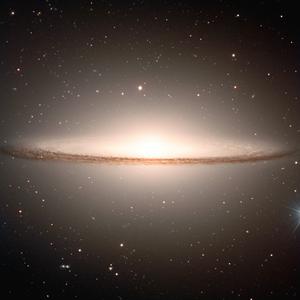
Sombrero galaxy
image
Caption: This prominent galaxy M 104 is often called the Sombrero galaxy due to its resemblance to the Mexican hat. This look is created by the thin disk oriented nearly edge-on, which appears illuminated by the dominant bulge. Both, the disk and bulge contain stars, but the stars in the bulge tend to be older, while the disk also harbors large amounts of dust and gas creating shadows. M 104 is located in the constellation Virgo approximately 50 light-years away. While some of the dots visible in the picture are foreground stars and others background galaxies, the majority are actually globular clusters, dense massive clusters of stars, associated with the Sombrero Galaxy.
Credit: ESO/P. Barthel
Credit Link
Glossary Terms:
Disk Galaxy , Galaxy
Categories:
Galaxies
License: Creative Commons Attribution 4.0 International (CC BY 4.0) Creative Commons Attribution 4.0 International (CC BY 4.0) icons
File
( image
4.93 MB)


