Documents & Resources - Search Results
Search results
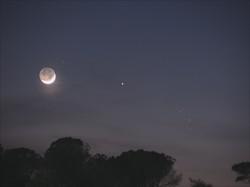
Moon-Mercury-Pleiades Conjunction
image
Created for the OAE
Caption: Honourable mention in the 2022 IAU OAE Astrophotography Contest, category Still images of celestial patterns.
This photograph shows the young lunar crescent, some of the nine brightest stars of the Pleiades (with one behind a cloud) on the right, and the planet Mercury, looking slightly red, in the middle of the image.
This picture is rather suggestive of the idea that the Pleiades might possibly consist of seven stars. However, the viewer is misled by the clouds; five of the stars form a tiny chariot, one is next to the handle, and three are at the other end of the quadrilateral. Eight stars would be clearly visible if there were no clouds.
This configuration of the young Moon next to the Pleiades is visible only in the northern hemisphere spring. Thus it was used by the ancient Babylonians to determine the second month of their year and to judge whether or not an intercalary month was necessary. At least as early as the second millennium before the common era, the Babylonians used several asterisms for each month, with another one of them reappearing every five days after invisibility during daylight. To determine the necessity of intercalation in order to synchronise the solar and the lunar year, the Babylonians used several asterisms, not only the Pleiades. For instance, they also made use of the bright stars Arcturus and Sirius, and they observed a configuration with the Moon as well as heliacal phenomena. The modern Jewish and modern Islamic traditions still make use of some of the Babylonian astronomical rules. However, given that the constellations have shifted as a result of precession, and the fact that nowadays we also have computational means to calculate our calendars, this configuration of the small crescent Moon and the Pleiades is less useful, though it remains exceptionally beautiful. Thus the ancient Babylonian and middle Babylonian tradition survives only rudimentarily. Furthermore, it is unlikely that it is depicted in the Nebra Disc from Bronze Age Europe, as has long been claimed.
This image was taken on Elba Island, Italy, in May 2022.
Credit: Giulio Colombo/ IAU OAE
Glossary Terms:
Conjunction , Mercury , Moon , Waxing Crescent , Crescent Moon , Pleiades
Categories:
Naked Eye Astronomy
License: Creative Commons Attribution 4.0 International (CC BY 4.0) Creative Commons Attribution 4.0 International (CC BY 4.0) icons
This file on Zenodo ( image 420.90 kB)

Cen-Lup-Cru-Panorama: Centaurus Carrying the Beast and Riding Along the Milky Way
image
Created for the OAE
Caption: Winner in the 2022 IAU OAE Astrophotography Contest, category Still images of celestial patterns.
This image was taken in February 2020 in the Coquimbo Region along the northern coast of Chile. It is one of the best places on Earth for astronomical observations, thanks to its clear skies, lack of light pollution and lack of precipitation, as it is close to the Atacama desert, one of the driest places on our planet. It is no coincidence that many of the most modern professional observatories are located here. The picture shows prominent patterns visible in the southern latitudes, containing rich cultural significance for various Indigenous groups of the southern world. In the bottom of the image towards the right, the Southern Cross is prominent. The orange star at the top of the Southern Cross is called Gacrux (gamma crux). The people in Chile celebrate the beginning of winter at the beginning of May when the constellation Crux is high up in the sky; for them it is a symbol of the start of the cold season. For the festival of the Cruz de Mayo (the Great Cross), they put candles next to crosses in their villages when the constellation Crux is high. As in Christianity, the four endpoints (stars) of the cross symbolise the cardinal virtues. For some indigenous Chileans, they represent the fundamental cultural principles: force, reciprocity, wisdom, and spirituality.
Unlike modern constellations that are arrangements of several stars, Indigenous peoples sometimes associate stories with individual stars. In the case of the Southern Cross for example, the Boorong, Djab Wurrung and Jardwadjali peoples of Australia refer to the star Gacrux as Bunya (the ring-tailed possum). From the Southern Cross to the left of the image are two bright stars, these are called the pointer stars (as they point to the Southern Cross). The Djab Wurrung and Jardwadjali people refer to the pointer stars as the Bram-bram-bult brothers, who hunted and killed the giant Emu Tchingal. Alpha Centauri, which is the brighter and whiter of the two pointer stars, is the closest star to the Sun that we can see with our eyes, located just over four light-years away. To the bottom left of the Southern Cross is a dark nebula, which the Indigenous Australians see as the head of the Emu Tchnigal (the Coalsack Nebula). The pointers are located on the neck of the Emu. The image also shows two other IAU constellations, Centaurus (The Centaur) and Lupus (The Wolf), and HII regions of the Eta Carina Nebula (seen in pink).
Credit: Uwe Reichert/IAU OAE
Glossary Terms:
Constellation , Milky Way , Southern Cross
Categories:
Milky Way and Interstellar Medium
, Naked Eye Astronomy
License: Creative Commons Attribution 4.0 International (CC BY 4.0) Creative Commons Attribution 4.0 International (CC BY 4.0) icons
This file on Zenodo ( image 24.14 MB)
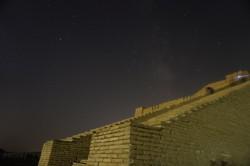
Galaxy Arm
image
Created for the OAE
Caption: Honourable mention in the 2022 IAU OAE Astrophotography Contest, category Still images of celestial patterns.
Taken from the south of Iraq in January 2022, this image shows a clear sky over one of the many ancient monuments in the region which looks like a Babylonian ziggurat. The Sumerians had invented these mountain-like buildings even before the invention of script; the earliest ziggurats appear around 4000 years before the common era. They look like the frustum of a pyramid and in Babylonian times often had temples on top. Next to the stairs of the ziggurat are the constellations of the southernmost part of the Zodiac, also invented in Babylon. Today, we call them Capricorn (left, with a planet in it) and Sagittarius, whose brightest stars form the asterism of the Teapot. For the Babylonians, Sagittarius was the god Pabilsang, the city god of Larak and a god of agriculture and war. He was also the husband of the mighty goddess of medicine, Gula, and his iconography is a hybrid creature holding a bow and arrow: a male human torso and head attached to the body of a horse with four legs, two gigantic wings and two tails — a horse tail and a scorpion tail. Such a creature did not exist in Greek mythology, so the Greeks reduced it to something they knew, a centaur holding a bow and arrow. This picture still did not make sense in Greek culture because centaurs were considered wild and cruel, and not intelligent enough to use a bow and arrow. Therefore, there was another Greek figure that existed simultaneously: a man with hooves instead of feet at the ends of his legs, a satyr, but this figure vanished in Roman times.
Capricornus is one of the most stable foreign creatures in the Zodiac and has been unchanged over millennia. It is depicted as a hybrid creature with the front part of a goat and the back part of a fish. This so-called Goat-Fish constellation has been recognised since the earliest writings of astronomy in Babylon. In Babylonian religion it is a good-natured, benevolent demon that protects humans, supports all healing processes and accompanies the god of wisdom and witchcraft. The Greeks simply adopted it and invented a saga for it. In Roman times, it became tremendously famous because emperor Augustus of Rome used it as his personal symbol, also imprinting it on coins and other political propaganda tools.
In Sagittarius, there is also the bright bulge of the Milky Way. That this is hardly visible in this photograph is a result of modern civilization; the huge number of artificial lights that we use on Earth also illuminates the night sky and makes it impossible to see the Milky Way in areas where humans live.
Credit: Ruqayah Mohammed/IAU OAE
Glossary Terms:
Capricornus , Sagittarius
Categories:
Naked Eye Astronomy
License: Creative Commons Attribution 4.0 International (CC BY 4.0) Creative Commons Attribution 4.0 International (CC BY 4.0) icons
This file on Zenodo ( image 83.57 kB)


