Documents & Resources - Search Results
Search results
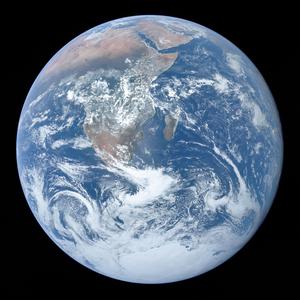
Earth as observed from Apollo 17
image
Caption: Full disk view of the Earth taken on 7 December 1972, by the crew of the Apollo 17 spacecraft en route to the Moon at a distance of about 29,000 kilometres (18,000 mi). It shows Africa, Antarctica, and the Arabian Peninsula.
Credit: NASA/Apollo 17 crew/Project Apollo Archive
Glossary Terms:
Earth , Planet , Terrestrial Planet , Inner Planet
Categories:
Planet Earth
, Solar System
License: Public Domain Public Domain icons
File
( image
5.97 MB)
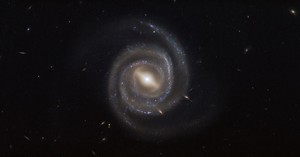
Hubble Image of Barred Spiral Galaxy UGC 6093
image
Caption: This image from the Hubble Space Telescope shows the barred spiral galaxy UGC 6093. This galaxy has two spiral arms in its outer regions but the inner edge of each arm joins with the outer edge of a straight bar feature that goes across the galaxy's center.
This galaxy has been classified as an active galaxy due to the emissions of certain lines in its spectrum. This indicates that the supermassive black hole that lies in the center of the galaxy is accreting gas from its surroundings. Unlike some active galactic nuclei (AGN), the center of this galaxy does not shine especially brightly in the visible light so its status as an AGN is not immediately visible from this image.
Credit: ESA/Hubble & NASA
Credit Link
Glossary Terms:
Active Galactic Nucleus , Supermassive Black Hole , Galactic Bar , Spectral Line
License: Creative Commons Attribution 4.0 International (CC BY 4.0) Creative Commons Attribution 4.0 International (CC BY 4.0) icons
File
( image
987.80 kB)

The Rotating Planet
video
Created for the OAE
Caption: Second place winner in the 2023 IAU OAE Astrophotography Contest, category of Time-lapses of rotation of Big Dipper or Southern Cross.
A cosmic journey unfolds across continents in this time-lapse video which captures both iconic constellations from diverse corners of the world. Starting in China, the Big Dipper graces the night sky, a steadfast guide embedded in cultural narratives. Its luminance marks the beginning of this celestial odyssey. The two pointer stars on the end of the Big Dipper point to the North Star (Polaris) which appears to remain stationary as the sky rotates. From Nepal’s lofty peaks, the Big Dipper’s familiarity persists, a reliable fixture in the shifting panorama of the rotating planet. Moving to Chile, the Southern Cross adorns the firmament, emblematic of the southern skies. Frames from Chile showcase this constellation accompanied by the Milky Way Galaxy. In Namibia, a telescope from the H.E.S.S. Observatory appears in the video. Later, nestled beneath sheltering trees, the Big Dipper persists in its celestial prominence, appearing against a canvas of stars. Using varied techniques — fisheye lenses, static cameras, and Earth's movement-tracking — each frame unveils the Cross’s grandeur against diverse landscapes. These sequences — marked by star trails and Earth’s rotation—highlight the enduring presence of the Big Dipper and Southern Cross, bridging cultures and celestial beauty across hemispheres.
Credit: Jianfeng Dai/IAU OAE (CC BY 4.0)
Glossary Terms:
Big Dipper , Celestial Pole , Celestial Sphere , Earth's Rotation , North Celestial Pole (NCP) , Polaris , Southern Cross , South Celestial Pole (SCP)
Categories:
Naked Eye Astronomy
Tags:
astrophotography
License: Creative Commons Attribution 4.0 International (CC BY 4.0) Creative Commons Attribution 4.0 International (CC BY 4.0) icons
This file on Zenodo ( video 863.53 MB)
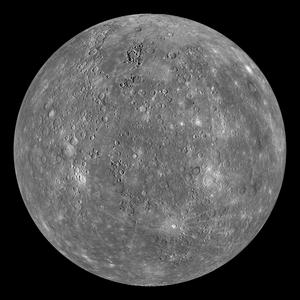
Mercury
image
Caption: This image is a composite of a picture mosaic of the planet Mercury's surface obtained by the MESSENGER (Mercury Surface, Space Environment, Geochemistry and Ranging) space probe. MESSENGER was launched by NASA in 2004 and explored Mercury from 2011 to 2015.
Credit: NASA/Johns Hopkins University Applied Physics Laboratory/Carnegie Institution of Washington
Credit Link
Glossary Terms:
Mercury , Planet , Terrestrial Planet , Inner Planet
Categories:
Solar System
License: Public Domain Public Domain icons
File
( image
903.54 kB)
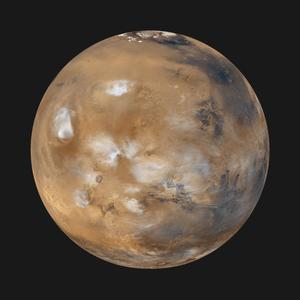
Mars
image
Caption: This image of the planet Mars taken by NASA's Mars Global Surveyor Orbiter in 1999 shows its dry surface. The picture features the most spectacular geological regions on Mars. Besides the deep Valles Marineris valley we see four volcanoes. While three of them form the Tharsis ridge, the Olympus Mons is largest volcano we have so far discovered in the Solar System. Ice clouds cover parts of the Martian surface.
Credit: NASA/JPL/MSSS
Credit Link
Glossary Terms:
Mars , Planet , Terrestrial Planet , Inner Planet
Categories:
Solar System
License: Public Domain Public Domain icons
File
( image
341.48 kB)


