Documents & Resources - Search Results
Search results

Smartphone Partial Eclipse Combined
image
Created for the OAE
Caption: Honorable mention in the 2023 IAU OAE Astrophotography Contest, category of Still images taken exclusively with smartphones/mobile devices.
In 2021, Maine, USA, bore witness to a captivating partial solar eclipse, an astronomical spectacle where the Moon passes between the Earth and the Sun, partially blocking the Sun’s radiant light as viewed from Earth. This image used a smartphone and an app and filter called “Solar Snap”, invented by the photographer, to capture various stages of this celestial phenomenon. It is crucial to note that observing a solar eclipse should only be done with proper eye protection to avoid eye damage caused by direct Sunlight exposure. During a solar eclipse, the Moon reaches a point in its orbit where it is between the Earth and the Sun, resulting in partial or complete coverage of the Sun’s disc, depending on the specific relative positions. This composite image seamlessly combines six distinct moments, presenting the Moon's gradual journey across the Sun’s disc. Each crescent showcased represents a unique phase of this captivating event, offering a fleeting glimpse into the wonder of our natural world. Accessible tools like smartphones, coupled with appropriate apps and filters, enable individuals to safely document and cherish these remarkable celestial events.
Credit: Douglas Duncan/IAU OAE (CC BY 4.0)
Glossary Terms:
Partial Solar Eclipse
Categories:
Naked Eye Astronomy
, Solar System
Tags:
astrophotography
License: Creative Commons Attribution 4.0 International (CC BY 4.0) Creative Commons Attribution 4.0 International (CC BY 4.0) icons
This file on Zenodo ( image 465.84 kB)

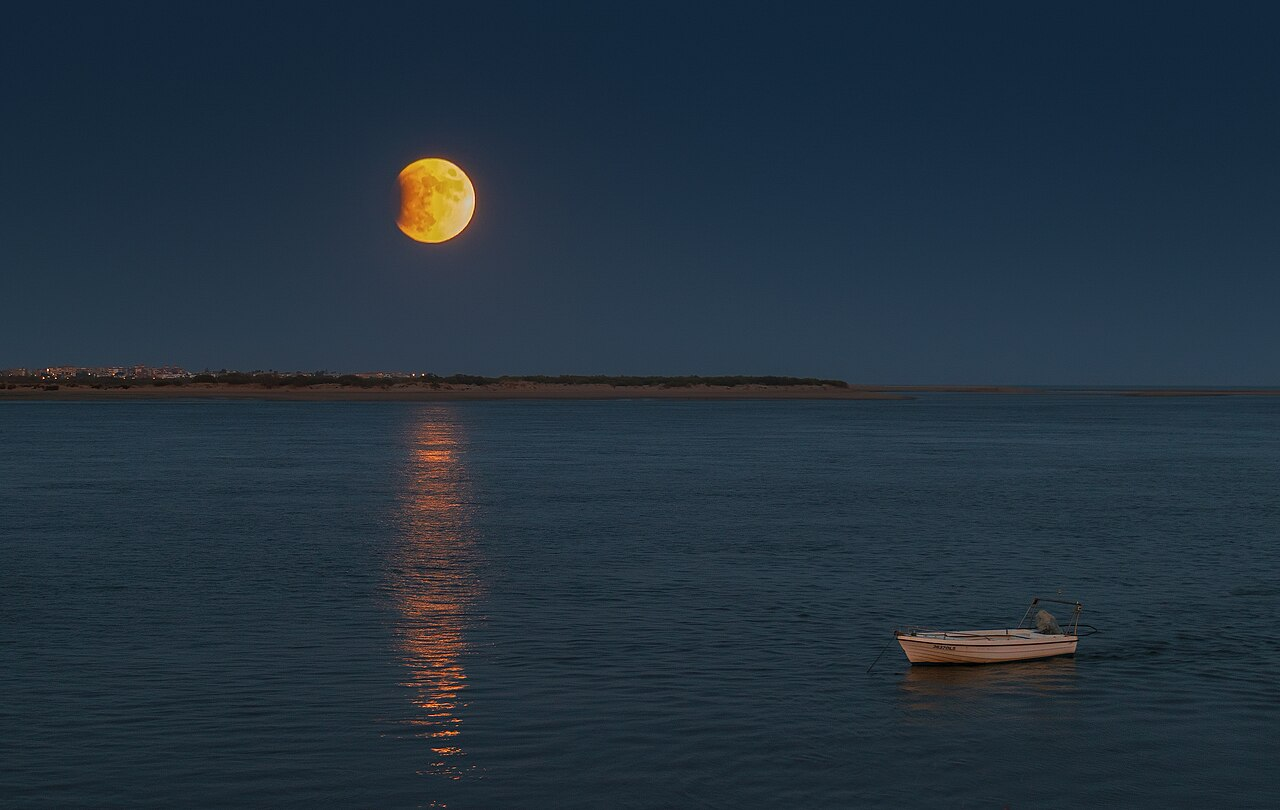
Partial Lunar Eclipse over southern Portugal
image
Caption: The image shows a partial lunar eclipse from the 16th of July 2019, taken in southern Portugal. A lunar eclipse happens at full moon so without the eclipse we would see the full lunar disk. Earth’s curved shadow is clearly visible on the left side of the lunar disk. The remaining surface of the Moon is dipped into a deep orange color due. This is because at a lunar eclipse the Earth is positioned between the Moon and the Sun. While the solid part of the Earth creates the shadow we see on the left side of the Moon, sunlight also shines through Earth’s atmosphere. This scatters blue sunlight allowing most red sunlight through, the same process which turns the evening sun into a beautiful and colorful sunset.
Credit: ToryYu1989
Credit Link
Glossary Terms:
Eclipse , Partial Lunar Eclipse
License: CC0 1.0 Universal (CC0 1.0) Public Domain Dedication CC0 1.0 Universal (CC0 1.0) Public Domain Dedication icons
File
( image
662.30 kB)

2024 Total Solar Eclipse from Space
video
Caption: The NASA Deep Space Climate Observatory (DSCOVR) captured the total solar eclipse over North America on the 8th of April, 2024 from space using its Earth Polychromatic Imaging Camera (EPIC). This video shows images of Earth taken over the course of four and a half hours. The Moon’s shadow on the Earth can be seen as it moves from south-west to north east. While the shadow looks like it covers a huge part of the continent, only a strip up to 185 km wide in the middle of the eclipse's path saw a total eclipse at some point on this day and at any one time only the central part of the shadow would have experienced a total solar eclipse. Most of the area covered by this shadow only saw a partial eclipse.
DSCOVR sits at L1, a stable gravitational point between the Sun and Earth and observes the day side of the Earth.
Credit: NASA/DSCOVR EPIC team/Michala Garrison and Wanmei Liang
Credit Link
Glossary Terms:
Solar Eclipse
Categories:
Planet Earth
, Solar System
License: Public Domain Public Domain icons
File
( video
2.86 MB)
Total Solar Eclipse
image
Created for the OAE
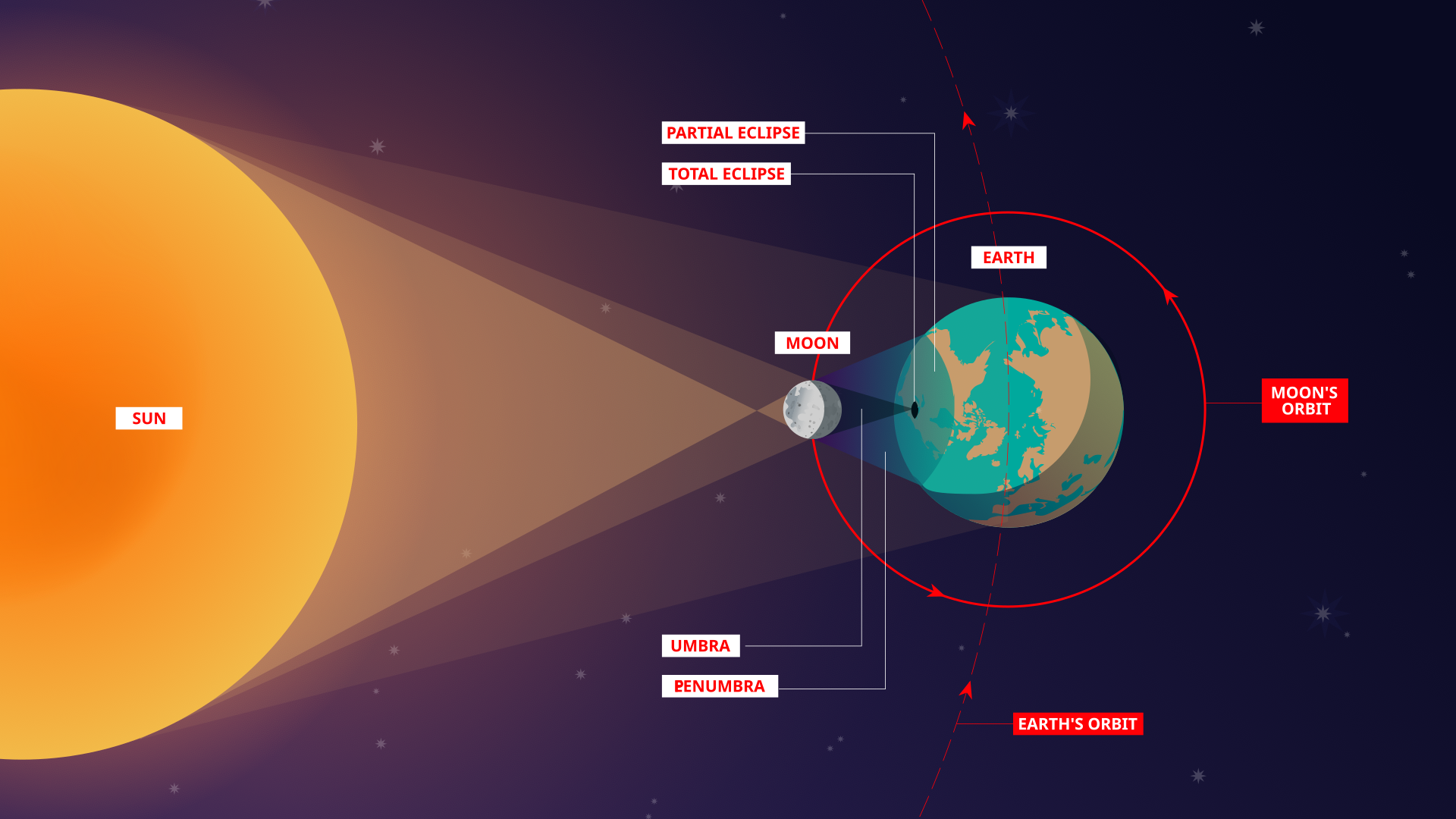
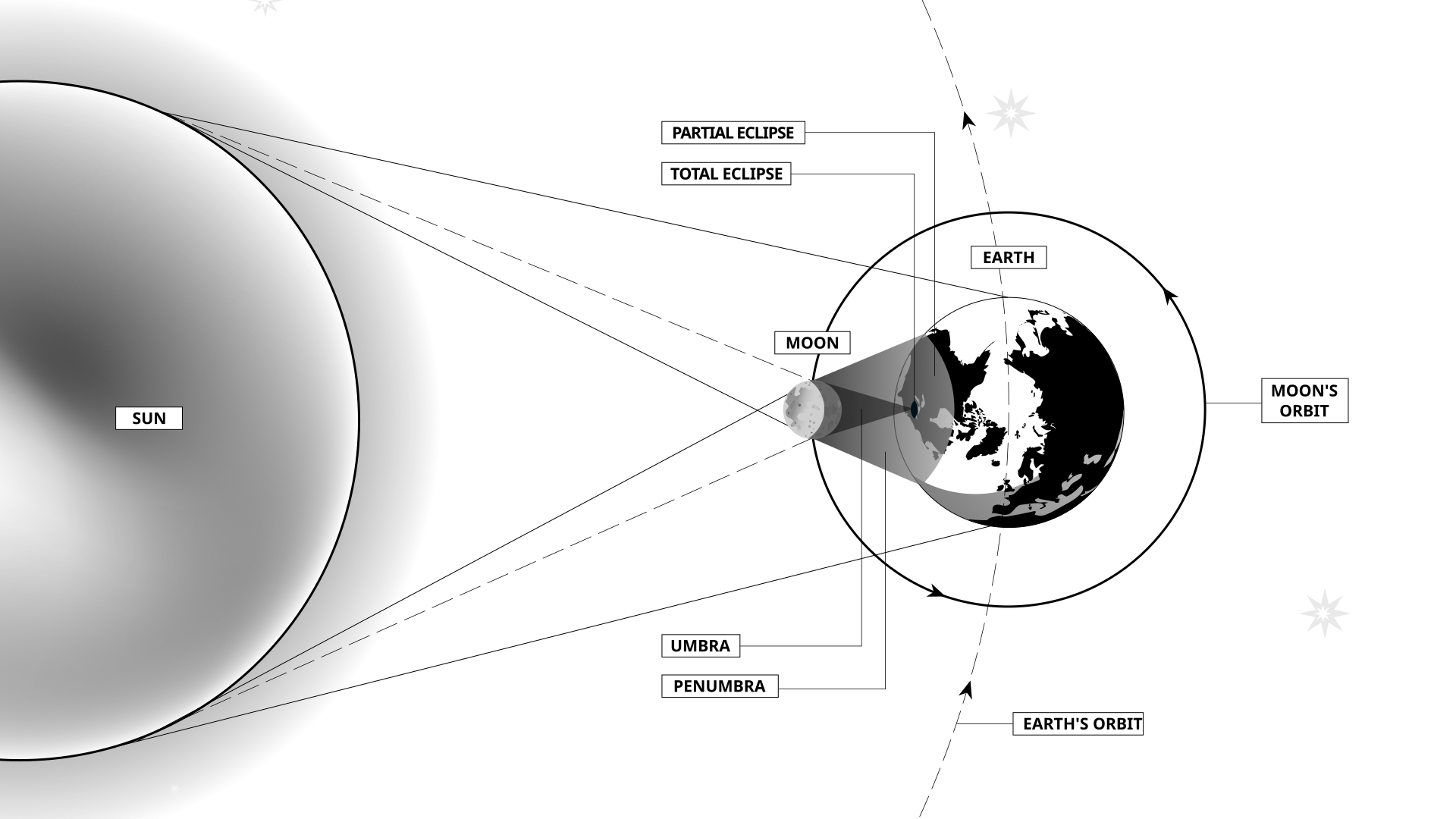
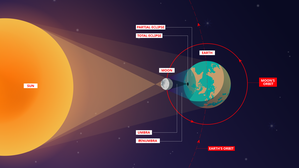
Caption: This not to scale diagram shows what happens during a total solar eclipse. The Moon orbits the Earth, but its orbit is slightly tilted with respect to the Earth’s orbit around the Sun. During the new moon lunar phase, the Moon lies between the Earth and the Sun, but due to the Moon’s tilted orbit around the Earth, the Moon normally lies above or below the Sun at this point. However twice a year the Moon’s orbit lines up in such a way that the Moon can lie in a direct line between the Earth and Sun. During each of these periods (each of which last roughly a month) solar (and lunar) eclipses can occur. The Moon is about 400 times smaller than the Sun, but is 400 times closer to the Earth than the Sun. Hence the Sun and Moon have approximately the same angular size when viewed from the Earth. This means that it is possible for the Moon to completely cover the Sun when viewed from Earth. This is known as a total solar eclipse.
Here we see a schematic of such and eclipse. The Moon casts a shadow on the Earth known as the umbra. This is a roughly circular shadow a few hundred kilometres across although its shape can be severely distorted when the eclipse is at the edge of the illuminated part of the Earth. Any region within the umbra will see the Moon completely cover the Sun and thus will experience a total solar eclipse. Outside of the umbra there are regions where the Moon will cover part of the Sun. This partial shadow is known as the penumbra. Regions in the penumbra will experience a partial solar eclipse.
An eclipse is a dynamic event with the Moon moving in its orbit and the Earth rotating. Hence the umbra and penumbra move across the Earth’s surface together. The path the umbra takes across the Earth is known as the path of totality. Let’s consider one particular region that lies in the path of totality: except in rare cases where an eclipse begins at sunrise, a region that experiences totality will first see the Moon cover part of the Sun and gradually move across Sun until it is totally covered. From outside the Earth this would appear as the penumbra moving over this particular region followed by the umbra moving over this region. Once the Moon moves so that it no longer completely covers the Sun, totality ends and the umbra moves away from this particular region. The Moon will continue to uncover the Sun until (unless the Sun sets before the end of the eclipse) the Sun is completely uncovered. From outside the Earth this would appear as the umbra moving away from our particular region and the edge of the penumbra approaching and eventually passing over the region.
Outside of the path or totality there is a much broader region that will lie in the penumbra but will be missed by the umbra. Such regions will not experience a total solar eclipse during this event, only a partial solar eclipse.
Credit: Aneta Margraf/IAU OAE
Glossary Terms:
Lunar Phase , Moon , New Moon , Partial Solar Eclipse , Penumbra , Solar Eclipse , Sun , Total Solar Eclipse , Umbra
Categories:
Naked Eye Astronomy
License: Creative Commons Attribution 4.0 International (CC BY 4.0) Creative Commons Attribution 4.0 International (CC BY 4.0) icons
File
( image
2.06 MB)
PDF File
(PDF file
1.56 MB)
Also available in black and white
File
( image
468.46 kB)
PDF File
(
1.96 MB)
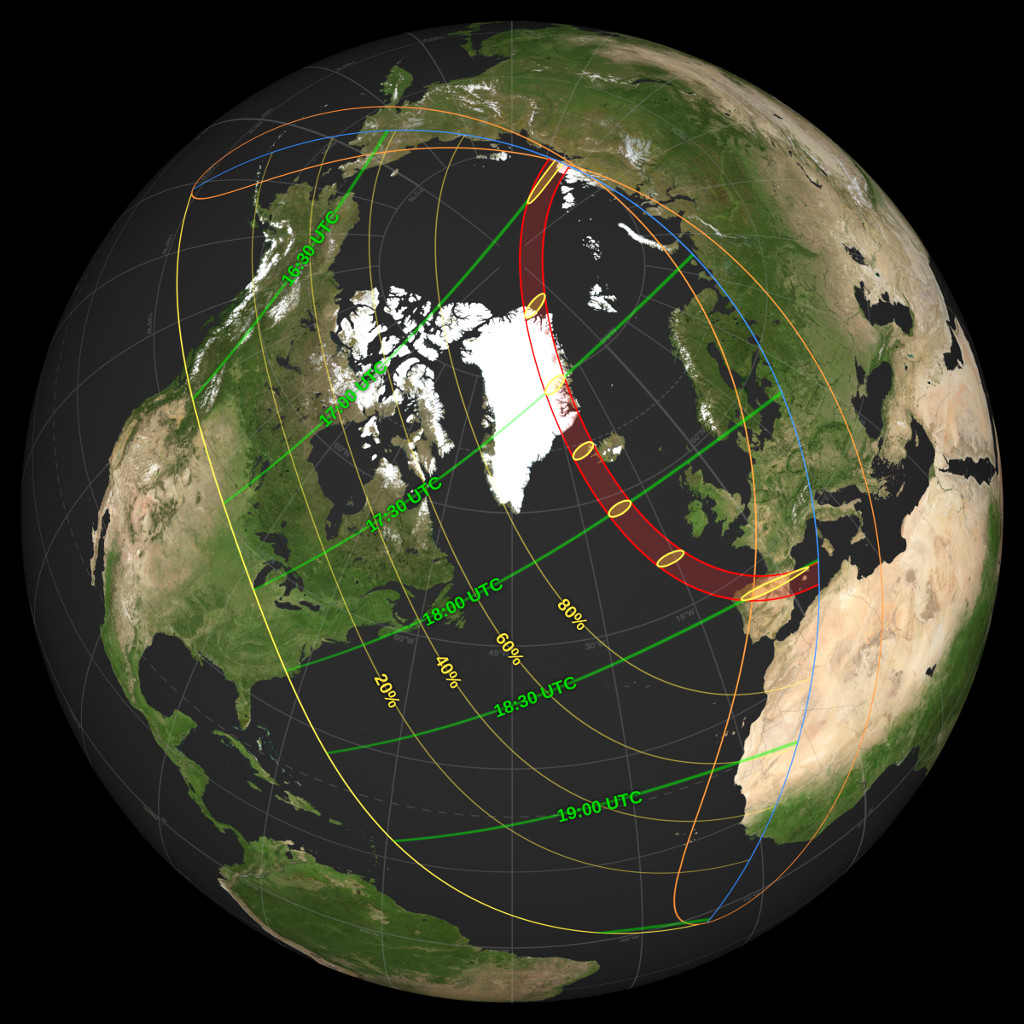
Solar eclipse visibility map
image
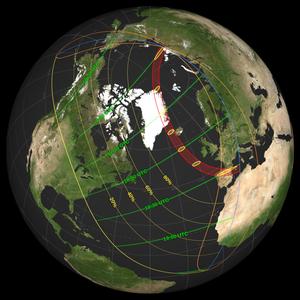
Caption: Map of the shadow path for the August 12, 2026, total solar eclipse.
Tags: Solar eclipse File ( image 275.12 kB)