Documents & Resources - Search Results
Search results
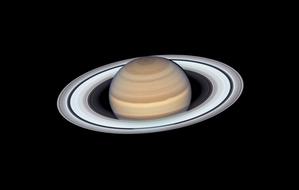
Saturn
image
Caption: The NASA/ESA Hubble Space Telescope’s Wide Field Camera 3 observed Saturn on 20 June 2019 as the planet made its closest approach to Earth this year, at approximately 1.36 billion kilometres away. The image shows coloured bands of gas on the planet's surface as well as its prominent rings made of ice and rocky material.
Credit: NASA, ESA, A. Simon (Goddard Space Flight Center), and M.H. Wong (University of California, Berkeley)
Credit Link
Glossary Terms:
Gas Giant , Giant Planet , Outer Planets , Ring , Saturn
Categories:
Solar System
License: Creative Commons Attribution 4.0 International (CC BY 4.0) Creative Commons Attribution 4.0 International (CC BY 4.0) icons
File
( image
262.21 kB)
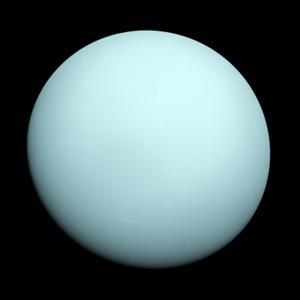
Uranus in natural colours
image
Caption: This is an image of the planet Uranus taken by the spacecraft Voyager 2 in 1986. Its appearance is close to what the naked eye would see. The greenish-blue colour indicates an atmosphere containing methane.
Credit: NASA/JPL-Caltech
Credit Link
Glossary Terms:
Giant Planet , Ice Giant , Outer Planets , Uranus
Categories:
Solar System
License: Public Domain Public Domain icons
File
( image
78.82 kB)
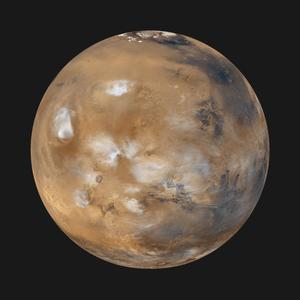
Mars
image
Caption: This image of the planet Mars taken by NASA's Mars Global Surveyor Orbiter in 1999 shows its dry surface. The picture features the most spectacular geological regions on Mars. Besides the deep Valles Marineris valley we see four volcanoes. While three of them form the Tharsis ridge, the Olympus Mons is largest volcano we have so far discovered in the Solar System. Ice clouds cover parts of the Martian surface.
Credit: NASA/JPL/MSSS
Credit Link
Glossary Terms:
Mars , Planet , Terrestrial Planet , Inner Planet
Categories:
Solar System
License: Public Domain Public Domain icons
File
( image
341.48 kB)
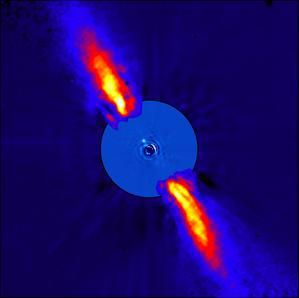
beta Pictoris b
image
Caption: This composite of two images shows the planet beta Pictoris b and a disk of material both of which orbit the young star beta Pictoris. Both are taken in infrared light. The inner image was one of the first pictures taken of a planet around another star (an exoplanet). This image was made using a technique called adaptive optics which removes the blurring effect of the Earth's atmosphere that spreads out a star's light. The star's light is then concentrated tightly enough that it can be hidden behind a blocking circle (shown here in black) called a coronagraph. The ripples around this are artifacts of the imaging process. Beta Pictoris b, a gas giant planet about twelve times the mass of Jupiter, appears as a dot above and to the left of the black circle.
The outer image shows the thermal emission from the warm disk of material surrounding the young star beta Pictoris. As we are viewing this disk edge-on it appears as a line. This disk of gas and dust provided the material to form beta Pictoris b.
Credit: ESO/A.-M. Lagrange et al.
Credit Link
Glossary Terms:
Exoplanet , Planet Formation , Adaptive Optics
Categories:
Exoplanets & Astrobiology
License: Creative Commons Attribution 4.0 International (CC BY 4.0) Creative Commons Attribution 4.0 International (CC BY 4.0) icons
File
( image
128.05 kB)
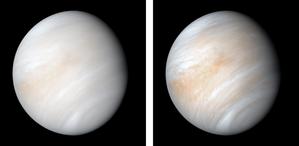
Venus in visible light
image
Caption: This picture taken by NASA's Mariner 10 probe shows what the planet Venus looks like when looking at it with naked eyes. Venus is enshrouded inside a thick cloudy atmosphere dominated by carbon dioxide, never revealing its hot surface.
Credit: NASA/JPL-Caltech
Credit Link
Glossary Terms:
Planet , Terrestrial Planet , Venus , Inner Planet
Categories:
Solar System
License: Public Domain Public Domain icons
File
( image
94.31 kB)





