Documents & Resources - Search Results
Search results

Fornax Constellation Map
image
Caption: The constellation Fornax with its bright stars and surrounding constellations. Fornax is surrounded by (going clockwise from the top): Cetus, Sculptor, Phoenix and Eridanus.
Fornax is a southern constellation and thus the whole constellation is visible in the whole southern hemisphere at some point in the year. The whole constellation is also visible from equatorial and most temperate regions of the northern hemisphere. Fornax is best viewed in the northern hemisphere winter and southern hemisphere summer.
The spiral galaxy NGC 1097 lies in Fornax and is marked here with a red ellipse.
The y-axis of this diagram is in degrees of declination with north as up and the x-axis is in hours of right ascension with east to the left. The sizes of the stars marked here relate to the star's apparent magnitude, a measure of its apparent brightness. The larger dots represent brighter stars. The Greek letters mark the brightest stars in the constellation. These are ranked by brightness with the brightest star being labeled alpha, the second brightest beta, etc., although this ordering is not always followed exactly. The dotted boundary lines mark the IAU's boundaries of the constellations and the solid green lines mark one of the common forms used to represent the figures of the constellations. Neither the constellation boundaries, nor the lines joining the stars appear on the sky.
Credit: Adapted by the IAU Office of Astronomy for Education from the original by the IAU and Sky & Telescope
Credit Link
Glossary Terms:
Apparent Magnitude , Celestial Coordinates , Constellation , Declination , Right Ascension (RA) , Spiral Galaxy
Categories:
Naked Eye Astronomy
License: Creative Commons Attribution 4.0 International (CC BY 4.0) Creative Commons Attribution 4.0 International (CC BY 4.0) icons
File
( image
92.12 kB)
PDF File
(PDF file
166.23 kB)

Ursa Major Constellation Map
image
Caption: The constellation Ursa Major along with its bright stars and its surrounding constellations. Ursa Major is surrounded by (going clockwise from the top): Draco, Camelopardalis, Lynx, Leo Minor, Leo, Coma Berenices, Canes Venatici and Boötes. Ursa Major is famous for the prominent asterism often known in English as the Big Dipper or the Plough. This prominent northern asterism has a wide variety of names from cultures across the world. While most constellations and asterisms are made up of unrelated stars that randomly appear close together on the sky, five of the stars in the Big Dipper are part of the Ursa Major Moving Group, a group of stars moving through space together that likely formed in the same location 300 million years ago. The two stars on the right-hand end of the Big Dipper on this diagram form a pair of pointer stars that can be used to locate Polaris, the northern pole star which lies in the constellation of Ursa Minor.
Ursa Major is a northern constellation and is visible from northern and equatorial regions. Parts of the constellation are visible from all but the most antarctic parts of the southern hemisphere but not all temperate regions of the southern hemisphere can see all of the Big Dipper. Conversely the Big Dipper and much of the rest of the constellation are circumpolar in arctic and many temperate regions of the northern hemisphere. Ursa Major is most visible in the evening in the northern hemisphere spring and southern hemisphere autumn.
Two prominent galaxies appear in the northern part of this constellation, the spiral galaxy M81 and M82, a possible spiral galaxy whose structure is difficult to observe from the Earth as it appears edge-on. Both are shown here as red ellipses. The planetary nebula M97 (the Owl Nebula) lies in the middle of the constellation and is marked by a green circle superimposed on a plus symbol.
The y-axis of this diagram is in degrees of declination with north as up and the x-axis is in hours of right ascension with east to the left. The sizes of the stars marked here relate to the star's apparent magnitude, a measure of its apparent brightness. The larger dots represent brighter stars. The Greek letters mark the brightest stars in the constellation. These are ranked by brightness with the brightest star being labeled alpha, the second brightest beta, etc., although this ordering is not always followed exactly. The dotted boundary lines mark the IAU's boundaries of the constellations and the solid green lines mark one of the common forms used to represent the figures of the constellations. Neither the constellation boundaries, nor the lines joining the stars appear on the sky.
Credit: Adapted by the IAU Office of Astronomy for Education from the original by IAU/Sky & Telescope
Credit Link
Glossary Terms:
Apparent Magnitude , Big Dipper , Celestial Coordinates , Circumpolar Stars , Constellation , Declination , Leo , Planetary Nebula , Right Ascension (RA) , Spiral Galaxy , Asterism
Categories:
Naked Eye Astronomy
License: Creative Commons Attribution 4.0 International (CC BY 4.0) Creative Commons Attribution 4.0 International (CC BY 4.0) icons
File
( image
143.67 kB)
PDF File
(PDF file
215.83 kB)
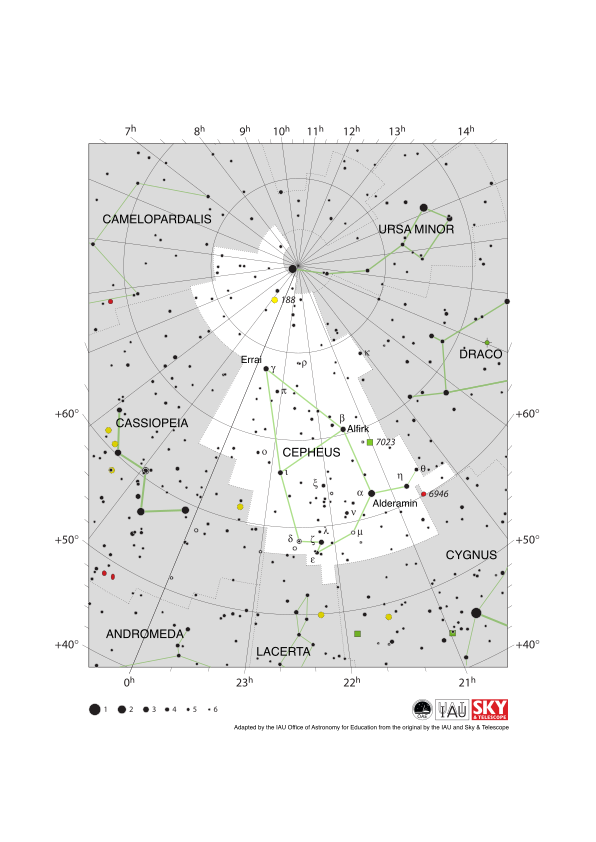
Cepheus Constellation Map
image
Caption: The constellation Cepheus along with its bright stars and surrounding constellations. Cepheus is surrounded by (going clockwise from the top): Camelopardalis, Ursa Minor, Draco, Cygnus, Lacerta and Cassiopeia. Cepheus is a large constellation. Its most notable star is Delta Cephei, the prototype for the class of variable stars known as Cepheid variables. These are variable stars which can be used to estimate distances both within our galaxy and to nearby galaxies.
Cepheus lies close to the north celestial pole. As such it is circumpolar for arctic and temperate regions of the northern hemisphere. The whole of the constellation is also visible at some point in the year in equatorial regions of the northern hemisphere with parts of it visible in equatorial regions of the southern hemisphere. It is best viewed in the evening in the northern hemisphere late autumn and southern hemisphere late spring.
The open cluster NGC 188 lies in Cepheus and is marked here with a yellow circle. The nebula NGC 7023 also lies in the constellation and is marked with a green square. The red ellipse in the lower right marks the position of the spiral galaxy NGC 6946.
This diagram maps an area around the north celestial pole. Here lines of constant right ascension converge. The right ascension values of these lines are marked on the x-axis above and below the diagram. Some of the lines of constant declination are marked on the y-axis. The sizes of the stars marked here relate to the star's apparent magnitude, a measure of its apparent brightness. The larger dots represent brighter stars. The Greek letters mark the brightest stars in the constellation. Delta Cephei is marked with a circle around a dot as it is a variable star. Mu Cephei is also a variable star marked here as an open circle. These are ranked by brightness with the brightest star being labeled alpha, the second brightest beta, etc., although this ordering is not always followed exactly. The dotted boundary lines mark the IAU's boundaries of the constellations and the solid green lines mark one of the common forms used to represent the figures of the constellations. Neither the constellation boundaries, nor the lines joining the stars appear on the sky.
Credit: Adapted by the IAU Office of Astronomy for Education from the original by the IAU and Sky & Telescope
Credit Link
Glossary Terms:
Apparent Magnitude , Celestial Coordinates , Circumpolar Stars , Constellation , Declination , Nebula , North Celestial Pole (NCP) , Right Ascension (RA) , Spiral Galaxy , Open Cluster
Categories:
Naked Eye Astronomy
License: Creative Commons Attribution 4.0 International (CC BY 4.0) Creative Commons Attribution 4.0 International (CC BY 4.0) icons
File
( image
162.00 kB)
PDF File
(PDF file
212.38 kB)
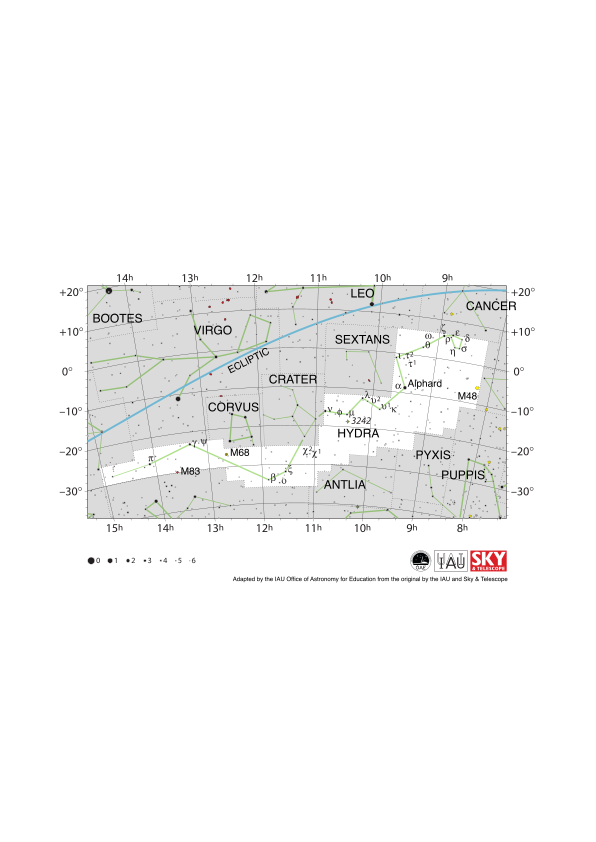
Hydra Constellation Map
image
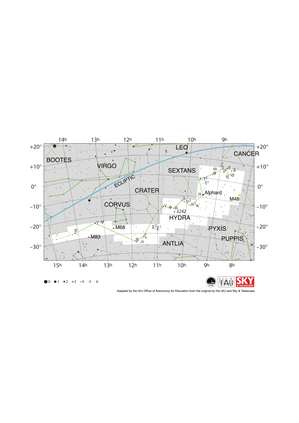
Caption: The constellation Hydra with its bright stars and surrounding constellations. Hydra is surrounded by (going clockwise from the top): Leo, Cancer, Canis Minor, Monoceros, Puppis, Pyxis, Antlia, Centaurus, Lupus, Libra, Virgo, Corvus, Crater and Sextans.
Hydra is a large constellation that covers over a quarter of the celestial sphere in right ascension. It also spans the celestial equator and thus part of the constellation is visible from everywhere on the Earth at some point in the year. All parts of the constellation are visible at some point for all but the most antarctic parts of the southern hemisphere and to equatorial and most temperate regions of the northern hemisphere. However the wide span of the constellation means that all of it may not be visible at the same time in many of these regions. Hydra is best viewed in the northern hemisphere spring and southern hemisphere autumn.
The famous spiral galaxy M83, also known as the Pinwheel Galaxy, lies in Hydra. It is marked here with a red ellipse. The planetary nebula NGC 3242 can also be found in Hydra. It is marked here with a green circle with a plus sign superimposed on it. The open cluster M48 is marked here with a yellow circle while the globular cluster M68 is marked with a yellow circle with a plus sign superimposed on it.
The y-axis of this diagram is in degrees of declination with north as up and the x-axis is in hours of right ascension with east to the left. The sizes of the stars marked here relate to the star's apparent magnitude, a measure of its apparent brightness. The larger dots represent brighter stars. The Greek letters mark the brightest stars in the constellation. These are ranked by brightness with the brightest star being labeled alpha, the second brightest beta, etc., although this ordering is not always followed exactly. The dotted boundary lines mark the IAU's boundaries of the constellations and the solid green lines mark one of the common forms used to represent the figures of the constellations. The blue line on the diagram marks the ecliptic. Neither the constellation boundaries, nor the line marking the ecliptic, nor the lines joining the stars appear on the sky.
Credit: Adapted by the IAU Office of Astronomy for Education from the original by the IAU and Sky & Telescope
Credit Link
Glossary Terms:
Apparent Magnitude , Celestial Coordinates , Constellation , Declination , Ecliptic , Globular Cluster , Libra , Planetary Nebula , Right Ascension (RA) , Spiral Galaxy , Cancer , Open Cluster , Virgo
Categories:
Naked Eye Astronomy
License: Creative Commons Attribution 4.0 International (CC BY 4.0) Creative Commons Attribution 4.0 International (CC BY 4.0) icons
File
( image
114.60 kB)
PDF File
(PDF file
253.49 kB)
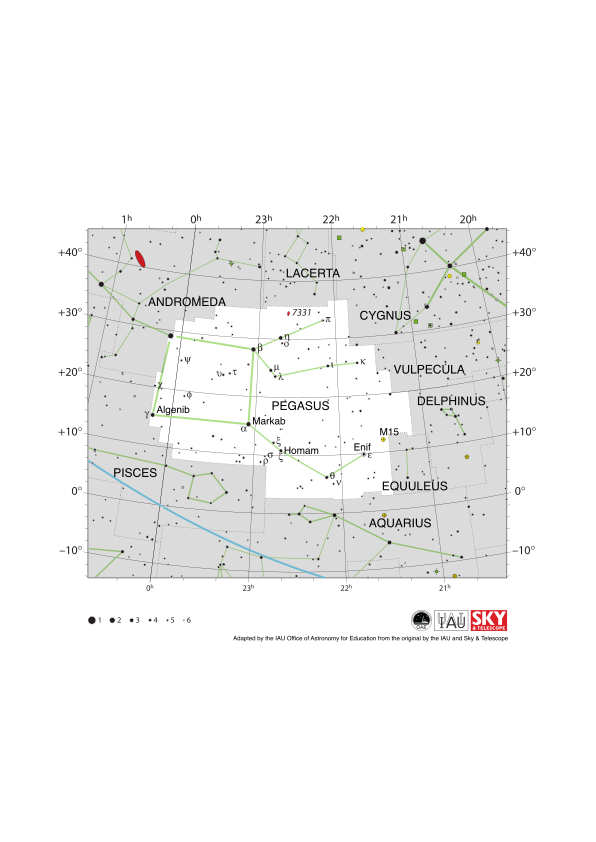
Pegasus Constellation Map
image
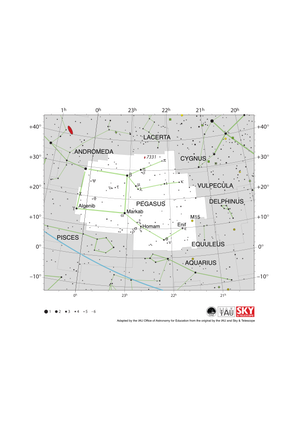
Caption: The constellation Pegasus with its bright stars and surrounding constellations. Pegasus is surrounded by (going clockwise from the top): Lacerta, Cygnus, Vulpecula, Delphinus, Equuleus, Aquarius, Pisces and Andromeda. Pegasus is known for the prominent asterism the “Square of Pegasus” which consists of its three brightest stars plus the brightest star in Andromeda.
Pegasus is a northern constellation and thus the whole constellation is visible at some point in the year throughout the northern hemisphere. The whole constellation is also visible to southern hemisphere equatorial and temperate zones with parts of the constellation visible from all but the most antarctic regions. Pegasus is best viewed in the evening in the northern hemisphere autumn and southern hemisphere spring.
The globular cluster M15 lies in Pegasus and is marked here with a yellow circle with a plus sign superimposed on it. The spiral galaxy NGC 7331 also lies in Pegasus and is marked here with a red ellipse.
The y-axis of this diagram is in degrees of declination with north as up and the x-axis is in hours of right ascension with east to the left. The sizes of the stars marked here relate to the star's apparent magnitude, a measure of its apparent brightness. The larger dots represent brighter stars. The Greek letters mark the brightest stars in the constellation. These are ranked by brightness with the brightest star being labeled alpha, the second brightest beta, etc., although this ordering is not always followed exactly. The dotted boundary lines mark the IAU's boundaries of the constellations and the solid green lines mark one of the common forms used to represent the figures of the constellations. The blue line at the bottom of the diagram marks the ecliptic. Neither the constellation boundaries, nor the lines joining the stars, nor the ecliptic, appear on the sky.
Credit: Adapted by the IAU Office of Astronomy for Education from the original by the IAU and Sky & Telescope
Credit Link
Glossary Terms:
Andromeda , Apparent Magnitude , Celestial Coordinates , Constellation , Declination , Ecliptic , Globular Cluster , Pisces , Right Ascension (RA) , Spiral Galaxy , Aquarius , Asterism
Categories:
Naked Eye Astronomy
License: Creative Commons Attribution 4.0 International (CC BY 4.0) Creative Commons Attribution 4.0 International (CC BY 4.0) icons
File
( image
122.04 kB)
PDF File
(PDF file
213.33 kB)