Documents & Resources - Search Results
Search results
Cetus Constellation Map
image
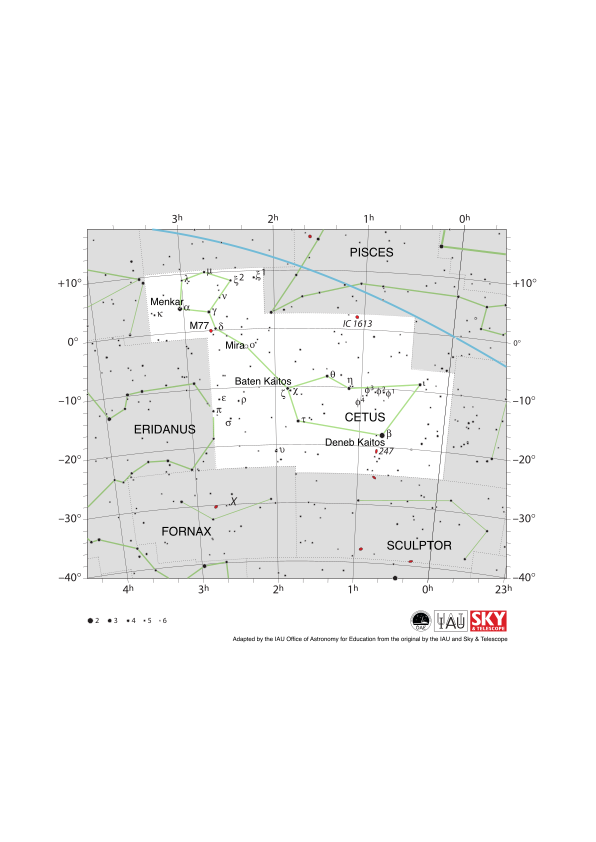
Caption: The constellation Cetus along with its bright stars and surrounding constellations. Cetus is surrounded by (going clockwise from the top): Pisces, Aquarius, Sculptor, Fornax, Eridanus, Taurus and Aries. Cetus lies just south of the ecliptic (shown here as a blue line), this is the path the Sun appears to take across the sky over the course of a year. While the Sun does not pass through Cetus, the other planets of the solar system and the Moon can sometimes be found in Cetus. The star Omicron Ceti or Mira is a famous variable star. This red giant varies in brightness by a factor of 600 over the course of its eleven month period.
Cetus spans the celestial equator, thus some part of the constellation is visible from all the the Earth at some point in the year. The full constellation is visible from equatorial and temperate regions of both hemispheres. Cetus is most visible in the evenings in the northern hemisphere late autumn and the southern hemisphere late spring.
The barred spiral galaxy M77 lies in Cetus as does the spiral galaxy NGC 247 and the dwarf irregular galaxy IC 1613. All three are marked here with red ellipses.
The y-axis of this diagram is in degrees of declination with north as up and the x-axis is in hours of right ascension with east to the left. The sizes of the stars marked here relate to the star's apparent magnitude, a measure of its apparent brightness. The larger dots represent brighter stars. Mira is marked with an open circle as it is a variable star not always visible to the naked eye. The Greek letters mark the brightest stars in the constellation. These are ranked by brightness with the brightest star being labeled alpha, the second brightest beta, etc., although this ordering is not always followed exactly. The dotted boundary lines mark the IAU's boundaries of the constellations and the solid green lines mark one of the common forms used to represent the figures of the constellations. Neither the constellation boundaries, nor the line marking the ecliptic, nor the lines joining the stars appear on the sky.
Credit: Adapted by the IAU Office of Astronomy for Education from the original by IAU/Sky & Telescope
Credit Link
Glossary Terms:
Apparent Magnitude , Celestial Coordinates , Constellation , Declination , Ecliptic , Right Ascension (RA) , Zodiac , Variable Star
Categories:
Naked Eye Astronomy
License: Creative Commons Attribution 4.0 International (CC BY 4.0) Creative Commons Attribution 4.0 International (CC BY 4.0) icons
File
( image
106.77 kB)
PDF File
(PDF file
206.60 kB)
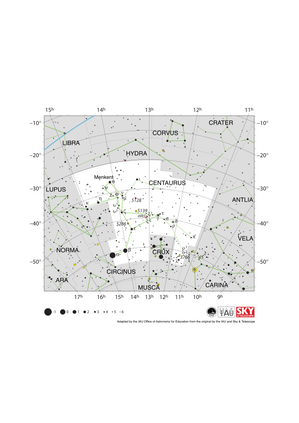
Centaurus Constellation Map
image
Caption: The constellation Centaurus with its bright stars and surrounding constellations. Centaurus is surrounded by (going clockwise from the top): Hydra, Antlia, Vela, Carina, Musca, Crux, Circinus, Lupus and Libra. Centaurus is a large constellation most notable for its brightest star Alpha Centauri. Alpha Centauri is a triple star system and is the nearest star system to the Solar System. When viewed with the naked eye, the two brightest components of Alpha Centauri appear as one star. The combined light from these two stars makes Alpha Centauri appear as the third brightest star in the night sky. The third component of the Alpha Centauri system Proxima Centauri, the nearest star to the Sun, is too faint to be viewed with the naked eye.
Centaurus is a southern constellation and thus the whole constellation is visible from the southern hemisphere at some point in the year. The whole constellation is also visible from equatorial regions of the northern hemisphere with parts of the constellation visible from temperate northern regions. The constellation is best viewed in the evening in the late northern hemisphere spring and late southern hemisphere autumn.
The globular cluster Omega Centauri, also known as NGC 5319, lies in Centaurus. Bright enough to be seen with the naked eye, this cluster was initially given a designation as a star in the constellation before its true nature was realised. It is marked here with a yellow circle with a plus sign superimposed on it. As is the globular cluster NGC 5286. The open cluster NGC 3766 is marked here with a yellow circle. NGC 5128, also known as Centaurus A, is the closest active galaxy to Earth. The supermassive black hole at the heart of this galaxy has launched two huge jets of matter which emit in many different wavelengths including x-ray and radio emission. NGC 5128 is marked with a red ellipse here, as is the edge-on spiral galaxy NGC 4945.
The y-axis of this diagram is in degrees of declination with north as up and the x-axis is in hours of right ascension with east to the left. The sizes of the stars marked here relate to the star's apparent magnitude, a measure of its apparent brightness. The larger dots represent brighter stars. The Greek letters mark the brightest stars in the constellation. These are ranked by brightness with the brightest star being labeled alpha, the second brightest beta, etc., although this ordering is not always followed exactly. The dotted boundary lines mark the IAU's boundaries of the constellations and the solid green lines mark one of the common forms used to represent the figures of the constellations. The blue line in the top left is the ecliptic. Neither the constellation boundaries, nor the line marking the ecliptic, nor the lines joining the stars appear on the sky.
Credit: Adapted by the IAU Office of Astronomy for Education from the original by the IAU and Sky & Telescope
Credit Link
Glossary Terms:
Apparent Magnitude , Celestial Coordinates , Constellation , Declination , Globular Cluster , Right Ascension (RA) , Open Cluster , Alpha Centauri
Categories:
Naked Eye Astronomy
License: Creative Commons Attribution 4.0 International (CC BY 4.0) Creative Commons Attribution 4.0 International (CC BY 4.0) icons
File
( image
152.88 kB)
PDF File
(PDF file
255.96 kB)
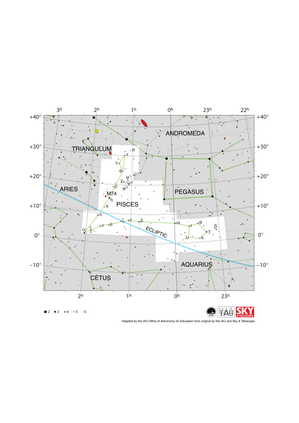
Pisces Constellation Map
image
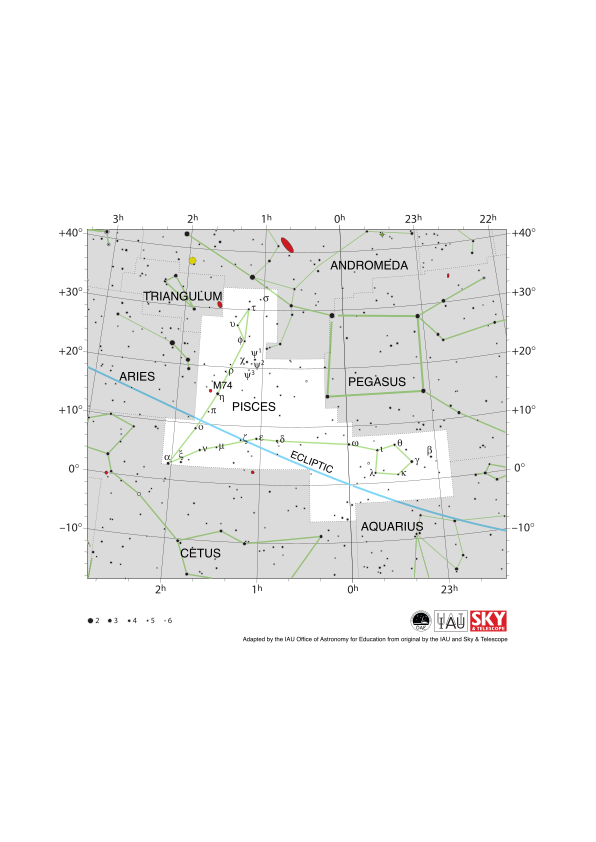
Caption: The constellation Pisces along with its bright stars and surrounding constellations. Pisces is surrounded by (going clockwise from the top) Andromeda, Pegasus, Aquarius, Cetus, Aries and Triangulum. Pisces lies on the ecliptic (shown here as a blue line), this is the path the Sun appears to take across the sky over the course of a year. The Sun is in Pisces from mid March to mid April. Thus the Sun is in Pisces at the March equinox. At this point the ecliptic crosses the celestial equator. The Sun’s location at the spring equinox is used to set the zero point of the Right Ascension positional coordinate. The other planets of the Solar System can often be found in Pisces.
Pisces spans the celestial equator and is thus visible at some time in the year from all of planet Earth. In the most arctic or antarctic regions of the world, some parts of the constellation may not be visible. Pisces is most visible in the evenings in the northern hemisphere autumn and southern hemisphere spring
The grand design spiral galaxy M74 is marked on this diagram with a small red circle.
The y-axis of this diagram is in degrees of declination with north as up and the x-axis is in hours of right ascension with east to the left. The sizes of the stars marked here relate to the star's apparent magnitude, a measure of its apparent brightness. The larger dots represent brighter stars. The Greek letters mark the brightest stars in the constellation. These are ranked by brightness with the brightest star being labeled alpha, the second brightest beta, etc., although this ordering is not always followed exactly. The dotted boundary lines mark the IAU's boundaries of the constellations and the solid green lines mark one of the common forms used to represent the figures of the constellations. Neither the constellation boundaries, nor the line marking the ecliptic, nor the lines joining the stars appear on the sky.
Credit: Adapted by the IAU Office of Astronomy for Education from the original by IAU/Sky & Telescope
Credit Link
Glossary Terms:
Andromeda , Apparent Magnitude , Aries , Equinox , Celestial Coordinates , Constellation , Declination , Ecliptic , Pisces , Right Ascension (RA) , Zodiac , Aquarius
Categories:
Naked Eye Astronomy
License: Creative Commons Attribution 4.0 International (CC BY 4.0) Creative Commons Attribution 4.0 International (CC BY 4.0) icons
File
( image
116.67 kB)
PDF File
(PDF file
209.48 kB)

Tucana Constellation Map
image
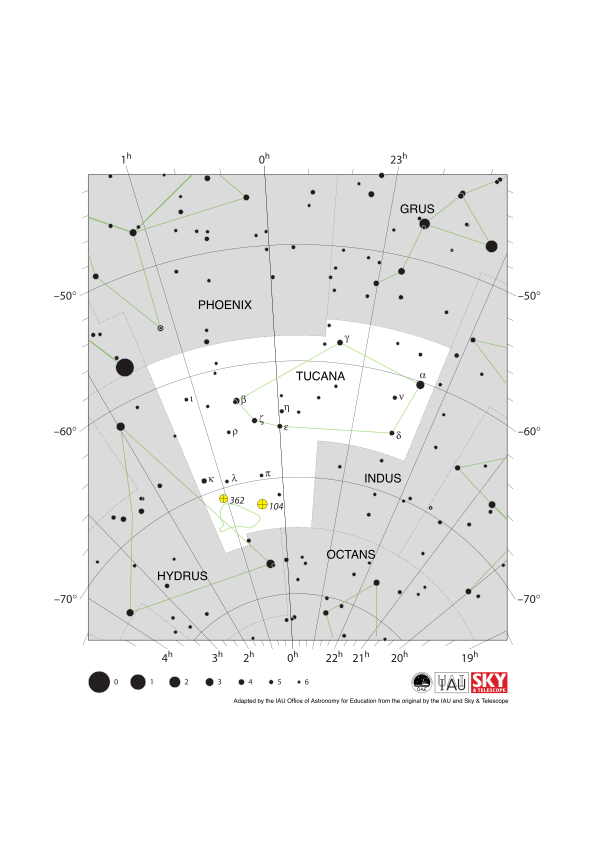
Caption: The constellation Tucana with its bright stars and surrounding constellations. Tucana is surrounded by (going clockwise from the top): Grus, Indus, Octans, Hydrus, Eridanus and Phoenix.
Tucana is a southern constellation and thus the whole constellation is visible at some point in the year throughout the southern hemisphere. The whole constellation is visible to some equatorial regions of the northern hemisphere with parts of the constellation visible to the remaining northern equatorial regions. Tucana is best viewed in the northern hemisphere autumn and southern hemisphere spring.
The Small Magellanic Cloud (SMC), a satellite galaxy of the Milky Way lies in Tucana with a small part spilling over into the neighbouring constellation of Hydrus. The SMC is marked here with a green loop in the south east of Tucana. The globular clusters NGC 104, also known as 47 Tucanae or 47 Tuc, and NGC 362 lie in Tucana and are marked here with yellow circles with plus signs superimposed on them. While these two clusters appear close to the SMC on the sky, they are both significantly closer than that satellite galaxy.
The y-axis of this diagram is in degrees of declination with north as up and the x-axis is in hours of right ascension with east to the left. The sizes of the stars marked here relate to the star's apparent magnitude, a measure of its apparent brightness. The larger dots represent brighter stars. The Greek letters mark the brightest stars in the constellation. These are ranked by brightness with the brightest star being labeled alpha, the second brightest beta, etc., although this ordering is not always followed exactly. The dotted boundary lines mark the IAU's boundaries of the constellations and the solid green lines mark one of the common forms used to represent the figures of the constellations. Neither the constellation boundaries, nor the lines joining the stars appear on the sky.
Credit: Adapted by the IAU Office of Astronomy for Education from the original by the IAU and Sky & Telescope
Credit Link
Glossary Terms:
Apparent Magnitude , Celestial Coordinates , Constellation , Declination , Globular Cluster , Right Ascension (RA) , Small Magellanic Cloud (SMC)
Categories:
Naked Eye Astronomy
License: Creative Commons Attribution 4.0 International (CC BY 4.0) Creative Commons Attribution 4.0 International (CC BY 4.0) icons
File
( image
113.87 kB)
PDF File
(PDF file
161.52 kB)
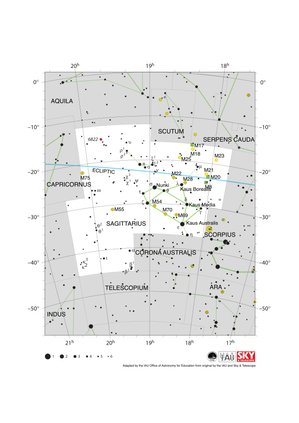
Sagittarius Constellation Map
image
Caption: The constellation Sagittarius along with its bright stars and surrounding constellations. Sagittarius is surrounded by (going clockwise from the top) Aquila, Scutum, Serpens Cauda, Ophiuchus, Scorpius, Corona Australis, Telescopium, Microscopium and Capricornus. The brighter stars in Sagittarius form a distinctive teapot shape. Sagittarius lies on the ecliptic (shown here as a blue line), this is the path the Sun appears to take across the sky over the course of a year. The Sun is in Sagittarius from mid December to mid January. The other planets of the Solar System can often be found in Sagittarius.
Sagittarius lies south of the celestial equator. The famous teapot asterism is visible for all but the most arctic regions of the world but the most southerly parts of the constellation are not visible in northern parts of Asia, Europe and North America. Sagittarius is most visible in the evenings in the northern hemisphere summer and southern hemisphere winter.
The supermassive black hole Sagittarius A* which lies at the center of our Milky Way Galaxy is sits on the western (here right-hand) edge of Sagittarius. Due to it covering an area at the center of our Galaxy, Sagittarius is home to many star clusters including open clusters (marked here with yellow circles) and globular clusters (marked here with yellow circles with + signs superimposed on them). Three nebulae are also marked here with green squares.
The y-axis of this diagram is in degrees of declination with north as up and the x-axis is in hours of right ascension with east to the left. The sizes of the stars marked here relate to the star's apparent magnitude, a measure of its apparent brightness. The larger dots represent brighter stars. The Greek letters mark the brightest stars in the constellation. These are ranked by brightness with the brightest star being labeled alpha, the second brightest beta, etc., although this ordering is not always followed exactly. The dotted boundary lines mark the IAU's boundaries of the constellations and the solid green lines mark one of the common forms used to represent the figures of the constellations. Neither the constellation boundaries, nor the line marking the ecliptic, nor the lines joining the stars appear on the sky.
Credit: Adapted by the IAU Office of Astronomy for Education from the original by IAU/Sky & Telescope
Credit Link
Glossary Terms:
Apparent Magnitude , Capricornus , Celestial Coordinates , Constellation , Declination , Ecliptic , Globular Cluster , Milky Way , Nebula , Right Ascension (RA) , Sagittarius A* , Scorpius , Supermassive Black Hole , Zodiac , Asterism , Open Cluster , Sagittarius
Categories:
Naked Eye Astronomy
License: Creative Commons Attribution 4.0 International (CC BY 4.0) Creative Commons Attribution 4.0 International (CC BY 4.0) icons
File
( image
150.62 kB)
PDF File
(PDF file
219.78 kB)