Documents & Resources - Search Results
Search results

Dreamlike Starry Sky and Airglow
image
Created for the OAE
Caption: Winner in the 2022 IAU OAE Astrophotography Contest, category Still images of celestial patterns.
This spectacular image shows a range of prominent constellations visible in the night sky over the desert of inner Mongolia, taken in August 2019. The yellowish star in the bottom left side is Arcturus, one of the brightest stars in the night sky, and the brightest in the constellation Boötes. The handle of the Big Dipper points towards this bright star and the Dipper is also visible above Boötes. The Northern Dipper (Bei Dou) is a traditional Chinese constellation. It is considered a chariot in which the Judges for Nobility are sitting. Arcturus is considered a single-star asterism, named the Horn, which forms part of the Chinese super-constellation for the spring, the Azure Dragon of the East. The front of the Northern Dipper points towards the star at the top of the photograph which is now called Polaris, the northern Pole Star. In ancient China, there was no bright star at the pole, so the stars in the nearest vicinity of the pole were considered to belong to the emperor and his family in the constellation the Purple Forbidden Palace. At least as early as mediaeval times, Polaris was considered part of the constellation of the Great Emperor of Heaven.
Corona Borealis is also visible in the top right corner of this image, although not in its completeness. It is called the Coiled Thong in China. With its characteristic semi-circular shape, this is one of the smaller constellations of the 88 modern ones, but also can be traced back at least three or four millennia through the Roman “Crown”, the Greek wedding “Wreath”, and the Babylonian “Asterism of Dignity”. The modern name literally means “Northern Crown” in Latin.
At the upper-right edge of the image, we find the part of the modern constellation Cassiopeia that is considered the Flying Corridor and an Auxiliary Road in ancient China. The W-shape of Cassiopeia is cut off by the edge of the photograph but the constellations to its south and southeast, Andromeda and Perseus, are clearly recognisable. Prominently we see the Andromeda galaxy, the most distant object that is visible to the unaided eye. It is located at the outermost outliers of the band of the Milky Way, which could explain why it has not been mentioned explicitly in ancient star catalogues, as it was mistakenly thought to be part of the Milky Way. The photograph also shows clearly reddish parts of the Milky Way that don’t appear bright to the naked eye, and also open clusters that are formed from the same molecular cloud, i.e., groups of stars with similar ages. This region is part of many big and small asterisms in traditional Chinese uranology.
Credit: Likai Lin/IAU OAE
Glosar de termeni:
Big Dipper , Circumpolar Stars , North Celestial Pole (NCP) , Polaris , Asterism
Categories:
Naked Eye Astronomy
License: Creative Commons Atribuire 4.0 Internațional (CC BY 4.0) Creative Commons Atribuire 4.0 Internațional (CC BY 4.0) icons
This file on Zenodo ( image 9.42 MB)
Romanian Orion
image
Created for the OAE
Caption: Winner in the 2022 IAU OAE Astrophotography Contest, category Still images of celestial patterns.
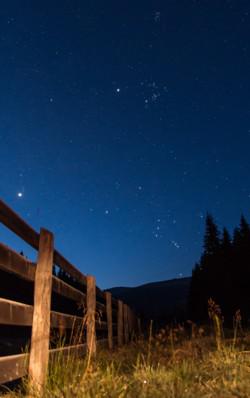
Taken in Romania in August 2012, this image shows two of the most recognisable constellations in the sky, Orion and Taurus.
Orion, the Hunter, is found near the horizon. The most prominent star visible in this image is Betelgeuse, while the asterism of Orion’s belt is formed by three aligned bright stars. Just above Orion we can find Taurus, one of the constellations of the Zodiac. As the Zodiac is inherited from Babylon, The Bull of Heaven represents a mighty but dangerous creature that was defeated by King Gilgamesh and his friend Enkidu. They cut the Bull in half and sacrificed the animal to the gods in order to protect their people. Taurus is also home to the star cluster Pleiades, also known as the Seven Sisters. Two planets are visible: Venus, the bright spot near the fence, and Jupiter, the bright spot at the top, next to the Bull’s face.
Different cultures have included the stars of these constellations in their own mythology. The Romanians, for instance, after Christianisation identified four other constellations using some of the stars of Orion and others surrounding it. One such constellation is called Trisfetitele (the Three Saints), which is associated with the three stars comprising Orion's Belt, representing the Three Hierarchs Basil, Gregory and John. This same asterism is also called Three Wise Men, Kings from the East or just Three Kings — all of these names being rooted in the Christian religion.
The agricultural calendar, in contrast, led farmers to define two other constellations, the Little Plough and the Sickle. Both are seen in the southern half of the Orion rectangle; the Little Plough is drawn by connecting the southern quadrilateral with Orion’s left shoulder, and the Sickle is formed by connecting Orion’s left foot (Rigel) with the belt stars, forming an arch and completing the form of a hoe. In the cultural calendar, these constellations were used to announce the harvest of wheat/grain. Finally, the fourth Romanian constellation is the Great Auger, where Orion’s belt represents the handle of the auger, and Betelgeuse is the tip, facing towards Pollux in Gemini. This constellation is associated with treasure, as Romanian peasants believe that the Auger points to the treasure when they approach the end of the world.
Most of the official star names in Orion are Arabic; Mintaka (meaning “belt”) is at the waist; Alnitak (meaning “girdle”) and Alnilam (meaning “string”) are at the belt; and Rigel (meaning foot) is at the left foot. The star on the left shoulder is named Bellatrix, the Latin term for a female warrior. The star at the right leg is called Saiph, for the sword or sabre of the Arabic Orion.
Credit: Alex Conu/IAU OAE
Glosar de termeni:
Constellation , Gemini , Jupiter , Taurus , Venus , Asterism , Orion , Pleiades
Categories:
Naked Eye Astronomy
License: Creative Commons Atribuire 4.0 Internațional (CC BY 4.0) Creative Commons Atribuire 4.0 Internațional (CC BY 4.0) icons
This file on Zenodo ( image 6.37 MB)

Watchtower and Paddy Fields Under the Starry Sky
image
Created for the OAE
Caption: Winner in the 2022 IAU OAE Astrophotography Contest, category Still images of celestial patterns.
This image, taken in April 2022, shows the sky over a plantation field around a century-old watchtower guarding a village in the province of Guangdong, China. Throughout the ages, the sky has been used as a tool for navigation and also as a calendar. By watching the apparent movement of the stars, it is possible to follow the passing of time, thereby understanding the change of the seasons which in turn helps to plan out the best timings of agricultural work.
The most prominent constellations in this image are Orion and Canis Major, the Great Dog. Commonly associated with a giant hunter in Greek mythology, Orion is followed by his hound in the shape of the constellation Canis Major.
In China, the seven bright stars of the constellation Orion are paradoxically called Three Stars (Shen) and this is one of the 28 Lunar Mansions. The Babylonian pre-zodiac, the so-called “Path of the Moon”, had 17 constellations and included Orion (therein named “True Shepherd of the Heavens”). This is not really surprising because, even in the system of the 88 modern constellations, the Moon sometimes stands in the constellation Orion. The modern constellation boundaries were defined in the 1920s in such a way that the area of Orion ends a half degree south of the ecliptic, in order to avoid the Sun entering it. Still, the Moon and the planets do occasionally. Therefore, Orion is part of the Zodiac (a stripe 5 to 10 degrees around the ecliptic), part of the path of the Moon and, of course, also used by many cultural calendars all over the world.
Sirius, the bright star in the left half of the photograph, is the brightest star in the night sky, and has been used by many indigenous cultures to determine their calendars; the Egyptians awaited the Nile flood with Sirius’s heliacal rise, while the Romans connected its reappearance after its invisibility in daylight with the hottest summer time. In Old China, Sirius was considered a single-star asterism called The Wolf. The adjacent area was called The Market for Soldiers and the area in the southern part of Canis Major was imagined as the Bow with an Arrow.
The reddish bright star in the top right corner is Betelgeuse, a red supergiant and one of the largest stars that can be seen with the naked eye. Orion’s Great Nebula below Orion’s Belt should be mentioned, but also the fainter huge red arc that is called Barnard’s Loop is clearly shown in this photograph. This galactic nebula and the circular red nebula around Orion’s not-so-bright head are both parts of star-forming regions, while the red nebula to the upper left of Orion is the Rosette Nebula in the unrecognisable constellation of Monoceros.
Credit: Likai Lin/IAU OAE
Glosar de termeni:
Color , Constellation , Red Supergiant , Star , Orion
Categories:
Naked Eye Astronomy
, Stars
License: Creative Commons Atribuire 4.0 Internațional (CC BY 4.0) Creative Commons Atribuire 4.0 Internațional (CC BY 4.0) icons
This file on Zenodo ( image 19.99 MB)

The Moon and Milky Way arch Above the Golden Hall
image
Created for the OAE
Caption: Winner in the 2022 IAU OAE Astrophotography Contest, category Still images of celestial patterns.
Taken in April 2021 from the top of the Laojun Mountain in China, this image shows a panoramic view of the Milky Way over the Golden Hall called “Yuhuangding” as a symbol of wealth. In China, the Milky Way is considered a huge stream like one of the big rivers. It separates the Cowherd (Altair) and his beloved Weaving Girl (Vega) and it has a Celestial Ford in the northern dark cloud in the modern constellation Cygnus.
The Milky Way appears as a whitish arch as we cannot distinguish all the individual stars, but instead see the accumulation of light from them. It is a disc-shaped galaxy and the Solar System is located within one of its spiral arms, so we see it from inside, which gives it the shape of a band in our sky. It is associated with the religions and mythologies of several cultures. The modern term Milky Way derives from Greek folklore as the milk spread in the sky by the mother goddess Hera, when she unwillingly breastfed young Heracles. This son of Zeus and a mortal woman was put next to her while she was asleep but from his strong sucking she woke up and realised she was feeding an unknown child, and immediately pushed the child away. Greek philosophers like Plato considered the glittering band in the sky to be the traces of a former path of the Sun.
Alternatively, for the Tupi-Guarani indigenous mythology from South America, the Milky Way represents the “path of tapir”. For some Australian native peoples, its dark clouds formed the shape of an emu if high in the sky, and of crocodiles if low on the horizon. For many southern African, South American and Australian cultures, it was considered a pathway to or from heaven. At the right edge of the image, we can recognise the modern constellation Scorpius with its most prominent star, Antares, the reddish star just above the Milky Way.
The brightest point seen in the centre bottom of the image is the rising Moon with Jupiter next to it. A few constellations can be distinguished in this image, including Corona Australis, a faint arc-shaped constellation located to the bottom right. Just above the Southern Crown, we can see the Teapot asterism as part of the Sagittarius constellation. Since Sagittarius lies next to the centre of the Milky Way, many structures such as star-forming regions, globular clusters and planetary nebulae can be found within its boundaries. In Sagittarius, we also find a supermassive black hole four million times as massive as our Sun.
At the left side of the band, we can identify the bright star Deneb in the constellation Cygnus, The Swan, through which the Milky Way runs, meaning that a variety of star clusters are found in this constellation.
Credit: Likai Lin/IAU OAE
Glosar de termeni:
Dust , Milky Way , Scorpius , Dust Cloud , Interstellar Extinction , Sagittarius
Categories:
Naked Eye Astronomy
License: Creative Commons Atribuire 4.0 Internațional (CC BY 4.0) Creative Commons Atribuire 4.0 Internațional (CC BY 4.0) icons
This file on Zenodo ( image 12.44 MB)

The Milky Way Over Anglers Reach
image
Created for the OAE
Caption: Winner in the 2022 IAU OAE Astrophotography Contest, category Still images of celestial patterns.
The Milky Way and several astronomical objects are seen in this image taken from the southern hemisphere, in Anglers Reach, Australia, in April 2022.
On the bottom-left side we can identify the constellation Scorpius with its brightest star, Antares, the reddish spot just above the arc. Some prominent but small southern constellations can also be seen: the dominating bright stars in the middle-left of the image in the Milky Way are the four bright stars of Crux (the Southern Cross) and to its left the two pointer stars, alpha and beta Centauri. Crux points towards the southern celestial pole, which is not marked by a bright star, and The pointer stars point towards Crux, distinguishing it from the asterism of the False Cross in the constellation Argo.
Crux features on the national flags of Australia, Brazil, Papua New Guinea, Samoa and New Zealand. As Crux lies in the brightest parts of the Milky Way, the dark cloud of the famous Coalsack Nebula is prominent next to the bright stars. It forms one of the dark constellations in South American, South African and Australian indigenous cultures. The huge Australian dark constellation of the Emu is almost completely above the horizon in this image, stretching from its head in the Coal Sack to the horizon.
In Greek antiquity, the stars of Crux also belonged to the constellation Centaurus, a hybrid creature with a human torso and head attached to a horse body with four legs. The Greek centaur represents Chiron, the wise teacher of all Greek heroes. Its brightest star is Rigil Kentaurus (Alpha Centauri), the front hoof of the centaur. Just below it, we find the small constellation Triangulum Australe. The triple star system of Alpha Centauri is our Sun’s nearest stellar neighbour.
Along the Milky Way in the middle-right of the picture we find the huge constellation Argo, the Ship. The smaller ancient constellation Argo was extended by Dutch navigators around 1600, and the number of stars in this constellation was then so big that the 18th-century French mathematician Lacaille needed to introduce subtitles for Argo in his star catalogue. In doing so, he invented the constellations Puppis, Carina and Vela. In Carina, the Keel of the ship, this reddish photograph clearly displays the Carina Nebula.
At the right edge of the image we can spot the brightest star in the night sky, Sirius, while the second brightest star, Canopus, the rudder of Argo, the Ship, dominates the area under the arch of the Milky Way.
Also below the Milky Way arc, we can see the Large Magellanic Cloud and the Small Magellanic Cloud, which are small satellite galaxies of our own Galaxy.
Credit: Lucy Yunxi Hu/IAU OAE
Glosar de termeni:
Color , Dust , Milky Way , Scorpius , Southern Cross , Dust Cloud , Interstellar Extinction , Large Magellanic Cloud (LMC) , Small Magellanic Cloud (SMC) , Alpha Centauri
Categories:
Galaxies
, Milky Way and Interstellar Medium
, Naked Eye Astronomy
License: Creative Commons Atribuire 4.0 Internațional (CC BY 4.0) Creative Commons Atribuire 4.0 Internațional (CC BY 4.0) icons
This file on Zenodo ( image 9.39 MB)


