Documents & Resources - Search Results
Search results
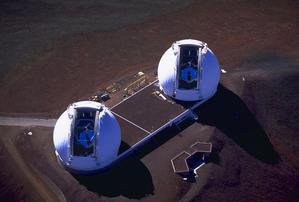
Keck Telescopes
image
Caption: The two Keck telescopes on Mauna Kea on the island of Hawai`i. These two telescopes are reflecting telescopes with primary mirrors 10m across.
Credit: NASA/JPL
Credit Link
Glosar de termeni:
Infrared Astronomy , Observatory , Optical Astronomy , Reflecting Telescope
Categories:
Telescopes, Instruments and Observatories
License: Public Domain Public Domain icons
Fișier
( image
45.04 kB)
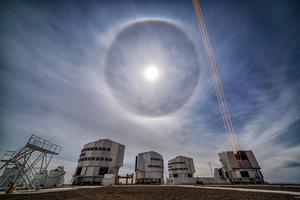
ESO's Very Large Telescope (VLT) at Paranal Observatory with a lunar halo
image
Caption: The Very Large Telescope on Cerro Paranal in Chile has four reflecting telescopes each with a primary mirror 8.2m across. In this image one dome is open and firing laser beams into the sky. These lasers create artificial stars in the sky that can be used to adjust the telescope optics to remove the blurring effect of the Earth's atmosphere. This process is known as adaptive optics.
In the sky the Moon is surrounded by a bright halo. This is caused by light from the moon reflecting inside ice crystals in the Earth's atmosphere.
Credit: Juan Carlos Muñoz-Mateos/ESO
Credit Link
Glosar de termeni:
Observatory , Adaptive Optics , Halo
Categories:
Telescopes, Instruments and Observatories
License: Creative Commons Atribuire 4.0 Internațional (CC BY 4.0) Creative Commons Atribuire 4.0 Internațional (CC BY 4.0) icons
Fișier
( image
4.27 MB)
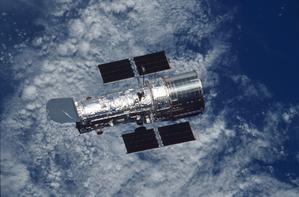
Hubble Space Telescope over Earth
image
Caption: The NASA/ESA Hubble Space Telescope orbiting Earth. This picture was taken by astronauts on board the space shuttle Columbia, right after the Servicing Mission 3B to the space telescope itself. The telescope has an opening that allows light in (seen here on the left). The light travels through the telescope optics to the cameras and spectrographs located in the bulge at the other end of the observatory (seen here on the right). Data from these instruments is then sent back to Earth using an antenna. The black rectangles on either side of the observatory are the solar panels that provide it with power.
Credit: NASA/ESA
Credit Link
Glosar de termeni:
Infrared Astronomy , Observatory , Optical Astronomy , Space Telescope
Categories:
Telescopes, Instruments and Observatories
License: Creative Commons Atribuire 4.0 Internațional (CC BY 4.0) Creative Commons Atribuire 4.0 Internațional (CC BY 4.0) icons
Fișier
( image
1.31 MB)
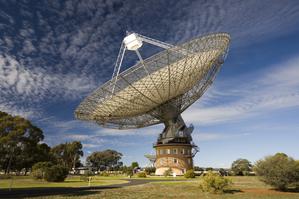
Parkes Radio Telescope
image
Caption: The 64m Radio Telescope at Parkes Observatory (New South Wales, Australia) is fully operantional since 1963 and continuously upgraded since. Also called "The Dish", it is run by the Commonwealth Scientific and Industrial Research Organisation (CSIRO). The telescope can be pointed at a part of the sky. The radio waves from this part of the sky are then reflected and focussed by the giant dish to a receiver at the focal point. The data from this receiver can then be analysed by astronomers.
Credit: David McClenaghan/CSIRO
Credit Link
Glosar de termeni:
Observatory , Radio Astronomy , Radio Telescope
Categories:
Telescopes, Instruments and Observatories
License: Creative Commons Atribuire 3.0 Ne-adaptată Creative Commons Atribuire 3.0 Ne-adaptată icons
Fișier
( image
3.44 MB)


