文档与资源 - 搜索结果
搜索结果
Total Solar Eclipse
图像
为 OAE 制作
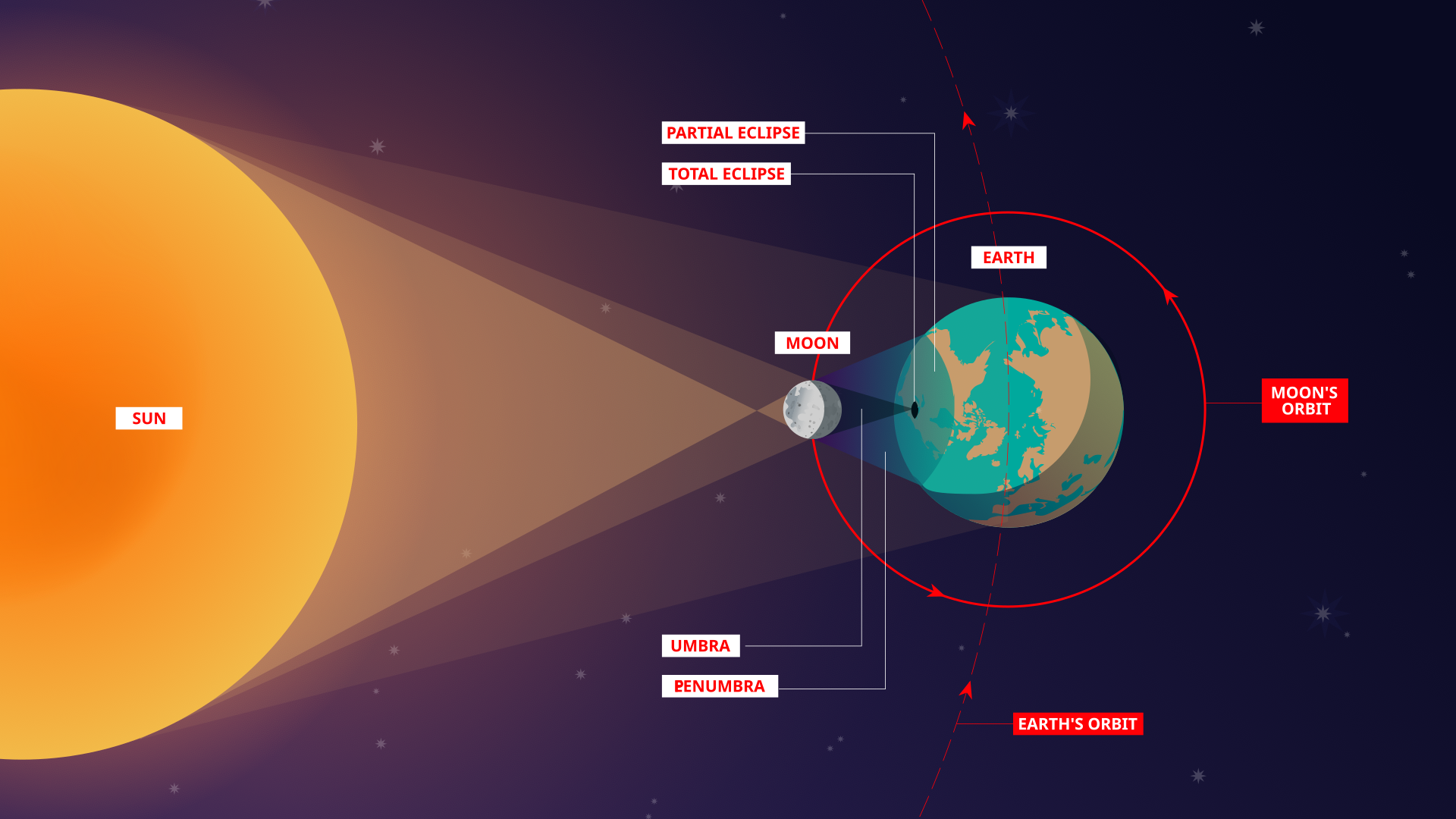
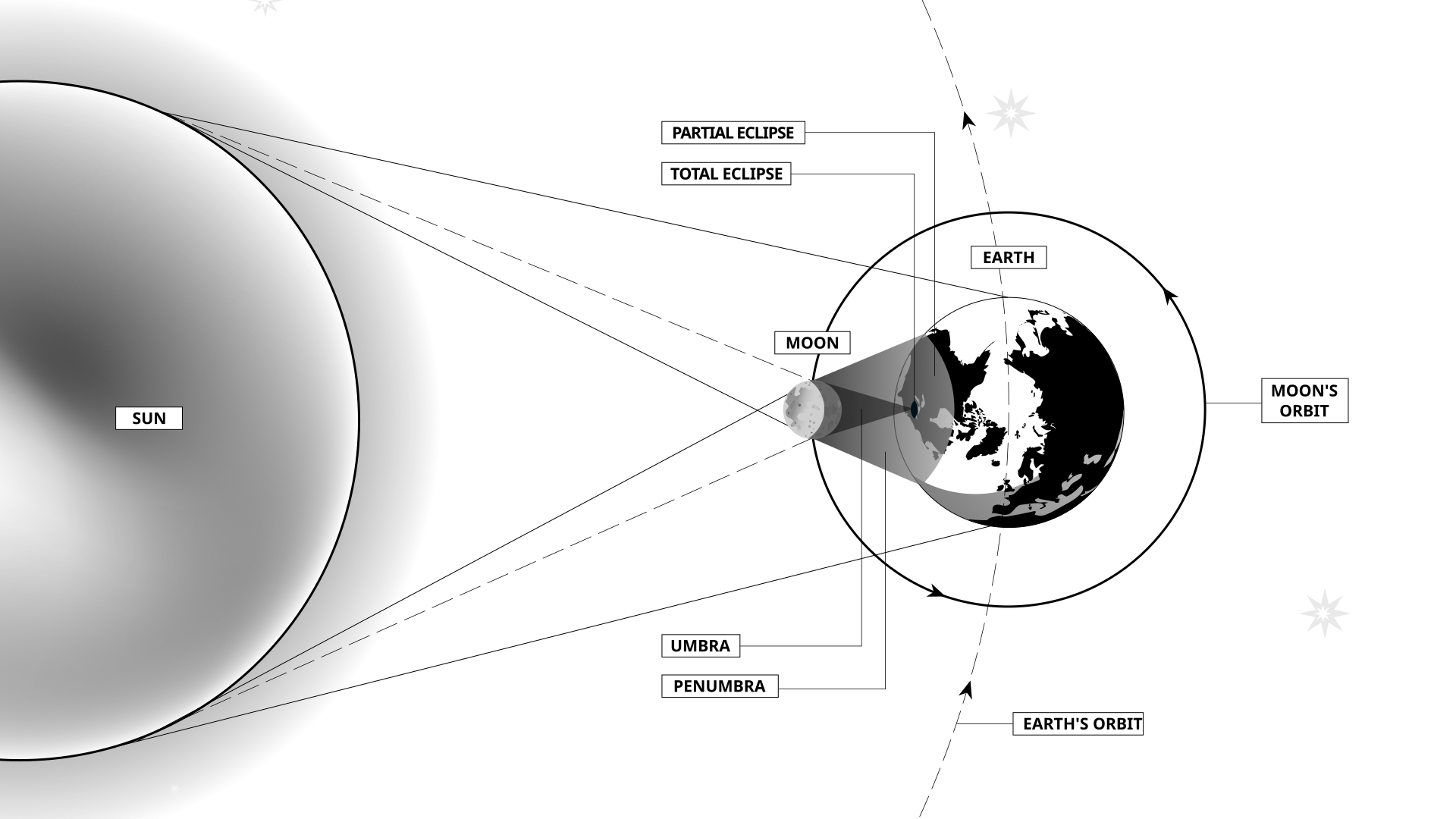
图注: This not to scale diagram shows what happens during a total solar eclipse. The Moon orbits the Earth, but its orbit is slightly tilted with respect to the Earth’s orbit around the Sun. During the new moon lunar phase, the Moon lies between the Earth and the Sun, but due to the Moon’s tilted orbit around the Earth, the Moon normally lies above or below the Sun at this point. However twice a year the Moon’s orbit lines up in such a way that the Moon can lie in a direct line between the Earth and Sun. During each of these periods (each of which last roughly a month) solar (and lunar) eclipses can occur. The Moon is about 400 times smaller than the Sun, but is 400 times closer to the Earth than the Sun. Hence the Sun and Moon have approximately the same angular size when viewed from the Earth. This means that it is possible for the Moon to completely cover the Sun when viewed from Earth. This is known as a total solar eclipse.
Here we see a schematic of such and eclipse. The Moon casts a shadow on the Earth known as the umbra. This is a roughly circular shadow a few hundred kilometres across although its shape can be severely distorted when the eclipse is at the edge of the illuminated part of the Earth. Any region within the umbra will see the Moon completely cover the Sun and thus will experience a total solar eclipse. Outside of the umbra there are regions where the Moon will cover part of the Sun. This partial shadow is known as the penumbra. Regions in the penumbra will experience a partial solar eclipse.
An eclipse is a dynamic event with the Moon moving in its orbit and the Earth rotating. Hence the umbra and penumbra move across the Earth’s surface together. The path the umbra takes across the Earth is known as the path of totality. Let’s consider one particular region that lies in the path of totality: except in rare cases where an eclipse begins at sunrise, a region that experiences totality will first see the Moon cover part of the Sun and gradually move across Sun until it is totally covered. From outside the Earth this would appear as the penumbra moving over this particular region followed by the umbra moving over this region. Once the Moon moves so that it no longer completely covers the Sun, totality ends and the umbra moves away from this particular region. The Moon will continue to uncover the Sun until (unless the Sun sets before the end of the eclipse) the Sun is completely uncovered. From outside the Earth this would appear as the umbra moving away from our particular region and the edge of the penumbra approaching and eventually passing over the region.
Outside of the path or totality there is a much broader region that will lie in the penumbra but will be missed by the umbra. Such regions will not experience a total solar eclipse during this event, only a partial solar eclipse.
来源: Aneta Margraf/IAU OAE
词汇表:
月相 , 月球 , 新月 , 日偏食 , 半影 , 日食 , 太阳 , 日全食 , 本影
分类:
肉眼天文学
授权许可: 知识共享许可协议 署名 4.0 国际 (CC BY 4.0) 知识共享许可协议 署名 4.0 国际 (CC BY 4.0) 图标
文件
( 图像
2.06 MB)
PDF 文件
(PDF file
1.56 MB)
Also available in black and white
文件
( 图像
468.46 kB)
PDF 文件
(
1.96 MB)

智能手机日偏食合成图
图像
为 OAE 制作
图注: 2021年,美国缅因州见证了迷人的日偏食,这是一种天文奇观,月球从地球和太阳之间穿过,从地球看去,太阳发出的光被部分遮挡。这张图像使用了智能手机以及摄影师发明的名为“Solar Snap”的应用程序和滤镜,捕捉到了这一天象的各个阶段。需要注意的是,观测日食时应佩戴合适的护目镜,以避免直视太阳对眼睛造成的伤害。日食期间,月球在其轨道上到达地球和太阳之间的某一点,从而部分或完全覆盖太阳圆面,具体取决于它们的相对位置。这张合成图像无缝结合了六个不同的时刻,展现了月球逐渐穿过太阳圆面的过程。每一弯月牙形的太阳,都展现了这迷人事件的一个独特阶段,让我们稍纵即逝地领略到自然世界的奇妙。智能手机等便捷工具,结合适当的应用程序和滤镜,使每个人都能够安全地记录并珍惜这些非凡的天象。
来源: Douglas Duncan/IAU OAE (CC BY 4.0)
词汇表:
日偏食
分类:
肉眼天文学
, 太阳系
标签:
astrophotography
授权许可: 知识共享许可协议 署名 4.0 国际 (CC BY 4.0) 知识共享许可协议 署名 4.0 国际 (CC BY 4.0) 图标
此文件在 Zenodo 上 ( 图像 465.84 kB)

在赤道的日出日食
图像
为 OAE 制作
图注: 这张令人叹为观止的照片展示了2006年日环食的日出序列,背景是法属圭亚那库鲁德罗什海滩的宁静景色。库鲁临近著名的航天发射中心,是观赏这一天文奇观的绝佳地点。该照片使用胶片相机拍摄,在同一张胶片上每隔10分钟曝光一次,并随着太阳升起调整曝光设置。从最早的影像(下)可以看到月盘面逐渐移动到太阳盘面上,直到覆盖太阳,然后慢慢移开,最终再次显露出完整的太阳盘面。库鲁因其靠近地球赤道的独特地理位置,能确保太阳升起的轨迹几乎垂直于地平线,从而增强了日环食的壮丽景象。
来源: 法布里齐奥·梅兰德里/国际天文学联合会教育办公室(CC BY 4.0)
词汇表:
日环食
分类:
肉眼天文学
, 太阳系
标签:
astrophotography
授权许可: 知识共享许可协议 署名 4.0 国际 (CC BY 4.0) 知识共享许可协议 署名 4.0 国际 (CC BY 4.0) 图标
此文件在 Zenodo 上 ( 图像 892.42 kB)
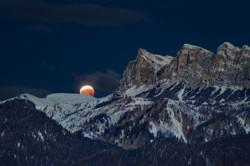
正发生月食的月亮从多洛米蒂山脉(联合国教科文组织世界遗产区)普伦德拉岩峰(Rochetta di Prendera )附近落下,作者 Alessandra Masi,意大利
图像
为 OAE 制作
图注: 2021 年国际天文学联合会 OAE 天体摄影比赛月全食类第一名。
月食发生于满月进入地球阴影时。这种现象发生在太阳、地球和月球的排布完全或非常接近一条直线时。月球表面反射的红光是太阳光照射月球途中,穿过地球大气层时发生折射造成的。较蓝的光由于瑞利散射作用消失,因此月球表面呈现红色。地球阴影在月球表面显示出的圆形形状,曾被亚里士多德用作地球是球体的证据之一。这张照片拍摄于2019 年 1 月 21 日,展示了被地球阴影笼罩的月球(月食)在意大利多洛米蒂山脉(联合国教科文组织世界遗产区)普伦德拉岩峰(Rochetta di Prendera ) 附近落下的景象。
来源: Alessandra Masi/IAU OAE
词汇表:
月食 , 月球 , 月全食
分类:
肉眼天文学
授权许可: 知识共享许可协议 署名 4.0 国际 (CC BY 4.0) 知识共享许可协议 署名 4.0 国际 (CC BY 4.0) 图标
此文件在 Zenodo 上 ( 图像 4.19 MB)
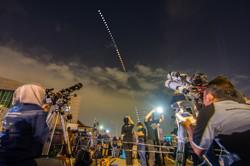
我们之间的日食,作者穆罕默德·雷汉,印度尼西亚
图像
为 OAE 制作
图注: 2021年国际天文学联合会教育办公室天文摄影大赛月全食类别的第二名。
月全食是一种相当壮观的天文现象,无论是否使用望远镜都可以轻松观测到。这里展示的是2018年1月31日在印度尼西亚拍摄的月全食各个阶段:从满月进入地球圆形本影的开始,到全食阶段呈现的“血月”,再到月亮开始离开地球本影直至月落。
来源: 穆罕默德·雷汉/国际天文学联合会教育办公室
词汇表:
天文学家 , 天文学 , 日蚀 , 月食 , 观测 , 望远镜 , 月全食
分类:
肉眼天文学
授权许可: 知识共享许可协议 署名 4.0 国际 (CC BY 4.0) 知识共享许可协议 署名 4.0 国际 (CC BY 4.0) 图标
此文件在 Zenodo 上 ( 图像 12.57 MB)