文档与资源 - 搜索结果
搜索结果
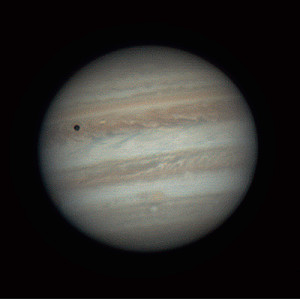
木星、木卫一及其阴影,作者:Ralf Burkart,德国
视频
为 OAE 制作
图注: 2021 年国际天文学联合会 OAE 天体摄影比赛伽利略卫星类第一名。
这幅木星的延时摄影是于2017 年从德国拍摄的,作品精美地展示了伽利略卫星之一木卫一在木星前的凌星现象。由于这只是卫星在行星上投下影子,因此相当于从更远的地方观测地球上的月食。虽然卫星的影子从一开始就清晰可见,但在木星美丽的大气带背景下,第一次观看视频时可能很难发现卫星本身。反复观看可以欣赏到这一奇妙的快速运动和旋转过程。
来源: Ralf Burkart/IAU OAE
词汇表:
伽利略卫星 , 气态巨行星 , 木卫一,音译为艾奥 , 木星 , 卫星 , 轨道 , 外行星 , 行星 , 凌
分类:
太阳系
授权许可: 知识共享许可协议 署名 4.0 国际 (CC BY 4.0) 知识共享许可协议 署名 4.0 国际 (CC BY 4.0) 图标
此文件在 Zenodo 上 ( 视频 12.64 MB)
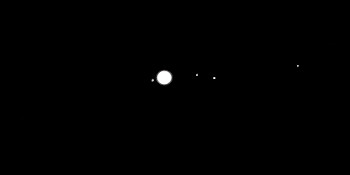
木卫影片2,Nicolas Hurez,Paul-Antoine Matrangolo,和Carl Pennypacker,美国
视频
为 OAE 制作
图注: 2021 年国际天文学联合会 OAE 天体摄影比赛伽利略卫星类第二名。
这组照片展示了四颗伽利略卫星围绕木星运行的轨道。从中几乎可以看到最内侧的卫星木卫一艾奥的两个完整轨道,其他卫星(木卫二欧罗巴和木卫三加尼美得,尤其是木卫四卡利斯托)距离较远,运行速度明显较慢。这些图像是在2018年由Las Cumbres全球天文台在地球上不同地点拍摄的,因此可以在大约半个星期内连续拍摄一系列图像,白天也没有间隙。在天空晴朗的条件下,连续几个夜晚,也可以用双筒望远镜观测到伽利略卫星的运动(最好将手肘稳稳地放在地面上)。
来源: Nicolas Hurez,Paul-Antoine Matrangolo 和 Carl Pennypacker/IAU OAE
词汇表:
伽利略卫星 , 气态巨行星 , 木卫一,音译为艾奥 , 木星 , 卫星 , 轨道 , 外行星 , 行星
分类:
太阳系
授权许可: 知识共享许可协议 署名 4.0 国际 (CC BY 4.0) 知识共享许可协议 署名 4.0 国际 (CC BY 4.0) 图标
此文件在 Zenodo 上 ( 视频 890.47 kB)
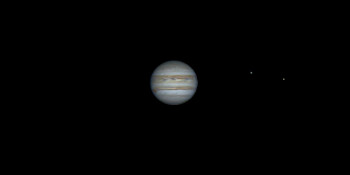
木星的自转,作者 Vishal Sharma,印度
视频
为 OAE 制作
图注: 2021 年国际天文学联合会 (IAU) 天文教育办公室 (OAE) 天体摄影比赛,伽利略卫星类第三名:《木星的自转》,作者 Vishal Sharma,来自印度。
这幅延时摄影作品精美地展示了木星的自转,以及画面右侧经过的两颗伽利略卫星。木星自转一圈只需不到 10 个小时,我们可以看到大红斑从左向右移动。在这短短的时间内,两颗卫星明显沿着它们的轨道前进了一段距离。这张照片是 2020 年在印度北部拍摄的。
来源: Vishal Sharma/IAU OAE
词汇表:
伽利略卫星 , 气态巨行星 , 木星 , 卫星 , 轨道 , 外行星 , 行星
分类:
太阳系
授权许可: 知识共享许可协议 署名 4.0 国际 (CC BY 4.0) 知识共享许可协议 署名 4.0 国际 (CC BY 4.0) 图标
此文件在 Zenodo 上 ( 视频 1.54 MB)

Detailed View of Charon, Moon of Pluto
图像
图注: Charon is the largest natural moon of the dwarf planet Pluto. This detailed image was taken by NASA’s New Horizons spacecraft in 2015 during its historic mission through the outer Solar System. Charon’s surface shows a fascinating mix of light and dark regions, including vast canyons, broad plains, and impact crater. With a diameter of about 1,200 kilometers, Charon is more than half the diameter of Pluto, making it unusually large compared to its parent body. Charon's mass is roughly 12% of that of Pluto.
Because Pluto and Charon are so close in mass, the center of mass of the system (the point both Pluto and Charon orbit) is not within Pluto but between Pluto and Charon. This is in contrast to systems like the Earth and its Moon where the center of mass lies within the larger body, the Earth in this case. Scientists think the Pluto-Charon system may have formed by a collision of two objects that then separated and began to orbit each other. By studying Charon and the smaller moons that circle Pluto, astronomers gain insight into how moons form and how distant icy bodies evolve over billions of years.
来源: NASA/Johns Hopkins University Applied Physics Laboratory/Southwest Research Institute/Alex Parker
来源链接
词汇表:
卫星 , 冥王星
授权许可: 公共领域 公共领域 图标
文件
( 图像
2.88 MB)

Transit of Phobos from Mars
视频
图注: This video shows the Sun viewed from Mars as Mars’ moon Phobos transits across the solar disk. This video is composed of images taken from the Martian surface on the 30th of September 2024 by the Mastcam-Z camera of NASA’s Perseverance Mars rover. While our Moon is perfectly sized to eclipse the Sun when seen from the Earth’s surface, Phobos’s size and orbit mean that it cannot cover the solar disk completely. This means that this event is a transit and not an eclipse.
This video is in real time, with the entire transit lasting just 32 seconds. This compares with the several hours a solar eclipse on Earth takes from the Moon first obscuring part of the Sun to the Sun being completely visible again. This is due to Phobos’ much shorter orbital period of just over seven and a half hours compared to the Moon’s orbital period of 27 days as well as the solar disk appearing slightly smaller from Mars than it does from Earth. Note the non-spherical shape of Phobos as it crosses the solar disk.
来源: NASA/JPL-Caltech/ASU/MSSS
来源链接
词汇表:
火星 , 卫星 , 日食 , 凌
分类:
太阳系
授权许可: 公共领域 公共领域 图标
文件
( 视频
111.64 kB)





