文档与资源 - 搜索结果
搜索结果

狮子座星图
图像
图注: 黄道星座狮子座与周边星座示意图。从顶部开始沿顺时针方向,狮子座周边的星座依次为:小狮座、巨蟹座、六分仪座、长蛇座、巨爵座、室女座和大熊座。狮子座最亮的恒星是轩辕十四,几乎正好位于黄道上。从地球看来,太阳以一年为周期在天球上移动,所经过的路径称为黄道,在图中以蓝色实线标注。太阳在每年八月中旬到九月中旬位于狮子座。太阳系中的其他行星也经常出现在狮子座。
狮子座横跨天赤道,因此在地球上的任何地方,一年中的某些时候都能看到其部分天区。但在地球南北两极,狮子座的部分天区会被遮蔽。狮子座在北半球的春季和南半球的秋季夜晚最适宜观测。
狮子座内可见多个深空天体,包括M65和M66——狮子三重星系中的两个成员,该星系群还包含NGC 3628,但图中并未标注。此外,使用小型望远镜,还可观测到呈现为一团模糊光斑的旋涡星系M96,以及椭圆星系M105。这些天体在图中均以红色椭圆标注。
该图的纵轴为赤纬,横轴为赤经,方向为上北下南左东右西。图中标注的恒星大小对应其视星等——衡量天体视亮度的标准,较大的圆点代表着较亮的恒星。图中的希腊字母标注着星座中最亮的恒星。这些恒星按亮度排序,最亮的一般被标记为α星,第二亮的一般为β星,等等,不过这种字母排序并不总是和实际亮度排序完全一致。图中虚线标注的是国际天文学联合会划定的星座边界,绿色实线则是一种常见的星座形象连线。需要注意的是,在实际观测时,这些边界与连线都不会出现在天空中。
来源: 国际天文学联合会天文教育办公室(IAU OAE)根据国际天文学联合会和《天空与望远镜》的原文改编
来源链接
词汇表:
视星等 , 天球坐标 , 星座 , 赤纬 , 黄道 , 椭圆星系 , 银河系 , 狮子座 , 赤经(RA) , 漩涡星系 , 黄道十二宫 , 巨蟹座 , 室女座
分类:
肉眼天文学
授权许可: 知识共享许可协议 署名 4.0 国际 (CC BY 4.0) 知识共享许可协议 署名 4.0 国际 (CC BY 4.0) 图标
文件
( 图像
113.22 kB)
PDF 文件
(PDF file
173.93 kB)
Coma Berenices Constellation Map
图像
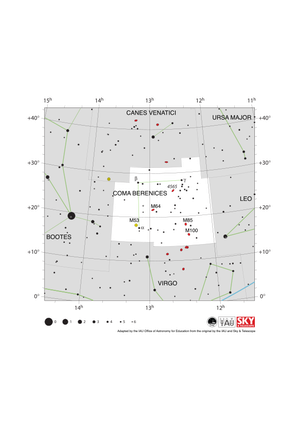
图注: The constellation Coma Berenices with its brighter stars and surrounding constellations. Coma Berenices is surrounded by (going clockwise from the top): Canes Venatici, Ursa Major, Leo, Virgo and Boötes. This constellation has relatively few bright stars.
Coma Berenices is a northern constellation close to the celestial equator. As such the whole constellation is visible at some point in the year everywhere on Earth except the most antarctic regions. The constellation is best viewed in the evening in the northern hemisphere late spring and southern hemisphere late autumn.
Coma Berenices is home to a large cluster of galaxies known as the Coma Supercluster. However none of the galaxies in this cluster are marked on this diagram as they are too faint to observe with most amateur telescopes. The elliptical galaxy M85 and the spiral galaxy M100 are members of the nearer Virgo cluster of galaxies. These are marked with red ellipses as are the even nearer M64 and NGC 4565, both of which are spiral galaxies. The globular cluster M53, marked here with a yellow circle with a plus sign superimposed on it, also lies in Coma Berenices.
The y-axis of this diagram is in degrees of declination with north as up and the x-axis is in hours of right ascension with east to the left. The sizes of the stars marked here relate to the star's apparent magnitude, a measure of its apparent brightness. The larger dots represent brighter stars. The Greek letters mark the brightest stars in the constellation. These are ranked by brightness with the brightest star being labeled alpha, the second brightest beta, etc., although this ordering is not always followed exactly. The dotted boundary lines mark the IAU's boundaries of the constellations and the solid green lines mark one of the common forms used to represent the figures of the constellations. The blue line at the bottom right of the diagram marks the ecliptic. Neither the constellation boundaries, nor the line marking the ecliptic, nor the lines joining the stars appear on the sky.
来源: Adapted by the IAU Office of Astronomy for Education from the original by the IAU and Sky & Telescope
来源链接
词汇表:
视星等 , 天球坐标 , 星系团 , 星座 , 赤纬 , 黄道 , 椭圆星系 , 狮子座 , 赤经(RA) , 漩涡星系 , 室女座
分类:
肉眼天文学
授权许可: 知识共享许可协议 署名 4.0 国际 (CC BY 4.0) 知识共享许可协议 署名 4.0 国际 (CC BY 4.0) 图标
文件
( 图像
87.27 kB)
PDF 文件
(PDF file
161.42 kB)

Canes Venatici Constellation Map
图像
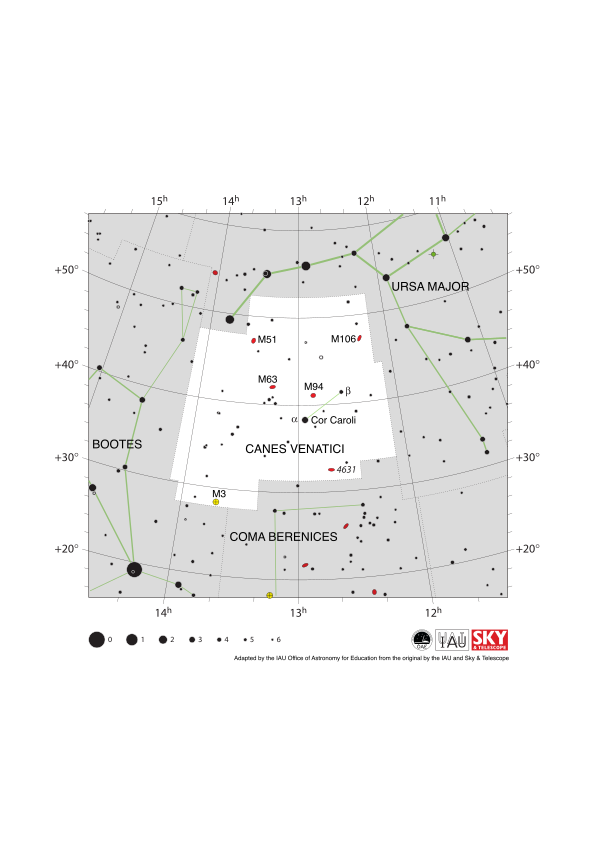
图注: The constellation Canes Venatici with its brighter stars and surrounding constellations. Canes Venatici is surrounded by (going clockwise from the top): Ursa Major, Coma Berenices and Boötes.
Canes Venatici is a northern constellation and thus the whole constellation is visible at some point in the year from the whole of the northern hemisphere. The whole of the constellation is also visible from equatorial regions of the southern hemisphere with parts of it visible from temperate southern regions. The constellation is best viewed in the northern hemisphere late spring and southern hemisphere late autumn.
The famous spiral galaxy commonly known as the Whirlpool Galaxy (M51) lies in Canes Venatici and is marked here with a red ellipse. Other notable spiral galaxies in the constellation include M63, M94, M106 and NGC 4631. All are marked here with red ellipses. The globular cluster M3 is marked here with a yellow circle with a plus symbol superimposed on it.
The y-axis of this diagram is in degrees of declination with north as up and the x-axis is in hours of right ascension with east to the left. The sizes of the stars marked here relate to the star's apparent magnitude, a measure of its apparent brightness. The larger dots represent brighter stars. The Greek letters mark the brightest stars in the constellation. These are ranked by brightness with the brightest star being labeled alpha, the second brightest beta, etc., although this ordering is not always followed exactly. The dotted boundary lines mark the IAU's boundaries of the constellations and the solid green lines mark one of the common forms used to represent the figures of the constellations. Neither the constellation boundaries, nor the lines joining the stars appear on the sky.
来源: Adapted by the IAU Office of Astronomy for Education from the original by the IAU and Sky & Telescope
来源链接
词汇表:
视星等 , 天球坐标 , 星座 , 赤纬 , 球状星团 , 赤经(RA) , 漩涡星系
分类:
肉眼天文学
授权许可: 知识共享许可协议 署名 4.0 国际 (CC BY 4.0) 知识共享许可协议 署名 4.0 国际 (CC BY 4.0) 图标
文件
( 图像
93.71 kB)
PDF 文件
(PDF file
165.31 kB)

Triangulum Constellation Map
图像
图注: The constellation Triangulum with its bright stars and surrounding constellations. Triangulum is surrounded by (going clockwise from the top): Andromeda, Pisces, Aries and Perseus.
Triangulum is a northern constellation and thus the whole constellation is visible at some point in the year throughout the northern hemisphere. The whole constellation is also visible from equatorial and most temperate regions of the southern hemisphere. Triangulum is best viewed in the evening in the northern hemisphere winter and southern hemisphere summer.
The Triangulum Galaxy M33 lies in the constellation. This spiral galaxy is the third largest member of the local group of galaxies after the Andromeda Galaxy and Milky Way. It is marked here with a red ellipse.
The y-axis of this diagram is in degrees of declination with north as up and the x-axis is in hours of right ascension with east to the left. The sizes of the stars marked here relate to the star's apparent magnitude, a measure of its apparent brightness. The larger dots represent brighter stars. The Greek letters mark the brightest stars in the constellation. These are ranked by brightness with the brightest star being labeled alpha, the second brightest beta, etc., although this ordering is not always followed exactly. The dotted boundary lines mark the IAU's boundaries of the constellations and the solid green lines mark one of the common forms used to represent the figures of the constellations. The blue line at the bottom left of the diagram marks the ecliptic. Neither the constellation boundaries, nor the lines joining the stars, nor the ecliptic, appear on the sky.
来源: Adapted by the IAU Office of Astronomy for Education from the original by the IAU and Sky & Telescope
来源链接
词汇表:
仙女座 , 仙女座星系 , 视星等 , 白羊座 , 天球坐标 , 星座 , 赤纬 , 银河系 , 双鱼座 , 赤经(RA) , 漩涡星系
分类:
肉眼天文学
授权许可: 知识共享许可协议 署名 4.0 国际 (CC BY 4.0) 知识共享许可协议 署名 4.0 国际 (CC BY 4.0) 图标
文件
( 图像
81.19 kB)
PDF 文件
(PDF file
150.67 kB)
Cepheus Constellation Map
图像
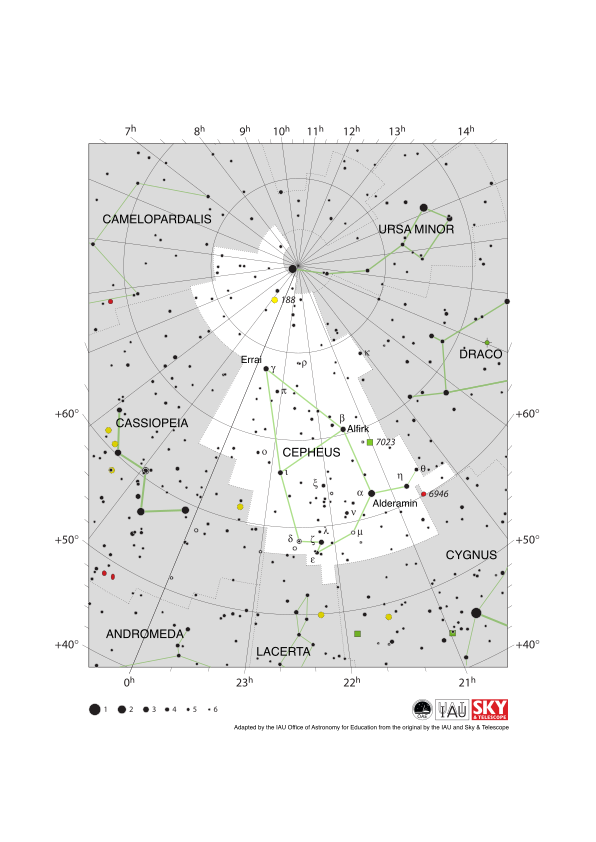
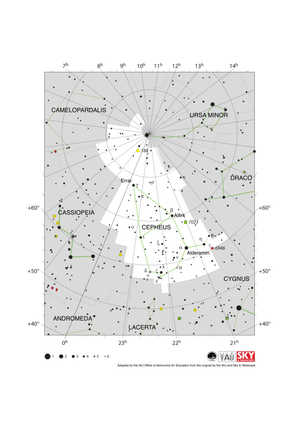
图注: The constellation Cepheus along with its bright stars and surrounding constellations. Cepheus is surrounded by (going clockwise from the top): Camelopardalis, Ursa Minor, Draco, Cygnus, Lacerta and Cassiopeia. Cepheus is a large constellation. Its most notable star is Delta Cephei, the prototype for the class of variable stars known as Cepheid variables. These are variable stars which can be used to estimate distances both within our galaxy and to nearby galaxies.
Cepheus lies close to the north celestial pole. As such it is circumpolar for arctic and temperate regions of the northern hemisphere. The whole of the constellation is also visible at some point in the year in equatorial regions of the northern hemisphere with parts of it visible in equatorial regions of the southern hemisphere. It is best viewed in the evening in the northern hemisphere late autumn and southern hemisphere late spring.
The open cluster NGC 188 lies in Cepheus and is marked here with a yellow circle. The nebula NGC 7023 also lies in the constellation and is marked with a green square. The red ellipse in the lower right marks the position of the spiral galaxy NGC 6946.
This diagram maps an area around the north celestial pole. Here lines of constant right ascension converge. The right ascension values of these lines are marked on the x-axis above and below the diagram. Some of the lines of constant declination are marked on the y-axis. The sizes of the stars marked here relate to the star's apparent magnitude, a measure of its apparent brightness. The larger dots represent brighter stars. The Greek letters mark the brightest stars in the constellation. Delta Cephei is marked with a circle around a dot as it is a variable star. Mu Cephei is also a variable star marked here as an open circle. These are ranked by brightness with the brightest star being labeled alpha, the second brightest beta, etc., although this ordering is not always followed exactly. The dotted boundary lines mark the IAU's boundaries of the constellations and the solid green lines mark one of the common forms used to represent the figures of the constellations. Neither the constellation boundaries, nor the lines joining the stars appear on the sky.
来源: Adapted by the IAU Office of Astronomy for Education from the original by the IAU and Sky & Telescope
来源链接
词汇表:
视星等 , 天球坐标 , 拱极星 , 星座 , 赤纬 , 星云 , 北天极(NCP) , 赤经(RA) , 漩涡星系 , 疏散星团
分类:
肉眼天文学
授权许可: 知识共享许可协议 署名 4.0 国际 (CC BY 4.0) 知识共享许可协议 署名 4.0 国际 (CC BY 4.0) 图标
文件
( 图像
162.00 kB)
PDF 文件
(PDF file
212.38 kB)