文档与资源 - 搜索结果
搜索结果
Cygnus Constellation Map
图像
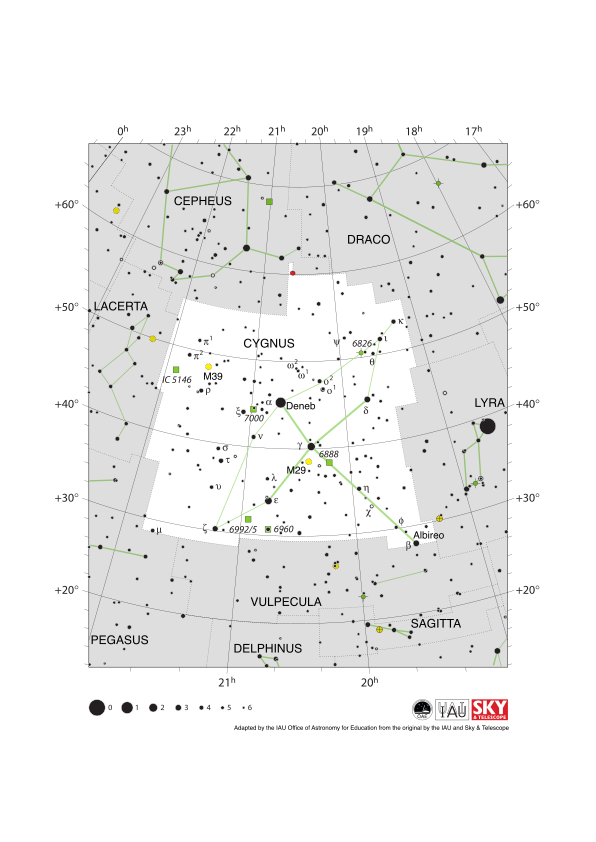
图注: The constellation Cygnus with its bright stars and surrounding constellations. Cygnus is surrounded by (going clockwise from the top): Cepheus, Draco, Lyra, Vulpecula, Pegasus and Lacerta. Cygnus is notable for its brightest star Deneb. This forms one vertex of the prominent Summer Triangle asterism that is visible in northern hemisphere summer evenings.
Cygnus is a northern constellation and thus the whole of the constellation is visible at some point in the year in the whole northern hemisphere. The whole constellation is also visible from equatorial regions of the southern hemisphere with parts of the constellation visible from temperate southern regions.
The plane of the Milky Way runs through Cygnus and thus the constellation is rich in nebulae and star clusters. These include the North America Nebula (NGC 7000) and the Crescent Nebula (NGC 6888). The Veil Nebula is a huge supernova remnant, parts of which are marked here as NGC 6960 and NGC 6992/5. All of the previously-mentioned nebulae are marked with green squares. The planetary nebula NGC 6826 is marked here with a green circle superimposed on a plus sign. The open star clusters M29 and M39 are marked here with yellow circles.
The y-axis of this diagram is in degrees of declination with north as up and the x-axis is in hours of right ascension with east to the left. The sizes of the stars marked here relate to the star's apparent magnitude, a measure of its apparent brightness. The larger dots represent brighter stars. The Greek letters mark the brightest stars in the constellation. These are ranked by brightness with the brightest star being labeled alpha, the second brightest beta, etc., although this ordering is not always followed exactly. The dotted boundary lines mark the IAU's boundaries of the constellations and the solid green lines mark one of the common forms used to represent the figures of the constellations. Neither the constellation boundaries, nor the lines joining the stars appear on the sky.
来源: Adapted by the IAU Office of Astronomy for Education from the original by the IAU and Sky & Telescope
来源链接
词汇表:
视星等 , 天球坐标 , 星座 , 赤纬 , 银河系 , 星云 , 行星状星云 , 赤经(RA) , 星宿(星群) , 疏散星团 , 超新星遗迹
分类:
肉眼天文学
授权许可: 知识共享许可协议 署名 4.0 国际 (CC BY 4.0) 知识共享许可协议 署名 4.0 国际 (CC BY 4.0) 图标
文件
( 图像
150.09 kB)
PDF 文件
(PDF file
216.56 kB)
Total Solar Eclipse
图像
为 OAE 制作
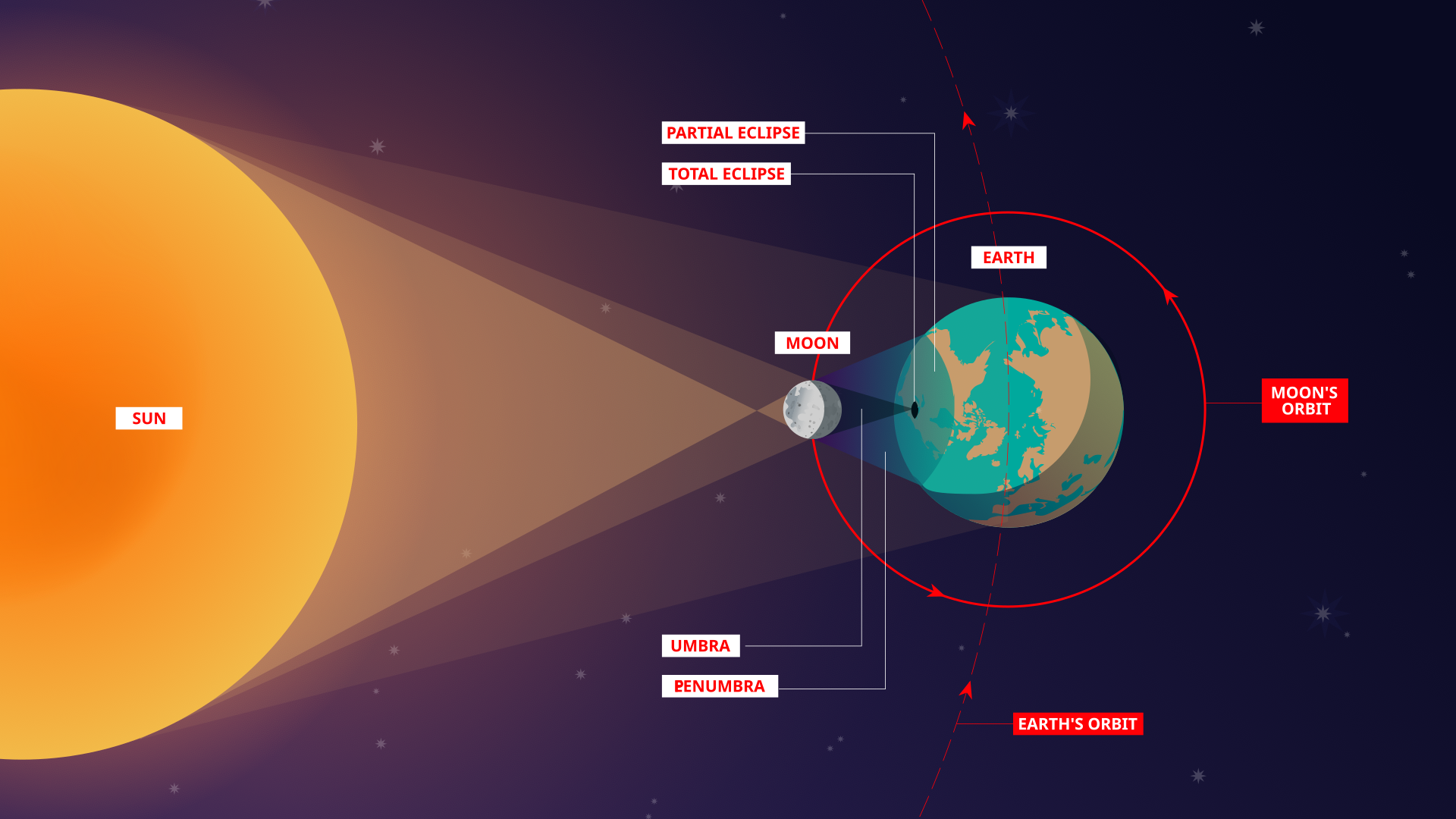
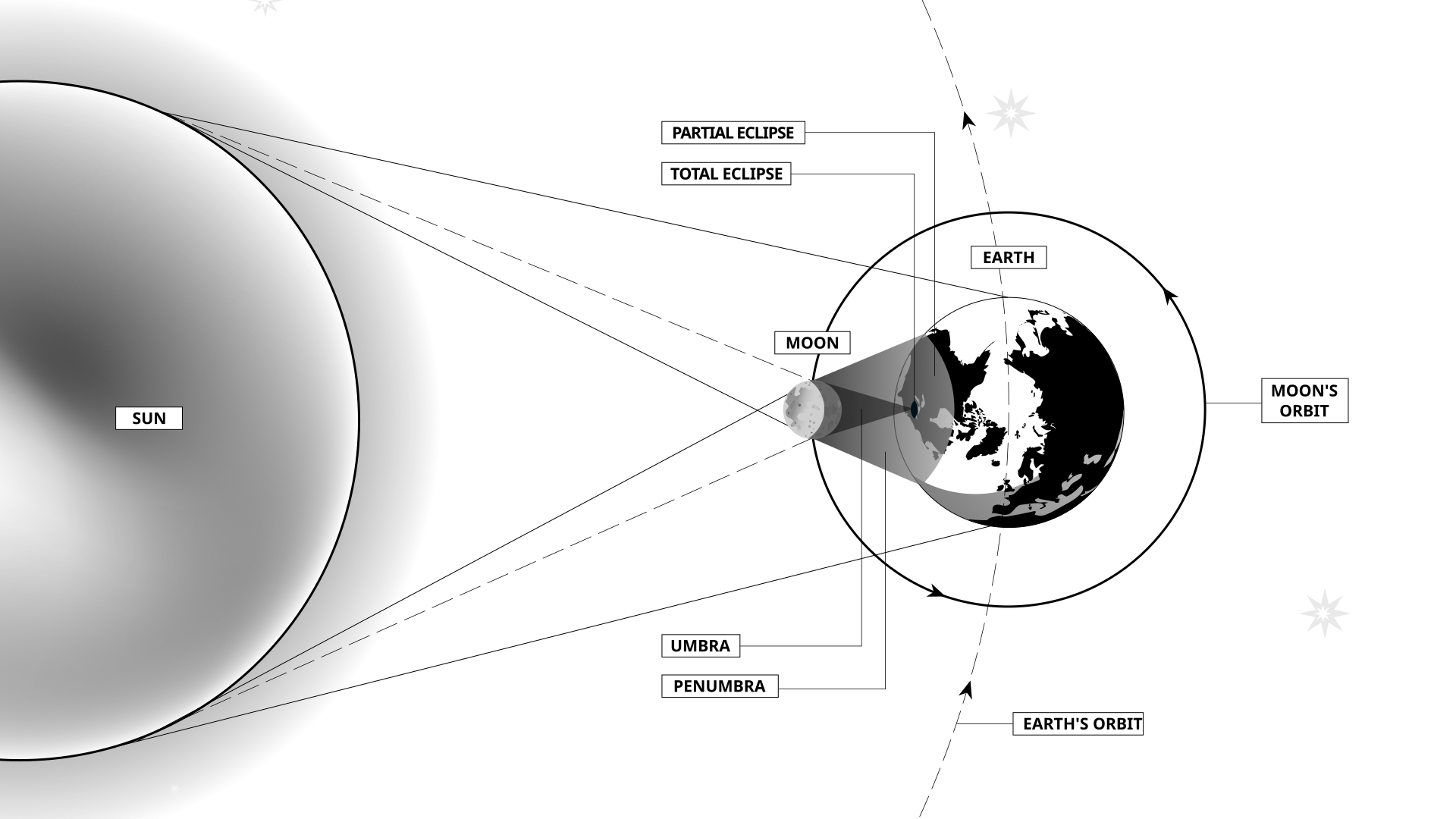
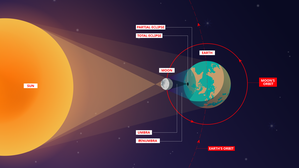
图注: This not to scale diagram shows what happens during a total solar eclipse. The Moon orbits the Earth, but its orbit is slightly tilted with respect to the Earth’s orbit around the Sun. During the new moon lunar phase, the Moon lies between the Earth and the Sun, but due to the Moon’s tilted orbit around the Earth, the Moon normally lies above or below the Sun at this point. However twice a year the Moon’s orbit lines up in such a way that the Moon can lie in a direct line between the Earth and Sun. During each of these periods (each of which last roughly a month) solar (and lunar) eclipses can occur. The Moon is about 400 times smaller than the Sun, but is 400 times closer to the Earth than the Sun. Hence the Sun and Moon have approximately the same angular size when viewed from the Earth. This means that it is possible for the Moon to completely cover the Sun when viewed from Earth. This is known as a total solar eclipse.
Here we see a schematic of such and eclipse. The Moon casts a shadow on the Earth known as the umbra. This is a roughly circular shadow a few hundred kilometres across although its shape can be severely distorted when the eclipse is at the edge of the illuminated part of the Earth. Any region within the umbra will see the Moon completely cover the Sun and thus will experience a total solar eclipse. Outside of the umbra there are regions where the Moon will cover part of the Sun. This partial shadow is known as the penumbra. Regions in the penumbra will experience a partial solar eclipse.
An eclipse is a dynamic event with the Moon moving in its orbit and the Earth rotating. Hence the umbra and penumbra move across the Earth’s surface together. The path the umbra takes across the Earth is known as the path of totality. Let’s consider one particular region that lies in the path of totality: except in rare cases where an eclipse begins at sunrise, a region that experiences totality will first see the Moon cover part of the Sun and gradually move across Sun until it is totally covered. From outside the Earth this would appear as the penumbra moving over this particular region followed by the umbra moving over this region. Once the Moon moves so that it no longer completely covers the Sun, totality ends and the umbra moves away from this particular region. The Moon will continue to uncover the Sun until (unless the Sun sets before the end of the eclipse) the Sun is completely uncovered. From outside the Earth this would appear as the umbra moving away from our particular region and the edge of the penumbra approaching and eventually passing over the region.
Outside of the path or totality there is a much broader region that will lie in the penumbra but will be missed by the umbra. Such regions will not experience a total solar eclipse during this event, only a partial solar eclipse.
来源: Aneta Margraf/IAU OAE
词汇表:
月相 , 月球 , 新月 , 日偏食 , 半影 , 日食 , 太阳 , 日全食 , 本影
分类:
肉眼天文学
授权许可: 知识共享许可协议 署名 4.0 国际 (CC BY 4.0) 知识共享许可协议 署名 4.0 国际 (CC BY 4.0) 图标
文件
( 图像
2.06 MB)
PDF 文件
(PDF file
1.56 MB)
Also available in black and white
文件
( 图像
468.46 kB)
PDF 文件
(
1.96 MB)
Pictor Constellation Map
图像
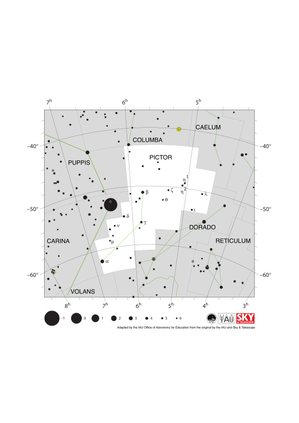
图注: The constellation Pictor with its bright stars and surrounding constellations. Pictor is surrounded by (going clockwise from the top): Columba, Caelum, Dorado, Volans, Carina and Puppis. Pictor is notable for its second brightest star, Beta Pictoris. This young star hosts a large disk of dusty material left over from the planet formation process along with two planets, one of which Beta Pictoris b was one of the first planets to be directly imaged by astronomers.
Pictor is a southern constellation and thus the whole constellation is visible at some point in the year throughout the southern hemisphere. The whole constellation is also visible from some equatorial regions of the northern hemisphere with parts of the constellation visible to the remaining northern equatorial regions and some northern hemisphere temperate zones. Pictor is best viewed in the northern hemisphere winter and southern hemisphere summer.
The y-axis of this diagram is in degrees of declination with north as up and the x-axis is in hours of right ascension with east to the left. The sizes of the stars marked here relate to the star's apparent magnitude, a measure of its apparent brightness. The larger dots represent brighter stars. The Greek letters mark the brightest stars in the constellation. These are ranked by brightness with the brightest star being labeled alpha, the second brightest beta, etc., although this ordering is not always followed exactly. The dotted boundary lines mark the IAU's boundaries of the constellations and the solid green lines mark one of the common forms used to represent the figures of the constellations. Neither the constellation boundaries, nor the lines joining the stars appear on the sky.
来源: Adapted by the IAU Office of Astronomy for Education from the original by the IAU and Sky & Telescope
来源链接
词汇表:
视星等 , 天球坐标 , 星座 , 赤纬 , 系外行星 , 行星形成 , 赤经(RA)
分类:
肉眼天文学
授权许可: 知识共享许可协议 署名 4.0 国际 (CC BY 4.0) 知识共享许可协议 署名 4.0 国际 (CC BY 4.0) 图标
文件
( 图像
95.44 kB)
PDF 文件
(PDF file
156.25 kB)

Horizontal Coordinate System
图像
为 OAE 制作
图注: This image shows the horizontal coordinate system of an observer on Earth. On the right we see the coordinate system in the local context of the observer. The observer appears here as a point surrounded by the celestial sphere. The ground appears as a plane, while the Earth is round, we can approximate the ground in the area around the observer as a plane. The line where this plane intersects with the celestial sphere is the horizon. The point directly above the observer is the zenith, the point directly below the observer is the nadir which is hidden by the ground.
Two coordinates define this coordinate system, altitude and azimuth, hence the reason this sometimes called an alt-az coordinate system. The altitude is zero at the horizon, maximum (90°) at the zenith and minimum (-90°) at the nadir. Azimuth is the angle around the horizon. Most commonly this is defined to be zero in the direction of north. Any point on the celestial sphere can be defined by these two coordinates. However what objects appear on these position will depend on the time and the location of the observer.
On the left-hand part of the diagram, we can see that when we put the observer and their local horizontal coordinate system in a global context, that the parts of the sky the observer can see depend on their position on the Earth and on the rotation of the Earth. The zenith points perpendicular to the Earth's surface so the position on the sky the zenith and nadir correspond to is dependent on the observer's latitude. The horizon also depends on the observer's position on the Earth.
来源: Maria Cristina Fortuna/IAU OAE
词汇表:
高度角 , 方位角 , 地平 , 天顶 , 天底
分类:
肉眼天文学
, 观测天文学
授权许可: 知识共享许可协议 署名 4.0 国际 (CC BY 4.0) 知识共享许可协议 署名 4.0 国际 (CC BY 4.0) 图标
文件
( 图像
1.76 MB)
PDF 文件
(PDF file
165.78 kB)
Also available in black and white
文件
( 图像
483.06 kB)
PDF 文件
(
136.70 kB)
Draco Constellation Map
图像
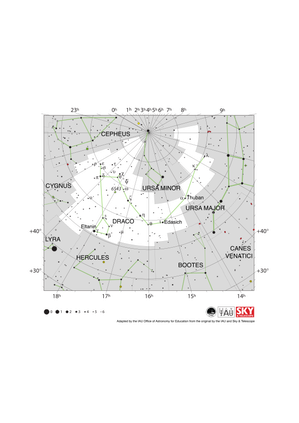
图注: The constellation Draco with its bright stars and surrounding constellations. Draco is surrounded by (going clockwise from the top): Cepheus, Ursa Minor, Boötes, Hercules, Lyra and Cygnus.
Draco is a sprawling northern constellation, parts of which lie close to the celestial north pole. As such the whole constellation is visible at some point in the year from the whole northern hemisphere and a thin sliver of the southern hemisphere near the equator. Parts of the constellation are visible from all other southern equatorial and some southern temperate regions. Draco is best viewed in the evenings in the northern hemisphere summer and southern hemisphere winter.
The planetary nebula NGC 6543 (also known as the Cat’s Eye Nebula) lies in Draco. It is marked here with a green circle superimposed on a plus sign.
This diagram maps an area around the north celestial pole. Here lines of constant right ascension converge. The right ascension values of these lines are marked on the x-axis above and below the diagram. Some of the lines of constant declination are marked on the y-axis. The sizes of the stars marked here relate to the star's apparent magnitude, a measure of its apparent brightness. The larger dots represent brighter stars. The Greek letters mark the brightest stars in the constellation. These are ranked by brightness with the brightest star being labeled alpha, the second brightest beta, etc., although this ordering is not always followed exactly. The dotted boundary lines mark the IAU's boundaries of the constellations and the solid green lines mark one of the common forms used to represent the figures of the constellations. Neither the constellation boundaries, nor the lines joining the stars appear on the sky.
来源: Adapted by the IAU Office of Astronomy for Education from the original by the IAU and Sky & Telescope
来源链接
词汇表:
视星等 , 天球坐标 , 拱极星 , 星座 , 赤纬 , 北天极(NCP) , 行星状星云 , 赤经(RA)
分类:
肉眼天文学
授权许可: 知识共享许可协议 署名 4.0 国际 (CC BY 4.0) 知识共享许可协议 署名 4.0 国际 (CC BY 4.0) 图标
文件
( 图像
138.13 kB)
PDF 文件
(PDF file
223.43 kB)