文档与资源 - 搜索结果
搜索结果
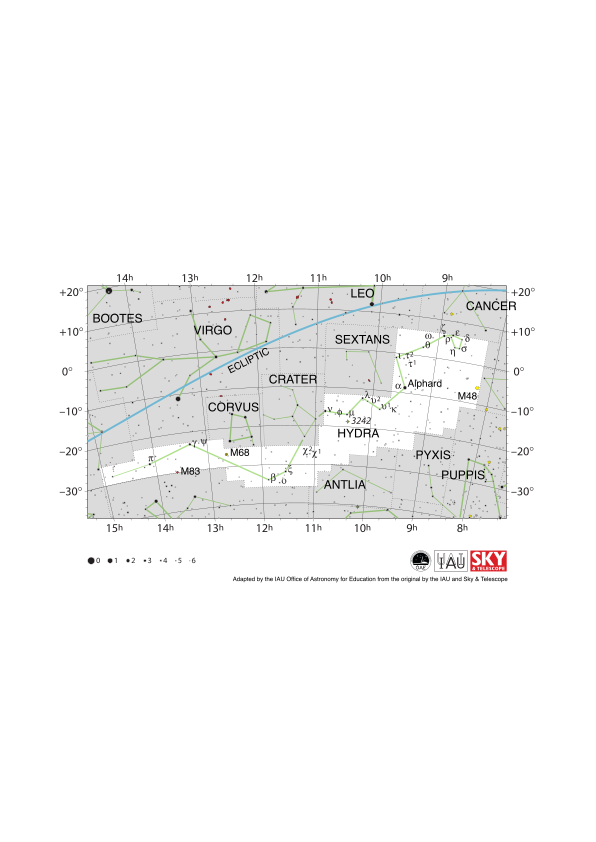
Hydra Constellation Map
图像
图注: The constellation Hydra with its bright stars and surrounding constellations. Hydra is surrounded by (going clockwise from the top): Leo, Cancer, Canis Minor, Monoceros, Puppis, Pyxis, Antlia, Centaurus, Lupus, Libra, Virgo, Corvus, Crater and Sextans.
Hydra is a large constellation that covers over a quarter of the celestial sphere in right ascension. It also spans the celestial equator and thus part of the constellation is visible from everywhere on the Earth at some point in the year. All parts of the constellation are visible at some point for all but the most antarctic parts of the southern hemisphere and to equatorial and most temperate regions of the northern hemisphere. However the wide span of the constellation means that all of it may not be visible at the same time in many of these regions. Hydra is best viewed in the northern hemisphere spring and southern hemisphere autumn.
The famous spiral galaxy M83, also known as the Pinwheel Galaxy, lies in Hydra. It is marked here with a red ellipse. The planetary nebula NGC 3242 can also be found in Hydra. It is marked here with a green circle with a plus sign superimposed on it. The open cluster M48 is marked here with a yellow circle while the globular cluster M68 is marked with a yellow circle with a plus sign superimposed on it.
The y-axis of this diagram is in degrees of declination with north as up and the x-axis is in hours of right ascension with east to the left. The sizes of the stars marked here relate to the star's apparent magnitude, a measure of its apparent brightness. The larger dots represent brighter stars. The Greek letters mark the brightest stars in the constellation. These are ranked by brightness with the brightest star being labeled alpha, the second brightest beta, etc., although this ordering is not always followed exactly. The dotted boundary lines mark the IAU's boundaries of the constellations and the solid green lines mark one of the common forms used to represent the figures of the constellations. The blue line on the diagram marks the ecliptic. Neither the constellation boundaries, nor the line marking the ecliptic, nor the lines joining the stars appear on the sky.
来源: Adapted by the IAU Office of Astronomy for Education from the original by the IAU and Sky & Telescope
来源链接
词汇表:
视星等 , 天球坐标 , 星座 , 赤纬 , 黄道 , 球状星团 , 天秤座 , 行星状星云 , 赤经(RA) , 漩涡星系 , 巨蟹座 , 疏散星团 , 室女座
分类:
肉眼天文学
授权许可: 知识共享许可协议 署名 4.0 国际 (CC BY 4.0) 知识共享许可协议 署名 4.0 国际 (CC BY 4.0) 图标
文件
( 图像
114.60 kB)
PDF 文件
(PDF file
253.49 kB)

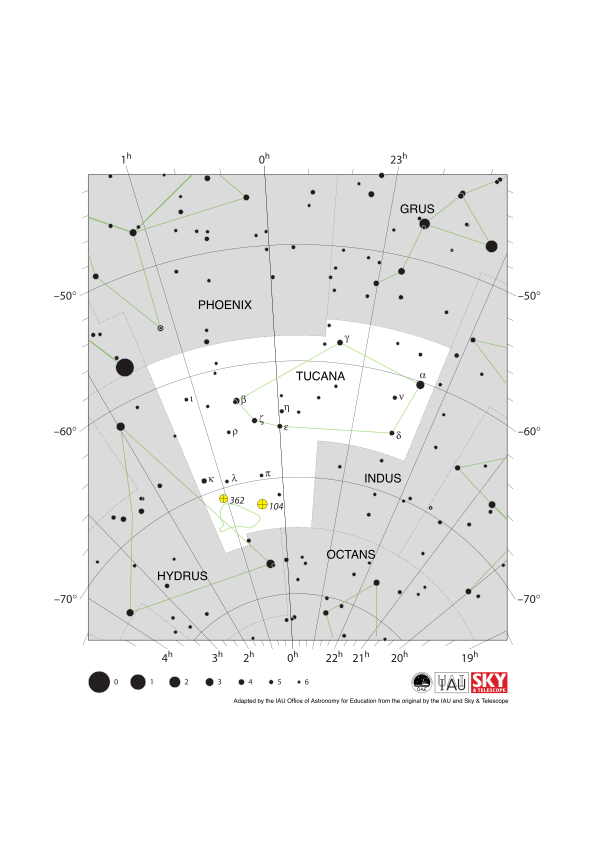
Tucana Constellation Map
图像
图注: The constellation Tucana with its bright stars and surrounding constellations. Tucana is surrounded by (going clockwise from the top): Grus, Indus, Octans, Hydrus, Eridanus and Phoenix.
Tucana is a southern constellation and thus the whole constellation is visible at some point in the year throughout the southern hemisphere. The whole constellation is visible to some equatorial regions of the northern hemisphere with parts of the constellation visible to the remaining northern equatorial regions. Tucana is best viewed in the northern hemisphere autumn and southern hemisphere spring.
The Small Magellanic Cloud (SMC), a satellite galaxy of the Milky Way lies in Tucana with a small part spilling over into the neighbouring constellation of Hydrus. The SMC is marked here with a green loop in the south east of Tucana. The globular clusters NGC 104, also known as 47 Tucanae or 47 Tuc, and NGC 362 lie in Tucana and are marked here with yellow circles with plus signs superimposed on them. While these two clusters appear close to the SMC on the sky, they are both significantly closer than that satellite galaxy.
The y-axis of this diagram is in degrees of declination with north as up and the x-axis is in hours of right ascension with east to the left. The sizes of the stars marked here relate to the star's apparent magnitude, a measure of its apparent brightness. The larger dots represent brighter stars. The Greek letters mark the brightest stars in the constellation. These are ranked by brightness with the brightest star being labeled alpha, the second brightest beta, etc., although this ordering is not always followed exactly. The dotted boundary lines mark the IAU's boundaries of the constellations and the solid green lines mark one of the common forms used to represent the figures of the constellations. Neither the constellation boundaries, nor the lines joining the stars appear on the sky.
来源: Adapted by the IAU Office of Astronomy for Education from the original by the IAU and Sky & Telescope
来源链接
词汇表:
视星等 , 天球坐标 , 星座 , 赤纬 , 球状星团 , 赤经(RA) , 小麦哲伦云(SMC)
分类:
肉眼天文学
授权许可: 知识共享许可协议 署名 4.0 国际 (CC BY 4.0) 知识共享许可协议 署名 4.0 国际 (CC BY 4.0) 图标
文件
( 图像
113.87 kB)
PDF 文件
(PDF file
161.52 kB)
Coma Berenices Constellation Map
图像
图注: The constellation Coma Berenices with its brighter stars and surrounding constellations. Coma Berenices is surrounded by (going clockwise from the top): Canes Venatici, Ursa Major, Leo, Virgo and Boötes. This constellation has relatively few bright stars.
Coma Berenices is a northern constellation close to the celestial equator. As such the whole constellation is visible at some point in the year everywhere on Earth except the most antarctic regions. The constellation is best viewed in the evening in the northern hemisphere late spring and southern hemisphere late autumn.
Coma Berenices is home to a large cluster of galaxies known as the Coma Supercluster. However none of the galaxies in this cluster are marked on this diagram as they are too faint to observe with most amateur telescopes. The elliptical galaxy M85 and the spiral galaxy M100 are members of the nearer Virgo cluster of galaxies. These are marked with red ellipses as are the even nearer M64 and NGC 4565, both of which are spiral galaxies. The globular cluster M53, marked here with a yellow circle with a plus sign superimposed on it, also lies in Coma Berenices.
The y-axis of this diagram is in degrees of declination with north as up and the x-axis is in hours of right ascension with east to the left. The sizes of the stars marked here relate to the star's apparent magnitude, a measure of its apparent brightness. The larger dots represent brighter stars. The Greek letters mark the brightest stars in the constellation. These are ranked by brightness with the brightest star being labeled alpha, the second brightest beta, etc., although this ordering is not always followed exactly. The dotted boundary lines mark the IAU's boundaries of the constellations and the solid green lines mark one of the common forms used to represent the figures of the constellations. The blue line at the bottom right of the diagram marks the ecliptic. Neither the constellation boundaries, nor the line marking the ecliptic, nor the lines joining the stars appear on the sky.
来源: Adapted by the IAU Office of Astronomy for Education from the original by the IAU and Sky & Telescope
来源链接
词汇表:
视星等 , 天球坐标 , 星系团 , 星座 , 赤纬 , 黄道 , 椭圆星系 , 狮子座 , 赤经(RA) , 漩涡星系 , 室女座
分类:
肉眼天文学
授权许可: 知识共享许可协议 署名 4.0 国际 (CC BY 4.0) 知识共享许可协议 署名 4.0 国际 (CC BY 4.0) 图标
文件
( 图像
87.27 kB)
PDF 文件
(PDF file
161.42 kB)

Astronomical Unit
图像
为 OAE 制作
图注: An astronomical unit (AU) is a convenient unit of distance equal to exactly 149,597,870.7 kilometers (km). This is approximately the average distance between the Earth and the Sun, which was a previous definition of the AU. The AU is often used to measure distances in the Solar System and in other planetary or stellar systems.
来源: Danielle Futselaar/IAU OAE
词汇表:
天文单位
分类:
太阳系
授权许可: 知识共享许可协议 署名 4.0 国际 (CC BY 4.0) 知识共享许可协议 署名 4.0 国际 (CC BY 4.0) 图标
文件
( 图像
264.08 kB)
PDF 文件
(PDF file
216.10 kB)
Also available in black and white
文件
( 图像
171.33 kB)
PDF 文件
(
55.68 kB)

Mensa Constellation Map
图像
图注: The constellation Mensa with its brighter stars and surrounding constellations. Mensa is surrounded by (going clockwise from the top): Dorado, Hydrus, Octans, Chamaeleon and Volans. Mensa is a faint constellation with relatively few bright stars.
Mensa lies close to the south celestial pole and thus the whole constellation is visible at some point in the year throughout the southern hemisphere. The whole constellation is visible to a thin strip of the northern hemisphere around the equator with parts of the constellation visible to some other northern equatorial regions. Mensa is circumpolar in temperate, antarctic and some equatorial regions of the southern hemisphere. Mensa is best viewed in the evenings in the northern hemisphere winter and southern hemisphere summer.
The Large Magellanic Cloud (LMC), a satellite galaxy of the Milky Way, lies in Mensa and the neighboring constellation Dorado. The outline of the Large Magellanic Cloud is marked here as a roughly circular loop in green.
This diagram maps an area around the south celestial pole. Here lines of constant right ascension converge. The right ascension values of these lines are marked on the x-axis above and below the diagram. The solid circle around the pole marks a line of -80° declination with the larger, incomplete circle to the right marking -70° declination. The sizes of the stars marked here relate to the star's apparent magnitude, a measure of its apparent brightness. The larger dots represent brighter stars. The Greek letters mark the brightest stars in the constellation. These are ranked by brightness with the brightest star being labeled alpha, the second brightest beta, etc., although this ordering is not always followed exactly. The dotted boundary lines mark the IAU's boundaries of the constellations and the solid green lines mark one of the common forms used to represent the figures of the constellations. Neither the constellation boundaries, nor the lines joining the stars appear on the sky.
来源: Adapted by the IAU Office of Astronomy for Education from the original by the IAU and Sky & Telescope
来源链接
词汇表:
视星等 , 天球坐标 , 星座 , 赤纬 , 赤经(RA)
分类:
肉眼天文学
授权许可: 知识共享许可协议 署名 4.0 国际 (CC BY 4.0) 知识共享许可协议 署名 4.0 国际 (CC BY 4.0) 图标
文件
( 图像
135.16 kB)
PDF 文件
(PDF file
172.00 kB)