文档与资源 - 搜索结果
搜索结果

Opposition and Conjunction
图像
为 OAE 制作
图注: This diagram shows the Earth's orbit around the Sun and the orbits of two other planets, one orbiting the Sun outside the Earth's orbit and one orbiting the Sun inside the Earth's orbit. At different times in the orbits of both of these planets, their positions appear to line up with the Earth and the Sun. At these points each planet would appear close to the Sun when viewed from Earth. When this happens each planet is said to be in conjunction with the Sun.
For the planet that orbits the Sun within the Earth's orbit it can be in conjunction with the Sun twice in its orbit, once when it is between the Sun and the Earth and once when it is on the other side of the Sun from the Earth. When the planet is in conjunction between the the Sun and Earth it is said to be in inferior conjunction and when it is in conjunction on the far side of the Sun from the Earth it is said to be in superior conjunction.
For the planet orbiting the Sun outside the Earth's orbit, it can sometimes be on the other side of the sky. At this point the Earth lies between the planet and the Sun. The planet in this case is said to be in opposition.
Opposition and conjunction are not just limited to planets and other types of solar system objects such as dwarf planets, comets and asteroids can also be in opposition and conjunction. However only those objects that have an orbit that takes them outside the Earth's orbit can be in opposition.
Conjunction is also used to refer to alignments in the sky between planets in the Solar System. For example when Jupiter and Venus appear very close on the sky when viewed from Earth they are said to be in conjunction with each other.
来源: Aneta Margraf/IAU OAE
词汇表:
合 , 冲
分类:
肉眼天文学
, 观测天文学
, 太阳系
授权许可: 知识共享许可协议 署名 4.0 国际 (CC BY 4.0) 知识共享许可协议 署名 4.0 国际 (CC BY 4.0) 图标
文件
( 图像
251.82 kB)
PDF 文件
(PDF file
148.69 kB)
Also available in black and white
文件
( 图像
109.06 kB)
PDF 文件
(
173.49 kB)

Perseus Constellation Map
图像
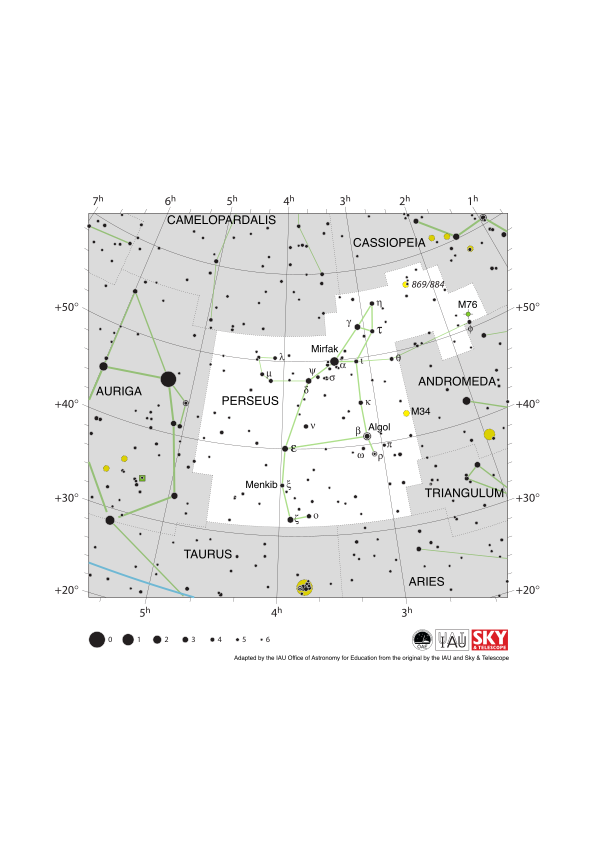
图注: The constellation Perseus with its bright stars and surrounding constellations. Perseus is surrounded by (going clockwise from the top): Camelopardalis, Cassiopeia, Andromeda, Triangulum, Aries, Taurus and Auriga. Perseus is home to the notable variable star Algol.
Perseus is a northern constellation and thus the whole constellation is visible at some point in the year throughout the northern hemisphere. The whole constellation is also visible to equatorial regions of the southern hemisphere with parts of the constellation visible to southern temperate regions. Perseus is best viewed in the evenings in the northern hemisphere winter and southern hemisphere summer.
The open clusters NGC 869 and NGC 884 (commonly known as the Double Cluster) lie in Perseus as does the open cluster M34. These are all marked with yellow circles. The brightest star in Perseus, Mirfak (alpha Persei), along with some of the surrounding stars are members of the Alpha Persei open cluster. The planetary nebula M76 also lies in Perseus, it is marked here with a green circle superimposed on a plus sign.
The y-axis of this diagram is in degrees of declination with north as up and the x-axis is in hours of right ascension with east to the left. The sizes of the stars marked here relate to the star's apparent magnitude, a measure of its apparent brightness. The larger dots represent brighter stars. The Greek letters mark the brightest stars in the constellation. These are ranked by brightness with the brightest star being labeled alpha, the second brightest beta, etc., although this ordering is not always followed exactly. The dot marking Algol is surrounded by a circle, showing it is a variable star. The dotted boundary lines mark the IAU's boundaries of the constellations and the solid green lines mark one of the common forms used to represent the figures of the constellations. The blue line at the bottom left of the diagram marks the ecliptic. Neither the constellation boundaries, nor the lines joining the stars, nor the ecliptic, appear on the sky.
来源: Adapted by the IAU Office of Astronomy for Education from the original by the IAU and Sky & Telescope
来源链接
词汇表:
视星等 , 天球坐标 , 星座 , 赤纬 , 黄道 , 行星状星云 , 赤经(RA) , 疏散星团 , 变星
分类:
肉眼天文学
授权许可: 知识共享许可协议 署名 4.0 国际 (CC BY 4.0) 知识共享许可协议 署名 4.0 国际 (CC BY 4.0) 图标
文件
( 图像
119.08 kB)
PDF 文件
(PDF file
189.39 kB)
Centaurus Constellation Map
图像
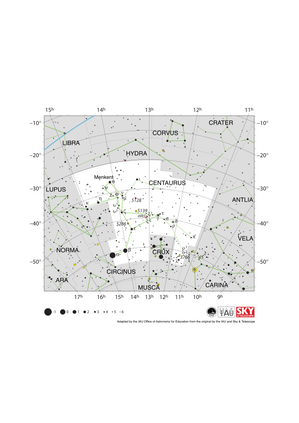
图注: The constellation Centaurus with its bright stars and surrounding constellations. Centaurus is surrounded by (going clockwise from the top): Hydra, Antlia, Vela, Carina, Musca, Crux, Circinus, Lupus and Libra. Centaurus is a large constellation most notable for its brightest star Alpha Centauri. Alpha Centauri is a triple star system and is the nearest star system to the Solar System. When viewed with the naked eye, the two brightest components of Alpha Centauri appear as one star. The combined light from these two stars makes Alpha Centauri appear as the third brightest star in the night sky. The third component of the Alpha Centauri system Proxima Centauri, the nearest star to the Sun, is too faint to be viewed with the naked eye.
Centaurus is a southern constellation and thus the whole constellation is visible from the southern hemisphere at some point in the year. The whole constellation is also visible from equatorial regions of the northern hemisphere with parts of the constellation visible from temperate northern regions. The constellation is best viewed in the evening in the late northern hemisphere spring and late southern hemisphere autumn.
The globular cluster Omega Centauri, also known as NGC 5319, lies in Centaurus. Bright enough to be seen with the naked eye, this cluster was initially given a designation as a star in the constellation before its true nature was realised. It is marked here with a yellow circle with a plus sign superimposed on it. As is the globular cluster NGC 5286. The open cluster NGC 3766 is marked here with a yellow circle. NGC 5128, also known as Centaurus A, is the closest active galaxy to Earth. The supermassive black hole at the heart of this galaxy has launched two huge jets of matter which emit in many different wavelengths including x-ray and radio emission. NGC 5128 is marked with a red ellipse here, as is the edge-on spiral galaxy NGC 4945.
The y-axis of this diagram is in degrees of declination with north as up and the x-axis is in hours of right ascension with east to the left. The sizes of the stars marked here relate to the star's apparent magnitude, a measure of its apparent brightness. The larger dots represent brighter stars. The Greek letters mark the brightest stars in the constellation. These are ranked by brightness with the brightest star being labeled alpha, the second brightest beta, etc., although this ordering is not always followed exactly. The dotted boundary lines mark the IAU's boundaries of the constellations and the solid green lines mark one of the common forms used to represent the figures of the constellations. The blue line in the top left is the ecliptic. Neither the constellation boundaries, nor the line marking the ecliptic, nor the lines joining the stars appear on the sky.
来源: Adapted by the IAU Office of Astronomy for Education from the original by the IAU and Sky & Telescope
来源链接
词汇表:
视星等 , 天球坐标 , 星座 , 赤纬 , 球状星团 , 赤经(RA) , 疏散星团 , 半人马座 α
分类:
肉眼天文学
授权许可: 知识共享许可协议 署名 4.0 国际 (CC BY 4.0) 知识共享许可协议 署名 4.0 国际 (CC BY 4.0) 图标
文件
( 图像
152.88 kB)
PDF 文件
(PDF file
255.96 kB)

Scutum Constellation Map
图像
图注: The constellation Scutum with its brighter stars and surrounding constellations. Scutum is surrounded by (going clockwise from the top): Serpens Cauda, Sagittarius and Aquila.
Scutum is a southern constellation and thus the whole constellation is visible at some point in the year throughout the southern hemisphere. The whole constellation is also visible from equatorial and temperate regions of the northern hemisphere with parts of the constellation visible from all but the most arctic regions.
Two open clusters lie in Scutum: M11, commonly known as the Wild Duck Cluster; and M26. Both of these are marked here with yellow circles.
The y-axis of this diagram is in degrees of declination with north as up and the x-axis is in hours of right ascension with east to the left. The sizes of the stars marked here relate to the star's apparent magnitude, a measure of its apparent brightness. The larger dots represent brighter stars. The Greek letters mark the brightest stars in the constellation. These are ranked by brightness with the brightest star being labeled alpha, the second brightest beta, etc., although this ordering is not always followed exactly. The dotted boundary lines mark the IAU's boundaries of the constellations and the solid green lines mark one of the common forms used to represent the figures of the constellations. The blue line at the bottom of the diagram marks the ecliptic. Neither the constellation boundaries, nor the lines joining the stars, nor the ecliptic, appear on the sky.
来源: Adapted by the IAU Office of Astronomy for Education from the original by the IAU and Sky & Telescope
来源链接
词汇表:
视星等 , 天球坐标 , 星座 , 赤纬 , 赤经(RA) , 疏散星团
分类:
肉眼天文学
授权许可: 知识共享许可协议 署名 4.0 国际 (CC BY 4.0) 知识共享许可协议 署名 4.0 国际 (CC BY 4.0) 图标
文件
( 图像
96.44 kB)
PDF 文件
(PDF file
162.71 kB)

Monoceros Constellation Map
图像
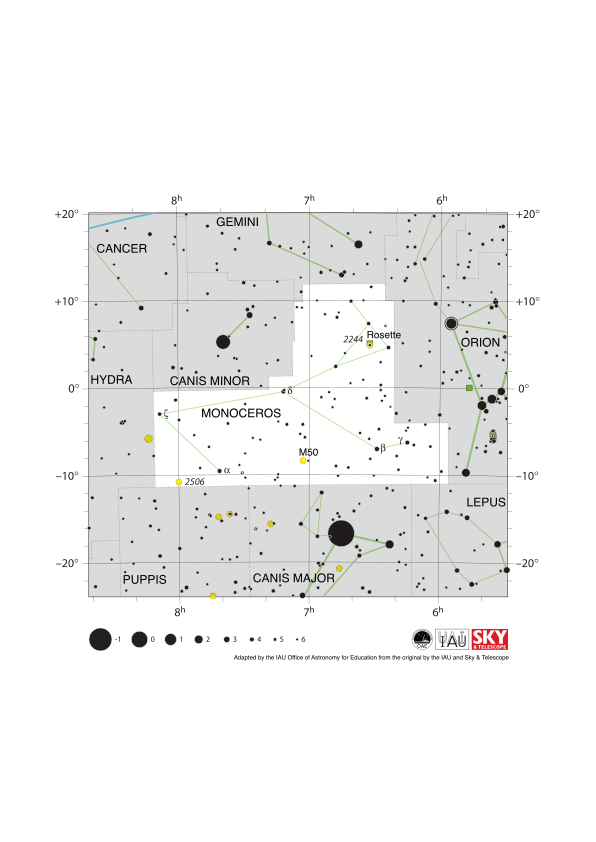
图注: The constellation Monoceros with its bright stars and surrounding constellations. Monoceros is surrounded by (going clockwise from the top): Gemini, Orion, Lepus, Canis Major, Puppis, Hydra and Canis Minor.
Monoceros spans the celestial equator and thus parts of the constellation are visible everywhere on the Earth at some point in the year. The whole constellation is visible to all but the most arctic and antarctic regions. Monoceros is best viewed in the evening in the northern hemisphere winter and southern hemisphere summer.
The star-forming Rosette Nebula is marked here with a green square. The open cluster of young stars NGC 2244, which is associated with the Rosette Nebula, is marked with a yellow circle just below it. The other open clusters M50 and NGC 2506 are also marked here with yellow circles.
The y-axis of this diagram is in degrees of declination with north as up and the x-axis is in hours of right ascension with east to the left. The sizes of the stars marked here relate to the star's apparent magnitude, a measure of its apparent brightness. The larger dots represent brighter stars. The Greek letters mark the brightest stars in the constellation. These are ranked by brightness with the brightest star being labeled alpha, the second brightest beta, etc., although this ordering is not always followed exactly. The dotted boundary lines mark the IAU's boundaries of the constellations and the solid green lines mark one of the common forms used to represent the figures of the constellations. The blue line at the top left of the diagram marks the ecliptic. Neither the constellation boundaries, nor the line marking the ecliptic, nor the lines joining the stars appear on the sky.
来源: Adapted by the IAU Office of Astronomy for Education from the original by the IAU and Sky & Telescope
来源链接
词汇表:
视星等 , 天球坐标 , 星座 , 赤纬 , 赤经(RA)
分类:
肉眼天文学
授权许可: 知识共享许可协议 署名 4.0 国际 (CC BY 4.0) 知识共享许可协议 署名 4.0 国际 (CC BY 4.0) 图标
文件
( 图像
103.71 kB)
PDF 文件
(PDF file
184.71 kB)