文档与资源 - 搜索结果
搜索结果

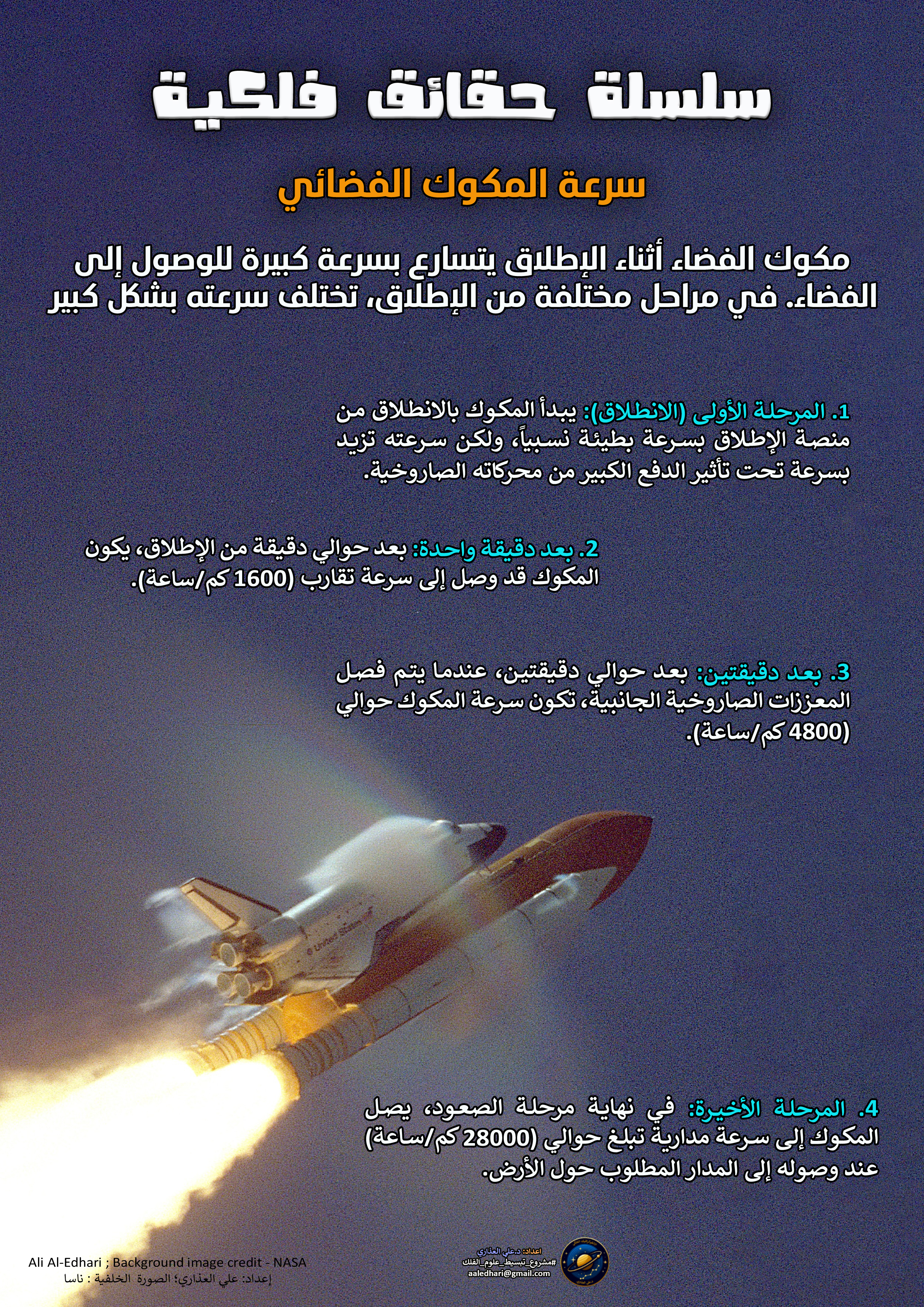
The Speed of Spacecraft
图像
图注: This infographic is part of the "Simplifying Astronomy for Arabic Speakers" project, aiming to present scientific concepts in a simple and accessible way. The design focuses on the speed of spacecraft during the various stages of their launch, illustrating how velocity changes as the spacecraft progresses to reach the desired orbit.
Details of the Stages:
Stage One (Launch):
The spacecraft begins its journey by launching from the launch pad with an increasing speed. The velocity in this stage is influenced by Earth's gravity and atmospheric resistance.
After One Minute:
The spacecraft reaches a speed of approximately 1,600 kilometers per hour (km/h), reflecting a rapid acceleration powered by its engines.
After Two and a Half Minutes:
The rocket boosters are jettisoned, allowing the spacecraft to reach a speed of about 4,800 km/h. At this point, the spacecraft becomes lighter, enabling it to accelerate more efficiently.
Final Stage:
By the end of the ascent phase, the spacecraft achieves its final speed of approximately 28,000 km/h, allowing it to enter the desired orbit around Earth.
Through educational designs like this, the project provides enthusiasts with an opportunity to understand the intricate details of space missions in an engaging and simplified manner.
来源: Ali Al-Edhari ; Background image credit - NASA
词汇表:
火箭
语言: Arabic
文字系统: Arabic
授权许可: 知识共享许可协议 署名 4.0 国际 (CC BY 4.0) 知识共享许可协议 署名 4.0 国际 (CC BY 4.0) 图标
文件
( 图像
11.88 MB)

Iron Meteorite
图像
图注: This iron meteorite was originally found in Harriman, Tennessee, USA and is now held in the collection of the Smithsonian Natural History Museum, Washington DC, USA. The total mass of the meteorite was about 30kg. Here we see the interior after the meteorite was cut into pieces.
Iron meteorites are largely composed of an iron-nickel. They also often have a crystalline structure which manifests here as a series of crossing shiny straight lines known as a Widmanstätten pattern. This is thought to have formed as the meteoroid (the object that would eventually fall through the Earth's atmosphere as a meteor and land on the ground as a meteorite) cooled very slowly in the vacuum of space in the early solar system. This led to the growth of this crystalline structure.
来源: Chuck Sutherland
来源链接
词汇表:
铁陨石 , 陨石 , 流星
分类:
地球
, 太阳系
授权许可: 公共领域 公共领域 图标
文件
( 图像
4.51 MB)