文档与资源 - 搜索结果
搜索结果

Astronomical Unit
图像
为 OAE 制作
图注: An astronomical unit (AU) is a convenient unit of distance equal to exactly 149,597,870.7 kilometers (km). This is approximately the average distance between the Earth and the Sun, which was a previous definition of the AU. The AU is often used to measure distances in the Solar System and in other planetary or stellar systems.
来源: Danielle Futselaar/IAU OAE
词汇表:
天文单位
分类:
太阳系
授权许可: 知识共享许可协议 署名 4.0 国际 (CC BY 4.0) 知识共享许可协议 署名 4.0 国际 (CC BY 4.0) 图标
文件
( 图像
264.08 kB)
PDF 文件
(PDF file
216.10 kB)
Also available in black and white
文件
( 图像
171.33 kB)
PDF 文件
(
55.68 kB)
Total Solar Eclipse
图像
为 OAE 制作
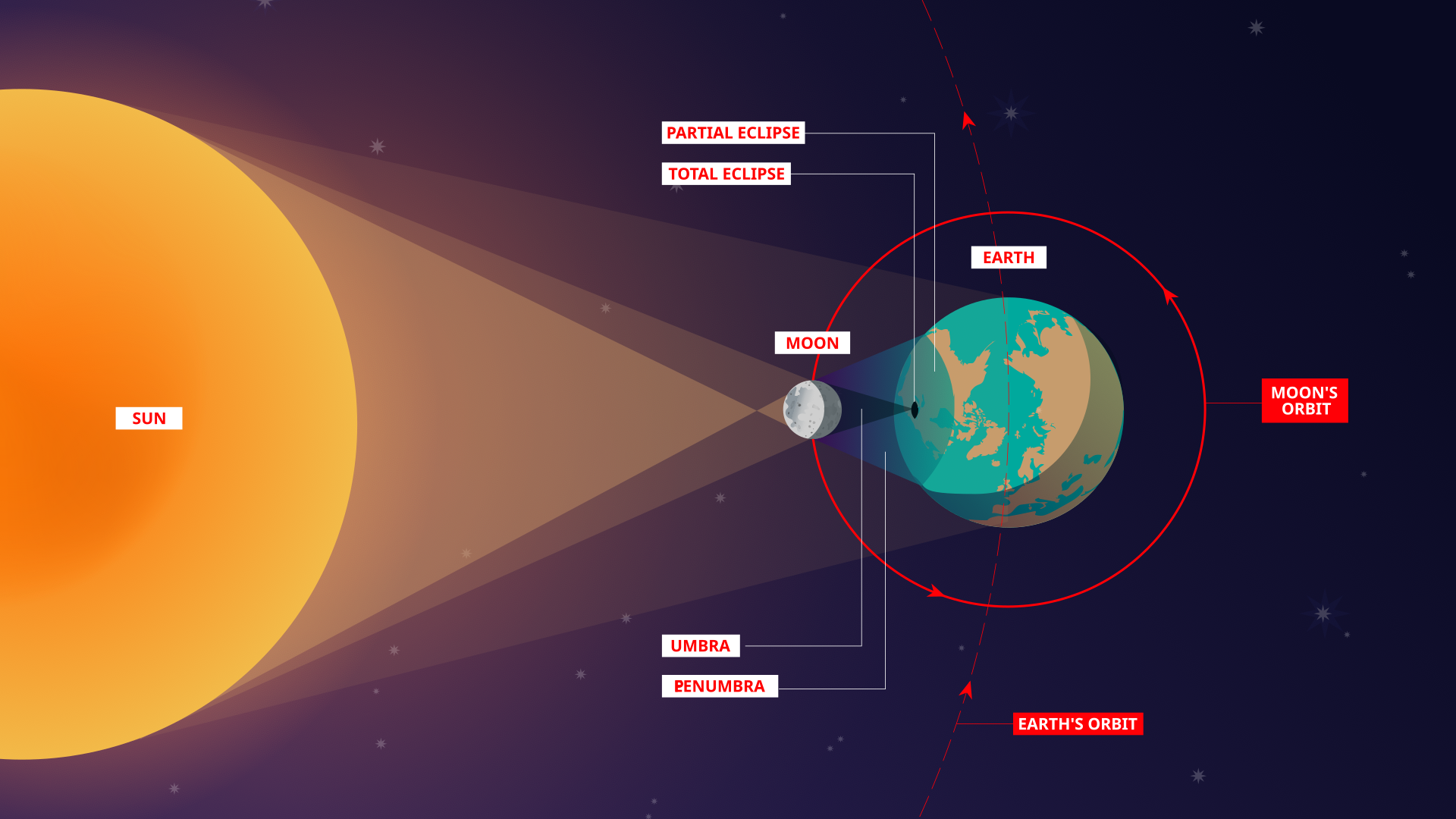
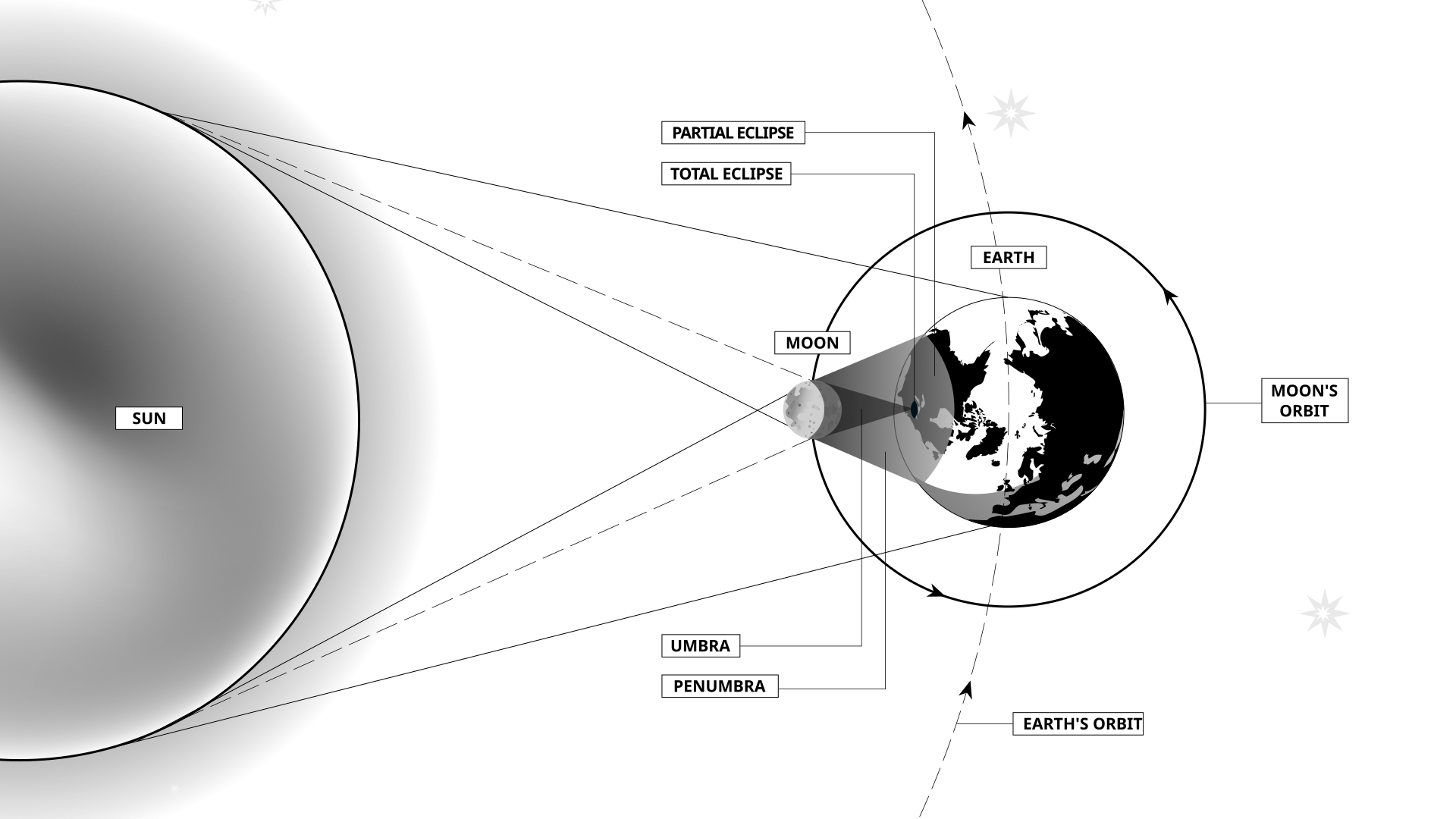
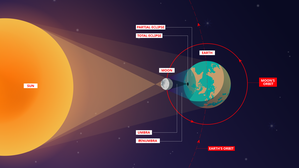
图注: This not to scale diagram shows what happens during a total solar eclipse. The Moon orbits the Earth, but its orbit is slightly tilted with respect to the Earth’s orbit around the Sun. During the new moon lunar phase, the Moon lies between the Earth and the Sun, but due to the Moon’s tilted orbit around the Earth, the Moon normally lies above or below the Sun at this point. However twice a year the Moon’s orbit lines up in such a way that the Moon can lie in a direct line between the Earth and Sun. During each of these periods (each of which last roughly a month) solar (and lunar) eclipses can occur. The Moon is about 400 times smaller than the Sun, but is 400 times closer to the Earth than the Sun. Hence the Sun and Moon have approximately the same angular size when viewed from the Earth. This means that it is possible for the Moon to completely cover the Sun when viewed from Earth. This is known as a total solar eclipse.
Here we see a schematic of such and eclipse. The Moon casts a shadow on the Earth known as the umbra. This is a roughly circular shadow a few hundred kilometres across although its shape can be severely distorted when the eclipse is at the edge of the illuminated part of the Earth. Any region within the umbra will see the Moon completely cover the Sun and thus will experience a total solar eclipse. Outside of the umbra there are regions where the Moon will cover part of the Sun. This partial shadow is known as the penumbra. Regions in the penumbra will experience a partial solar eclipse.
An eclipse is a dynamic event with the Moon moving in its orbit and the Earth rotating. Hence the umbra and penumbra move across the Earth’s surface together. The path the umbra takes across the Earth is known as the path of totality. Let’s consider one particular region that lies in the path of totality: except in rare cases where an eclipse begins at sunrise, a region that experiences totality will first see the Moon cover part of the Sun and gradually move across Sun until it is totally covered. From outside the Earth this would appear as the penumbra moving over this particular region followed by the umbra moving over this region. Once the Moon moves so that it no longer completely covers the Sun, totality ends and the umbra moves away from this particular region. The Moon will continue to uncover the Sun until (unless the Sun sets before the end of the eclipse) the Sun is completely uncovered. From outside the Earth this would appear as the umbra moving away from our particular region and the edge of the penumbra approaching and eventually passing over the region.
Outside of the path or totality there is a much broader region that will lie in the penumbra but will be missed by the umbra. Such regions will not experience a total solar eclipse during this event, only a partial solar eclipse.
来源: Aneta Margraf/IAU OAE
词汇表:
月相 , 月球 , 新月 , 日偏食 , 半影 , 日食 , 太阳 , 日全食 , 本影
分类:
肉眼天文学
授权许可: 知识共享许可协议 署名 4.0 国际 (CC BY 4.0) 知识共享许可协议 署名 4.0 国际 (CC BY 4.0) 图标
文件
( 图像
2.06 MB)
PDF 文件
(PDF file
1.56 MB)
Also available in black and white
文件
( 图像
468.46 kB)
PDF 文件
(
1.96 MB)

International Date Line
图像
为 OAE 制作
图注: The International Date Line (shown here as a solid line) is a specific meridian which roughly follows the meridian of longitude 180°. The International Date Line passes north–south between Russia and Alaska, through the Pacific Ocean including parts of Micronesia and Polynesia, and to the east of Australia/New Zealand before reaching the South Pole on Antarctica. The International Date Line marks the boundary where calendar dates change by one. Therefore, regions to the west of the International Date line are one calendar day ahead of regions to the east.
The International Date Line does not always exactly follow the meridian of longitude 180°. This is partly to stop some territory of a country falling on the other side of the International Date Line than the rest of that country (the Aleutian Islands in the United States being a good example). Some countries also choose which side of the International Date Line they lie on. Samoa changed which side of the date line it lay on in 2011. At this point the International Date Line was moved to lie to the east of Samoa having previously passed to the west of Samoa.
On the opposite side of the world the dashed line marks the prime meridian (the meridian of longitude 0°). This is a line that passes through the Royal Greenwich Observatory in the UK. All time zones are measure relative to Universal Time which is the zero point for all timezones. The time zones marked at the top of the diagram are the timezones in the shaded regions excluding the effects of daylight savings time.
来源: Maria Cristina Fortuna/IAU OAE
词汇表:
时区 , 世界时(UT) , 本初子午线 , 国际日期变更线
分类:
天文学与社会
, 地球
授权许可: 知识共享许可协议 署名 4.0 国际 (CC BY 4.0) 知识共享许可协议 署名 4.0 国际 (CC BY 4.0) 图标
文件
( 图像
214.47 kB)
PDF 文件
(PDF file
88.40 kB)
Also available in black and white
文件
( 图像
272.39 kB)
PDF 文件
(
88.60 kB)
Stellar Structure
图像
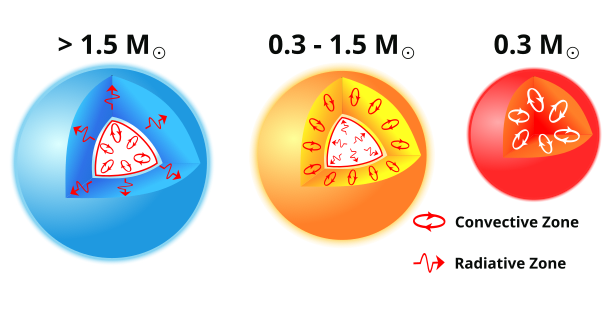
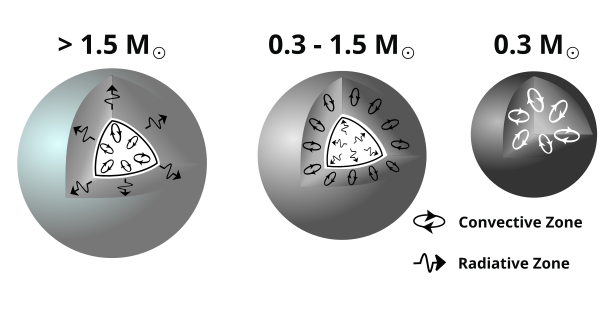
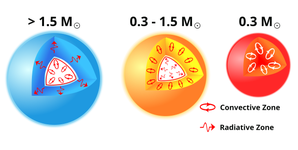
图注: Stars are balls of plasma. For most of a star’s life it burns hydrogen into helium in its core. This phase of a star’s life is known as the main sequence. Burning hydrogen into helium produces heat, that heat travels out of the star’s core eventually reaching the star’s photosphere (often referred to as the “surface” of the star). From here the heat can radiate into space as various forms of electromagnetic radiation. However, how heat travels from the core to the photosphere depends on the star’s mass.
Imagine a parcel of gas rising inside a star. As it rises, it moves into an area of lower pressure, so it cools down and expands. If the parcel is still hotter, and therefore less dense than its surroundings, it keeps moving upward due to buoyancy. Eventually, it will rise far enough to cool and sink back down. This rising and sinking cycle is called convection. Whether convection occurs depends on how quickly temperature changes as you move away from the star’s core. If the temperature in a star drops rapidly, rising parcels of gas are more likely to stay hotter than their surroundings, so convection dominates as the mode of energy transfer in this part of the star. Conversely if the temperature drops more slowly (i.e. if the temperature gradient is small) then heat will mostly be transferred by radiation (photons).
In the most massive main sequence stars (more massive than about 1.5 times the mass of the Sun, seen here on the left), hydrogen is burned into helium using the CNO cycle. This is highly temperature dependent and thus energy production is concentrated near the center of the star. This leads to a larger temperature gradient and thus a convective core. Further out the temperature gradient becomes smaller and heat transport is dominated by radiation. This is called the radiative zone.
For lower mass stars like the Sun (between 0.3 and 1.5 solar masses, seen here in the middle) hydrogen is burned to helium using a different process (the pp chain). This depends less on the internal temperature than the CNO cycle and so energy production is more distributed in the star’s core. This leads to a smaller temperature gradient and thus a radiative core where convection occurs surrounded by a radiative zone. Going further out the gas becomes cool enough for some elements to hang to on some of their electrons, i.e. not being completely ionised. This partially ionised gas is more opaque to photons, trapping heat. This leads to a large temperature gradient and thus convection.
The lowest mass stars (below 0.3 solar masses, seen here on the right) have no radiative zone and are fully convective.
The arrows in the radiative zone are shown as wavy lines heading out of the star. However, a photon’s journey out of a star is much more complex with each individual photon travelling only a short distance before being deflected by some of the charged particles that make up the plasma of the star’s interior. This leads to a long and winding road that takes millennia instead of the few seconds it would take if the photon did not interact with particles in the plasma.
来源: Based on a vector diagram by Wikimedia user Д.Ильин which itself is based on a diagram from sun.org
来源链接
词汇表:
电磁辐射 , 氢聚变 , 光球 , 辐射区 , 恒星结构 , 对流区 , 恒星核心
分类:
恒星
授权许可: 知识共享许可协议 署名 4.0 国际 (CC BY 4.0) 知识共享许可协议 署名 4.0 国际 (CC BY 4.0) 图标
文件
( 图像
102.93 kB)
PDF 文件
(PDF file
26.25 kB)
Also available in black and white
文件
( 图像
74.95 kB)
PDF 文件
(
18.56 kB)