文档与资源 - 搜索结果
搜索结果
Canis Minor Constellation Map
图像
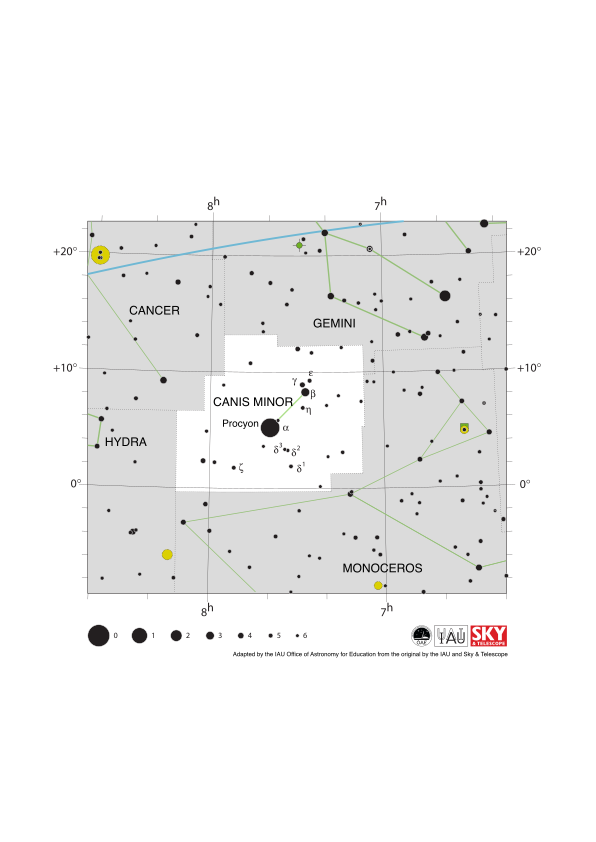
图注: The constellation Canis Minor with its bright stars and surrounding constellations. Canis Minor is surrounded by (going clockwise from the top): Gemini, Monoceros, Hydra and Cancer. Canis Minor has relatively few bright stars but its brightest star Procyon is the eight brightest star in the sky.
Canis Minor spans the celestial equator and thus part of the constellation is visible from the whole Earth at some point during the year. The whole constellation is visible to all but the most arctic and antarctic regions.
The y-axis of this diagram is in degrees of declination with north as up and the x-axis is in hours of right ascension with east to the left. The sizes of the stars marked here relate to the star's apparent magnitude, a measure of its apparent brightness. The larger dots represent brighter stars. The Greek letters mark the brightest stars in the constellation. These are ranked by brightness with the brightest star being labeled alpha, the second brightest beta, etc., although this ordering is not always followed exactly. The dotted boundary lines mark the IAU's boundaries of the constellations and the solid green lines mark one of the common forms used to represent the figures of the constellations. The blue line in the top right of the diagram marks the ecliptic. Neither the constellation boundaries, nor the line marking the ecliptic, nor the lines joining the stars appear on the sky.
来源: Adapted by the IAU Office of Astronomy for Education from the original by the IAU and Sky & Telescope
来源链接
词汇表:
视星等 , 天球坐标 , 天赤道 , 星座 , 赤纬 , 黄道 , 赤经(RA)
分类:
肉眼天文学
授权许可: 知识共享许可协议 署名 4.0 国际 (CC BY 4.0) 知识共享许可协议 署名 4.0 国际 (CC BY 4.0) 图标
文件
( 图像
76.24 kB)
PDF 文件
(PDF file
153.55 kB)
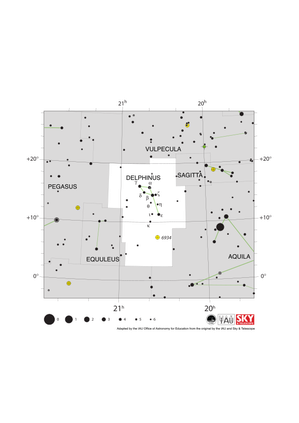
Delphinus Constellation Map
图像
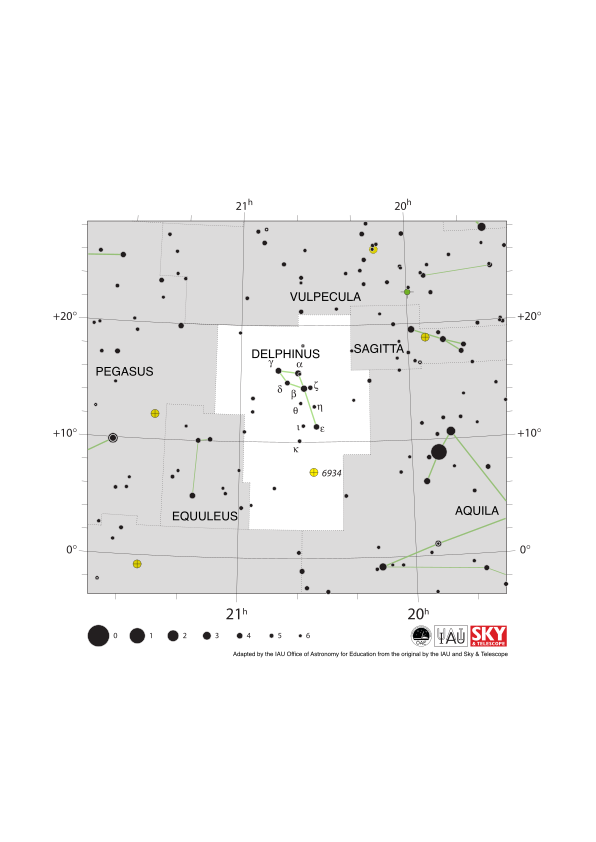
图注: The constellation Delphinus with its brighter stars and surrounding constellations. Delphinus is surrounded by (going clockwise from the top): Vulpecula, Sagitta, Aquila, Aquarius, Equuleus and Pegasus. Delphinus is a relatively small constellation with few bright stars.
Delphinus lies just north of the celestial equator and thus the whole constellation is visible at some point in the year to all but the most antarctic regions. The constellation is best viewed in the evenings in the early northern hemisphere autumn and early southern hemisphere spring.
The globular cluster NGC 6934 lies in Dephinus. It is marked here with a yellow circle with a plus sign superimposed on it.
The y-axis of this diagram is in degrees of declination with north as up and the x-axis is in hours of right ascension with east to the left. The sizes of the stars marked here relate to the star's apparent magnitude, a measure of its apparent brightness. The larger dots represent brighter stars. The Greek letters mark the brightest stars in the constellation. These are ranked by brightness with the brightest star being labeled alpha, the second brightest beta, etc., although this ordering is not always followed exactly. The dotted boundary lines mark the IAU's boundaries of the constellations and the solid green lines mark one of the common forms used to represent the figures of the constellations. Neither the constellation boundaries, nor the lines joining the stars appear on the sky.
来源: Adapted by the IAU Office of Astronomy for Education from the original by the IAU and Sky & Telescope
来源链接
词汇表:
视星等 , 天球坐标 , 天赤道 , 星座 , 赤纬 , 球状星团 , 赤经(RA) , 宝瓶座
分类:
肉眼天文学
授权许可: 知识共享许可协议 署名 4.0 国际 (CC BY 4.0) 知识共享许可协议 署名 4.0 国际 (CC BY 4.0) 图标
文件
( 图像
70.98 kB)
PDF 文件
(PDF file
147.37 kB)
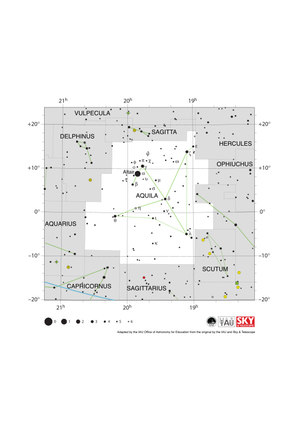
Aquila Constellation Map
图像
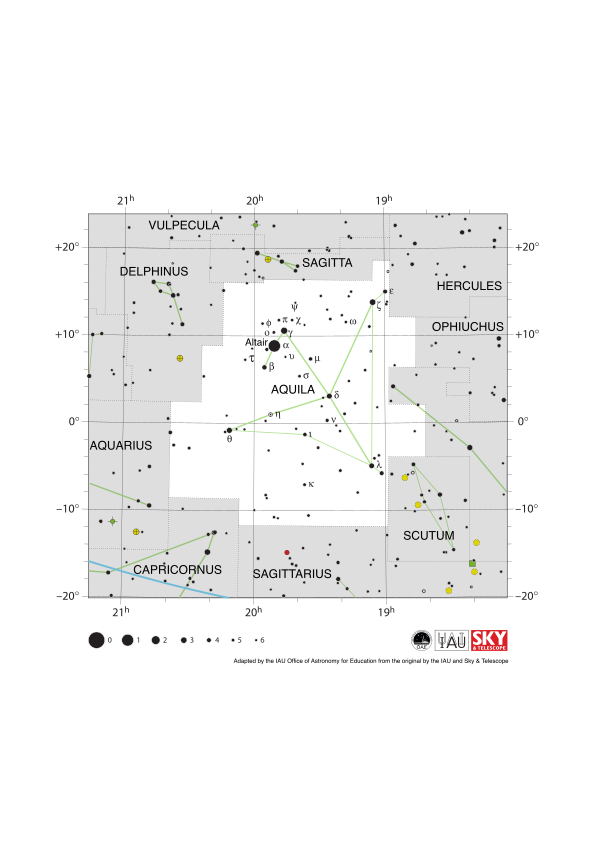
图注: The constellation Aquila with its bright stars and surrounding constellations. Aquila is surrounded by (going clockwise from the top): Sagitta, Hercules, Ophiuchus, Serpens Cauda, Scutum, Sagittarius, Capricornus, Aquarius and Delphinus. Aquila is most notable for its brightest star Altair. This forms one vertex of the prominent Summer Triangle asterism that is visible in northern hemisphere summer evenings.
Aquila spans the celestial equator and thus some part of it is visible from all of the Earth at some point in the year. It is most visible in the evenings in the late northern hemisphere summer and late southern hemisphere winter.
The y-axis of this diagram is in degrees of declination with north as up and the x-axis is in hours of right ascension with east to the left. The sizes of the stars marked here relate to the star's apparent magnitude, a measure of its apparent brightness. The larger dots represent brighter stars. The Greek letters mark the brightest stars in the constellation. These are ranked by brightness with the brightest star being labeled alpha, the second brightest beta, etc., although this ordering is not always followed exactly. The dotted boundary lines mark the IAU's boundaries of the constellations and the solid green lines mark one of the common forms used to represent the figures of the constellations. The blue line in the lower right of the diagram is the ecliptic. Neither the constellation boundaries, nor the line marking the ecliptic, nor the lines joining the stars appear on the sky.
来源: Adapted by the IAU Office of Astronomy for Education from the original by IAU/Sky & Telescope
来源链接
词汇表:
视星等 , 摩羯座 , 天球坐标 , 天赤道 , 星座 , 赤纬 , 黄道 , 赤经(RA) , 宝瓶座 , 星宿(星群)
分类:
肉眼天文学
授权许可: 知识共享许可协议 署名 4.0 国际 (CC BY 4.0) 知识共享许可协议 署名 4.0 国际 (CC BY 4.0) 图标
文件
( 图像
95.28 kB)
PDF 文件
(PDF file
175.09 kB)

Sextans Constellation Map
图像
图注: The constellation Sextans with its brighter stars and surrounding constellations. Sextans is surrounded by (going clockwise from the top): Leo, Hydra and Crater. Sextans is a small constellation with relatively few bright stars.
Sextans spans the celestial equator and thus parts of the constellation are visible at some point in the year across the Earth. The whole constellation is visible in all but the most arctic and most antarctic regions. Sextans is best viewed in the evening in the northern hemisphere spring and southern hemisphere autumn.
The lenticular galaxy NGC 3115 lies in Sextans. It is marked here with a red ellipse.
The y-axis of this diagram is in degrees of declination with north as up and the x-axis is in hours of right ascension with east to the left. The sizes of the stars marked here relate to the star's apparent magnitude, a measure of its apparent brightness. The larger dots represent brighter stars. The Greek letters mark the brightest stars in the constellation. These are ranked by brightness with the brightest star being labeled alpha, the second brightest beta, etc., although this ordering is not always followed exactly. The dotted boundary lines mark the IAU's boundaries of the constellations and the solid green lines mark one of the common forms used to represent the figures of the constellations. The blue line at the top of the diagram marks the ecliptic. Neither the constellation boundaries, nor the lines joining the stars, nor the ecliptic, appear on the sky.
来源: Adapted by the IAU Office of Astronomy for Education from the original by the IAU and Sky & Telescope
来源链接
词汇表:
视星等 , 天球坐标 , 天赤道 , 星座 , 赤纬 , 黄道 , 狮子座 , 赤经(RA) , 透镜状星系
分类:
肉眼天文学
授权许可: 知识共享许可协议 署名 4.0 国际 (CC BY 4.0) 知识共享许可协议 署名 4.0 国际 (CC BY 4.0) 图标
文件
( 图像
73.40 kB)
PDF 文件
(PDF file
153.02 kB)

Serpens Cauda Constellation Map
图像
图注: A map of part of the constellation Serpens. Serpens is unique amongst IAU constellations in that it is divided into two non-contiguous parts. The part of Serpens shown here is known as Serpens Cauda, representing the tail of the serpent. This part of Serpens is surrounded by (going clockwise from the top): Ophiuchus, Sagittarius, Scutum and Aquila.
Serpens Cauda spans the celestial equator thus parts of the constellation are visible at some point in the year across the Earth. The whole constellation is visible to all but the most arctic and antarctic regions. Serpens Cauda is best viewed in the evening in the northern hemisphere summer and southern hemisphere winter.
The Eagle Nebula and its associated star cluster are marked here as M16 with a yellow circle. This region was the location of the famous “pillars of creation” image taken by the Hubble Space Telescope.
The y-axis of this diagram is in degrees of declination with north as up and the x-axis is in hours of right ascension with east to the left. The sizes of the stars marked here relate to the star's apparent magnitude, a measure of its apparent brightness. The larger dots represent brighter stars. The Greek letters mark the brightest stars in the constellation. These are ranked by brightness with the brightest star being labeled alpha, the second brightest beta, etc., although this ordering is not always followed exactly. The dotted boundary lines mark the IAU's boundaries of the constellations and the solid green lines mark one of the common forms used to represent the figures of the constellations. The blue line at the bottom of the diagram marks the ecliptic. Neither the constellation boundaries, nor the lines joining the stars, nor the ecliptic, appear on the sky.
来源: Adapted by the IAU Office of Astronomy for Education from the original by the IAU and Sky & Telescope
来源链接
词汇表:
视星等 , 天球坐标 , 天赤道 , 星座 , 赤纬 , 星云 , 赤经(RA) , 疏散星团 , 人马座
分类:
肉眼天文学
授权许可: 知识共享许可协议 署名 4.0 国际 (CC BY 4.0) 知识共享许可协议 署名 4.0 国际 (CC BY 4.0) 图标
文件
( 图像
103.44 kB)
PDF 文件
(PDF file
218.49 kB)