文档与资源 - 搜索结果
搜索结果

Triangulum Australe Constellation Map
图像
图注: The constellation Triangulum Australe with its bright stars and surrounding constellations. Triangulum Australe is surrounded by (going clockwise from the top): Norma, Circinus, Apus and Ara.
Triangulum Australe is a southern constellation and thus the whole constellation is visible at some point in the year throughout the southern hemisphere. The whole constellation is also visible from some equatorial regions of the northern hemisphere with parts of the constellation visible from the remaining northern equatorial regions. Triangulum Australe is best viewed in the evening in the northern hemisphere summer and southern hemisphere winter.
The open cluster NGC 6025 lies in Triangulum Australe and is marked here with a yellow circle.
The y-axis of this diagram is in degrees of declination with north as up and the x-axis is in hours of right ascension with east to the left. The sizes of the stars marked here relate to the star's apparent magnitude, a measure of its apparent brightness. The larger dots represent brighter stars. The Greek letters mark the brightest stars in the constellation. These are ranked by brightness with the brightest star being labeled alpha, the second brightest beta, etc., although this ordering is not always followed exactly. The dotted boundary lines mark the IAU's boundaries of the constellations and the solid green lines mark one of the common forms used to represent the figures of the constellations. Neither the constellation boundaries, nor the lines joining the stars appear on the sky.
来源: Adapted by the IAU Office of Astronomy for Education from the original by the IAU and Sky & Telescope
来源链接
词汇表:
视星等 , 天球坐标 , 星座 , 赤纬 , 赤经(RA) , 疏散星团
分类:
肉眼天文学
授权许可: 知识共享许可协议 署名 4.0 国际 (CC BY 4.0) 知识共享许可协议 署名 4.0 国际 (CC BY 4.0) 图标
文件
( 图像
112.83 kB)
PDF 文件
(PDF file
166.92 kB)

Boötes Constellation Map
图像
图注: The constellation Boötes with its bright stars and surrounding constellations. Boötes is surrounded by (going clockwise from the top): Draco, Ursa Major, Canes Venatici, Coma Berenices, Virgo, Serpens Caput, Corona Borealis and Hercules. It is notable for its brightest star Arcturus which is the fourth brightest star in the night sky.
Boötes is a northern constellation and the whole constellation is visible to the entire northern hemisphere at some point in the year. Parts of the constellation are visible from all but the most antarctic parts of the southern hemisphere but the whole constellation is only visible from equatorial and some temperate parts of that hemisphere. Boötes is most visible in the evenings in the northern hemisphere summer and southern hemisphere winter.
The y-axis of this diagram is in degrees of declination with north as up and the x-axis is in hours of right ascension with east to the left. The sizes of the stars marked here relate to the star's apparent magnitude, a measure of its apparent brightness. The larger dots represent brighter stars. The Greek letters mark the brightest stars in the constellation. These are ranked by brightness with the brightest star being labeled alpha, the second brightest beta, etc., although this ordering is not always followed exactly. The dotted boundary lines mark the IAU's boundaries of the constellations and the solid green lines mark one of the common forms used to represent the figures of the constellations. Neither the constellation boundaries, nor the lines joining the stars appear on the sky.
来源: Adapted by the IAU Office of Astronomy for Education from the original by the IAU and Sky & Telescope
来源链接
词汇表:
视星等 , 天球坐标 , 星座 , 赤纬 , 赤经(RA)
分类:
肉眼天文学
授权许可: 知识共享许可协议 署名 4.0 国际 (CC BY 4.0) 知识共享许可协议 署名 4.0 国际 (CC BY 4.0) 图标
文件
( 图像
123.58 kB)
PDF 文件
(PDF file
185.26 kB)

Horologium Constellation Map
图像
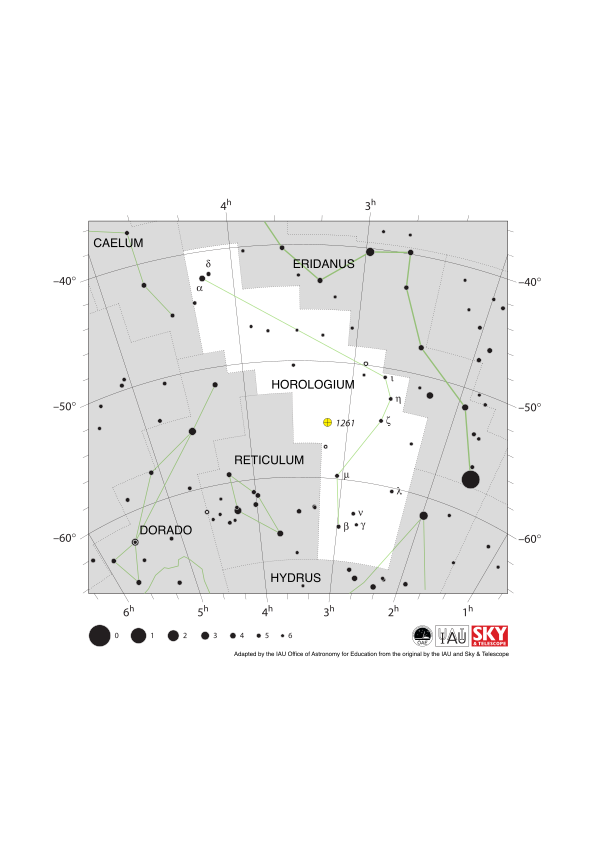
图注: The constellation Horologium with its bright stars and surrounding constellations. Horologium is surrounded by (going clockwise from the top): Eridanus, Hydrus, Reticulum, Dorado and Caelum.
Horologium is a southern constellation and thus is visible in the whole southern hemisphere at some point in the year. The whole constellation is also visible from equatorial parts of the northern hemisphere with parts of it visible to some northern temperate regions. Horologium is circumpolar in antarctic and some temperate regions of the southern hemisphere. This constellation is best viewed in the evenings in the northern hemisphere winter and southern hemisphere summer.
The globular cluster NGC 1261 lies in Horologium, it is marked here with a yellow circle with a plus sign superimposed on it.
The y-axis of this diagram is in degrees of declination with north as up and the x-axis is in hours of right ascension with east to the left. The sizes of the stars marked here relate to the star's apparent magnitude, a measure of its apparent brightness. The larger dots represent brighter stars. The Greek letters mark the brightest stars in the constellation. These are ranked by brightness with the brightest star being labeled alpha, the second brightest beta, etc., although this ordering is not always followed exactly. The dotted boundary lines mark the IAU's boundaries of the constellations and the solid green lines mark one of the common forms used to represent the figures of the constellations. Neither the constellation boundaries, nor the lines joining the stars appear on the sky.
来源: Adapted by the IAU Office of Astronomy for Education from the original by the IAU and Sky & Telescope
来源链接
词汇表:
视星等 , 天球坐标 , 拱极星 , 星座 , 赤纬 , 球状星团 , 赤经(RA)
分类:
肉眼天文学
授权许可: 知识共享许可协议 署名 4.0 国际 (CC BY 4.0) 知识共享许可协议 署名 4.0 国际 (CC BY 4.0) 图标
文件
( 图像
94.08 kB)
PDF 文件
(PDF file
151.54 kB)

Norma Constellation Map
图像
图注: The constellation Norma with its brighter stars and surrounding constellations. Norma is surrounded by (going clockwise from the top): Scorpius, Lupus, Circinus, Triangulum Australe and Ara. Norma is a faint constellation with relatively few bright stars.
Norma is a southern constellation and thus the whole constellation is visible at some point in the year throughout the southern hemisphere. The whole constellation is also visible from equatorial regions of the northern hemisphere with parts of the constellation visible from some northern hemisphere temperate regions. Norma is best viewed in the evening in the northern hemisphere summer and southern hemisphere winter.
The open clusters NGC 6025 and NGC 6087 lie in Norma and are marked here with yellow circles.
The y-axis of this diagram is in degrees of declination with north as up and the x-axis is in hours of right ascension with east to the left. The sizes of the stars marked here relate to the star's apparent magnitude, a measure of its apparent brightness. The larger dots represent brighter stars. The Greek letters mark the brightest stars in the constellation. These are ranked by brightness with the brightest star being labeled alpha, the second brightest beta, etc., although this ordering is not always followed exactly. The dotted boundary lines mark the IAU's boundaries of the constellations and the solid green lines mark one of the common forms used to represent the figures of the constellations. Neither the constellation boundaries, nor the lines joining the stars appear on the sky.
来源: Adapted by the IAU Office of Astronomy for Education from the original by the IAU and Sky & Telescope
来源链接
词汇表:
视星等 , 天球坐标 , 星座 , 赤纬 , 赤经(RA) , 天蝎座 , 疏散星团
分类:
肉眼天文学
授权许可: 知识共享许可协议 署名 4.0 国际 (CC BY 4.0) 知识共享许可协议 署名 4.0 国际 (CC BY 4.0) 图标
文件
( 图像
108.17 kB)
PDF 文件
(PDF file
166.47 kB)
Canis Major Constellation Map
图像
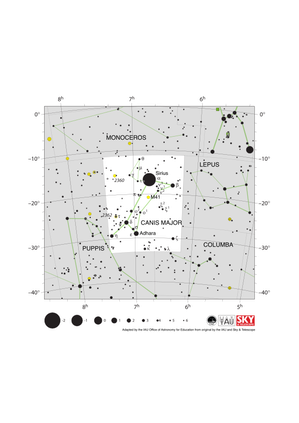
图注: The constellation Canis Major along with its bright stars and its surrounding constellations. Canis Major is surrounded by (going clockwise from the top): Monoceros, Lepus, Columba and Puppis. The constellation is dominated by Sirius, the star which appears brightest in the night sky, which far outshines all of the other stars in the constellation.
Canis Major lies just south of the celestial equator and is visible from all of the southern hemisphere as well as equatorial and temperate regions of the northern hemisphere. Sirius is visible from all but the most arctic regions. Canis Major is most visible in the evenings in late winter in the northern hemisphere and late summer in the southern hemisphere.
The open star clusters M41, NGC 2360 and NGC 2362 lie in the constellation. These are marked with yellow circles.
The y-axis of this diagram is in degrees of declination with north as up and the x-axis is in hours of right ascension with east to the left. The sizes of the stars marked here relate to the star's apparent magnitude, a measure of its apparent brightness. The larger dots represent brighter stars. The Greek letters mark the brightest stars in the constellation. These are ranked by brightness with the brightest star being labeled alpha, the second brightest beta, etc., although this ordering is not always followed exactly. The dotted boundary lines mark the IAU's boundaries of the constellations and the solid green lines mark one of the common forms used to represent the figures of the constellations. Neither the constellation boundaries, nor the lines joining the stars appear on the sky.
来源: Adapted by the IAU Office of Astronomy for Education from the original by IAU/Sky & Telescope
来源链接
词汇表:
视星等 , 天球坐标 , 天赤道 , 星座 , 赤纬 , 赤经(RA) , 天狼星 , 疏散星团
分类:
肉眼天文学
授权许可: 知识共享许可协议 署名 4.0 国际 (CC BY 4.0) 知识共享许可协议 署名 4.0 国际 (CC BY 4.0) 图标
文件
( 图像
116.56 kB)
PDF 文件
(PDF file
200.43 kB)