文档与资源 - 搜索结果
搜索结果
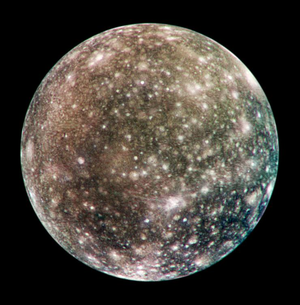
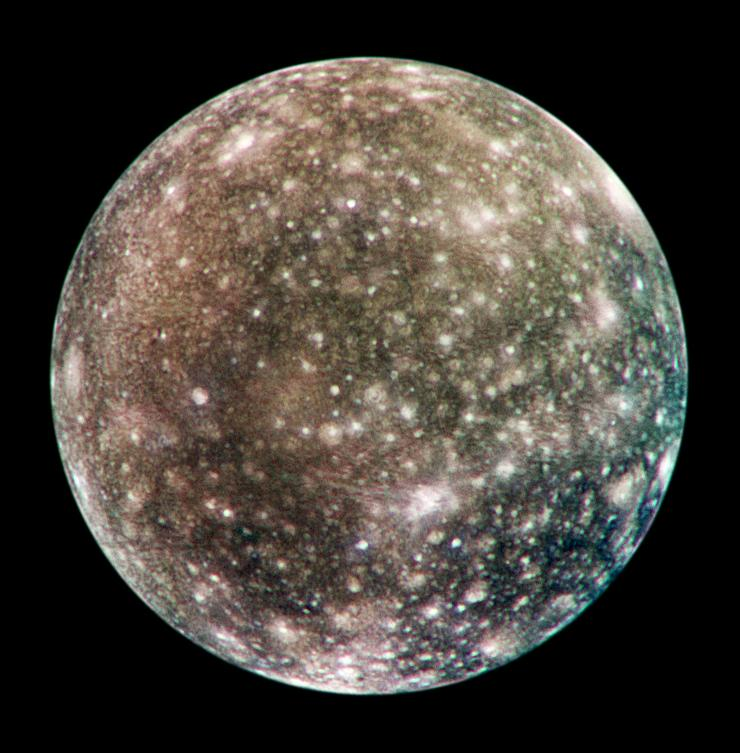
The Callisto satellite
图像
图注: Callisto is the outermost of the four large Galilean moons of Jupiter and the third largest in the whole solar system, falling behind only Ganymede and Saturn's moon Titan. It orbits Jupiter at an average distance of around 1.9 million kilometers, roughly six times the distance between Earth and the Moon.
With a diameter of nearly 5,000 kilometers, it is almost as large as Mercury, the smallest planet in our solar system, but has only a third of its mass as it is composed of approximately equal amounts of rock and ice.
Callisto orbits Jupiter in a tidally locked rotation, always showing the same side to Jupiter. In contrast to the other three Galilean satellites – Io, Europa, and Ganymede – it is not in orbital resonance due to its farther outward location and is thus not appreciably tidally heated. It does not show any signs of plate tectonics or volcanic activity. Its lack of geological processes means that surface features like craters remain unchanged for billions of years. It is thought to have evolved predominantly under the influence of impacts, as its surface is the oldest and most heavily cratered object in the solar system. In fact, it is so covered in craters that any new impact will likely erase a former one.
Callisto's internal structure is still subject to discussion; it may consist of a deep salty ocean. It is thought to be composed mainly of a mix of ice and rock, which are present in various states throughout the inner layers of the moon. Callisto hosts a very thin atmosphere composed mainly of carbon dioxide and some traces of oxygen. The moon has been studied by numerous space probes, such as the Pioneer and Voyager missions and the Galileo orbiter, and will be subject to further explorations by NASA, ESA, and China’s National Space Administration (CNSA).
来源: NASA/JPL/DLR
来源链接
词汇表:
伽利略卫星 , 卫星
授权许可: 公共领域 公共领域 图标
文件
( 图像
610.45 kB)
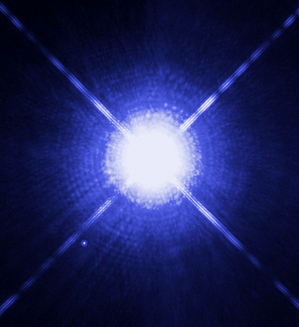
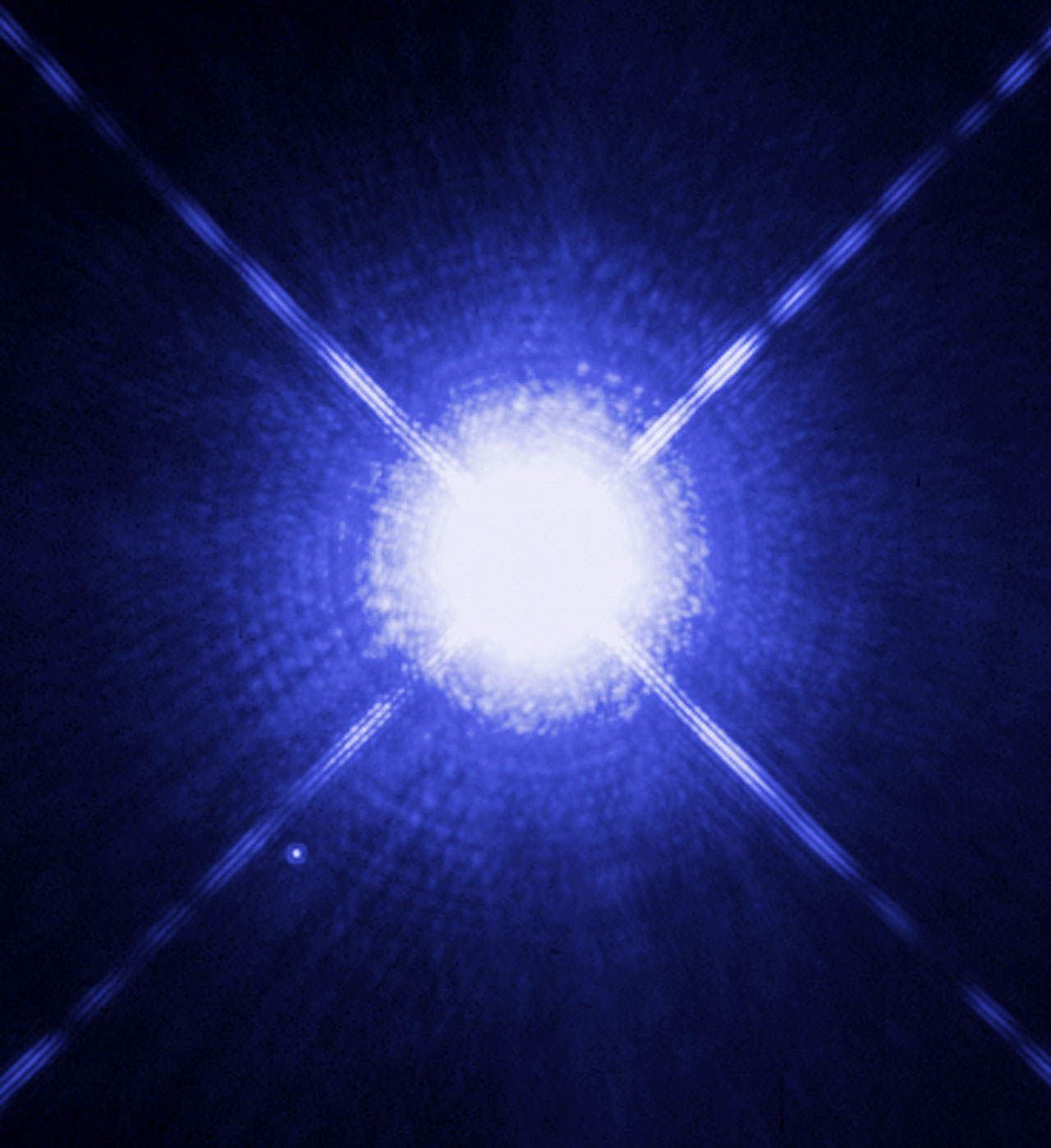
Sirius A with his faint white dwarf companion Sirius B
图像
图注: This Hubble Space Telescope image highlights Sirius, the brightest star in Earth’s night sky, appearing as an intensely luminous object at the center with prominent cross-shaped diffraction spikes. These spikes, along with the saturated glow around the main star, are caused by the Sirius' light being spread out by the telescope and camera used to make this image. Slightly below and to the left of the main star, a tiny point of light marks Sirius B, a much dimmer object captured thanks to Hubble’s high sensitivity.
Sirius A is an A-type star, known for its high surface temperature and strong white-blue light, while Sirius B is a compact white dwarf, the dense remnant of a star that has exhausted its nuclear fuel. Together, they form a well-known Binary star system located about 8.6 light-years from Earth.
Sirius B was originally a higher mass and brighter star that burned through its hydrogen fuel more quickly than Sirius A. This led to Sirius B evolving into a red giant and eventually ending its life as a planetary nebula, leaving only the remains of its core as a white dwarf orbiting Sirius A.
来源: NASA, ESA, H. Bond (STScI), and M. Barstow (University of Leicester)
来源链接
词汇表:
A型星 , 双星 , 天狼星 , 白矮星
分类:
恒星
授权许可: 知识共享许可协议 署名 4.0 国际 (CC BY 4.0) 知识共享许可协议 署名 4.0 国际 (CC BY 4.0) 图标
文件
( 图像
1.45 MB)
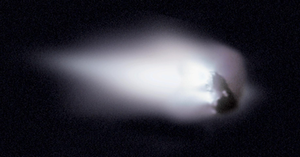
An Encounter With Halley's Comet
图像
图注: This image shows the solid core, or nucleus, of Halley’s Comet, captured in 1986 by the European Space Agency spacecraft Giotto during its flyby of the comet in the inner Solar System. The nucleus appears irregular and potato-shaped, measuring roughly 15 kilometers (about 9 miles) across, and is composed of a mixture of ice, dust, and rock. Unlike the glowing fuzzy cloud (coma) and long tail that make comets visible from Earth, the nucleus itself is dark and difficult to see until a spacecraft passes close enough to take detailed images.
Halley’s Comet is one of the best-known comets because it returns to the inner Solar System approximately every 76 years, allowing generations of astronomers to observe it repeatedly. The material that is released from the nucleus as the comet warms near the Sun forms a glowing coma and long tails of gas and dust, and over many returns leaves trails of debris that produce meteor showers on Earth, such as the Eta Aquarids in May and the Orionids in October.
来源: NASA/ESA/Giotto Project
来源链接
词汇表:
彗发 , 彗星 , 彗核 , 哈雷彗星
授权许可: 公共领域 公共领域 图标
文件
( 图像
1.45 MB)
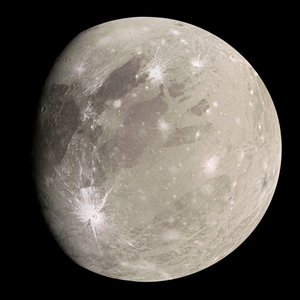
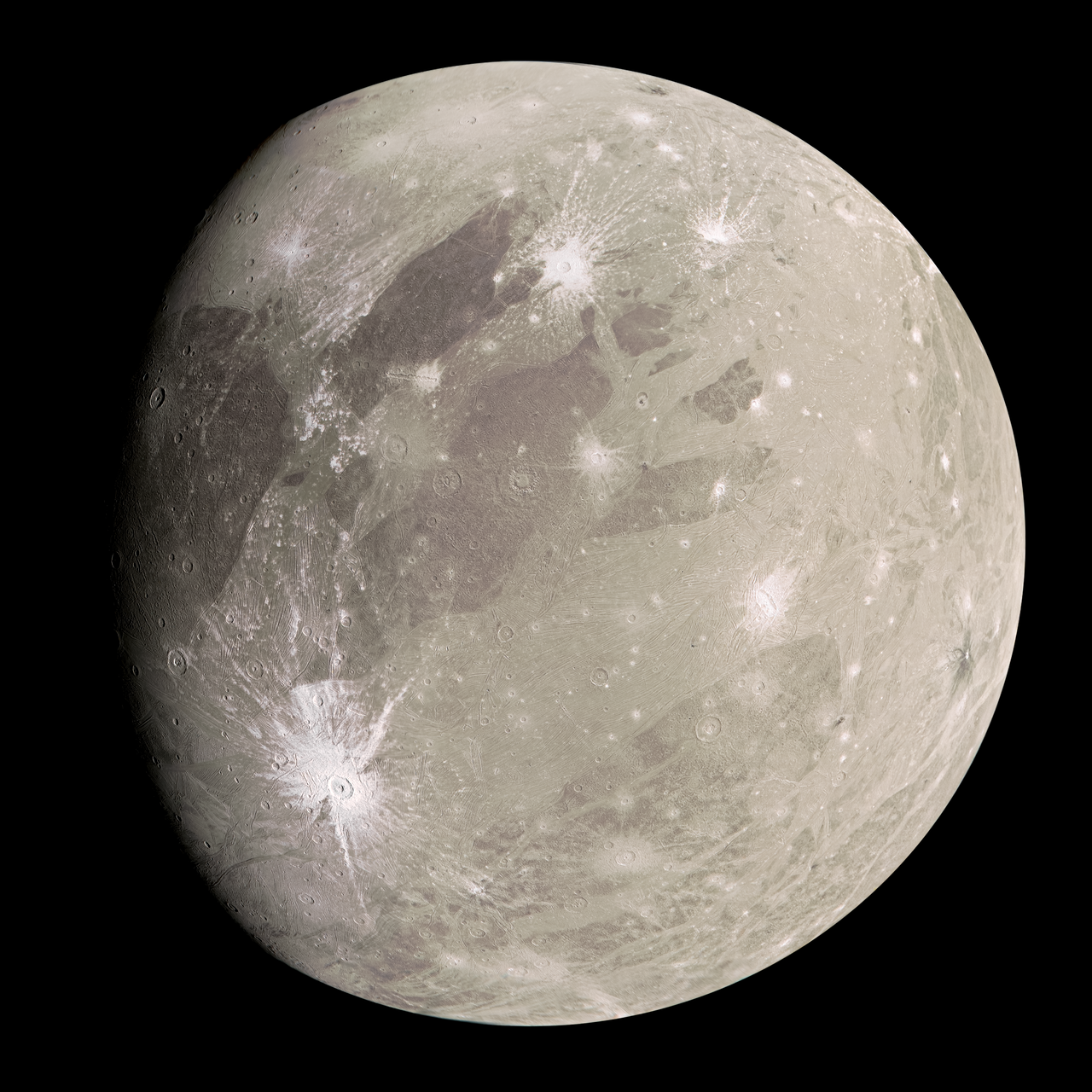
Ganymede seen by Juno spacecraft
图像
图注: Ganymede is the largest and most massive natural moon of Jupiter, and at the same time, the largest moon in the solar system. It also stands out as it is the only moon in the solar system which has an internally generated magnetic field. This is likely created by a liquid iron or iron sulfide core.
With a diameter of over 5,000 kilometers, it exceeds Mercury in size. Although it has more than twice the mass of Earth's Moon, it hosts weaker surface gravity than Mercury, Io, and the Moon due to its lower mean density.
Ganymede's appearance is primarily composed of darker, heavily cratered regions, and brighter, less bombarded ones with deep grooves and ridges indicating geological activity. Whether this might be caused by tidal heating is still subject to further analysis. The brighter regions make up around two-thirds of Ganymede's surface.
The remaining area consists of dark regions, saturated with impact craters, which have been dated back to four billion years. It is assumed that the moon hosts a large saltwater ocean under its icy surface with extreme depths of up to 800 kilometers.
Ganymede likely has a very tenuous oxygen atmosphere, comparable to that found on the Jupiter moon Europa. It cannot be interpreted as a sign of life. Instead, it is thought that hydrogen and oxygen are split up by radiation on the moon's surface.
The first space probe to visit Ganymede was Pioneer 10, performing a high-speed flyby manoeuvre through the Jupiter system. Since then, it has been investigated by several other probes such as Galileo, New Horizons, and Juno. The Jupiter Icy Moons Explorer (JUICE) will be the first to actually enter orbit around Ganymede itself (in around 2034) to further study the moon's magnetic and icy surface. JUICE will impact Ganymede as the last act of its mission.
来源: NASA/JPL-Caltech/SwRI/MSSS/Kevin M. Gill
来源链接
词汇表:
伽利略卫星 , 卫星
授权许可: 知识共享许可协议 Attribution 2.0 Generic 知识共享许可协议 Attribution 2.0 Generic 图标
文件
( 图像
1.85 MB)

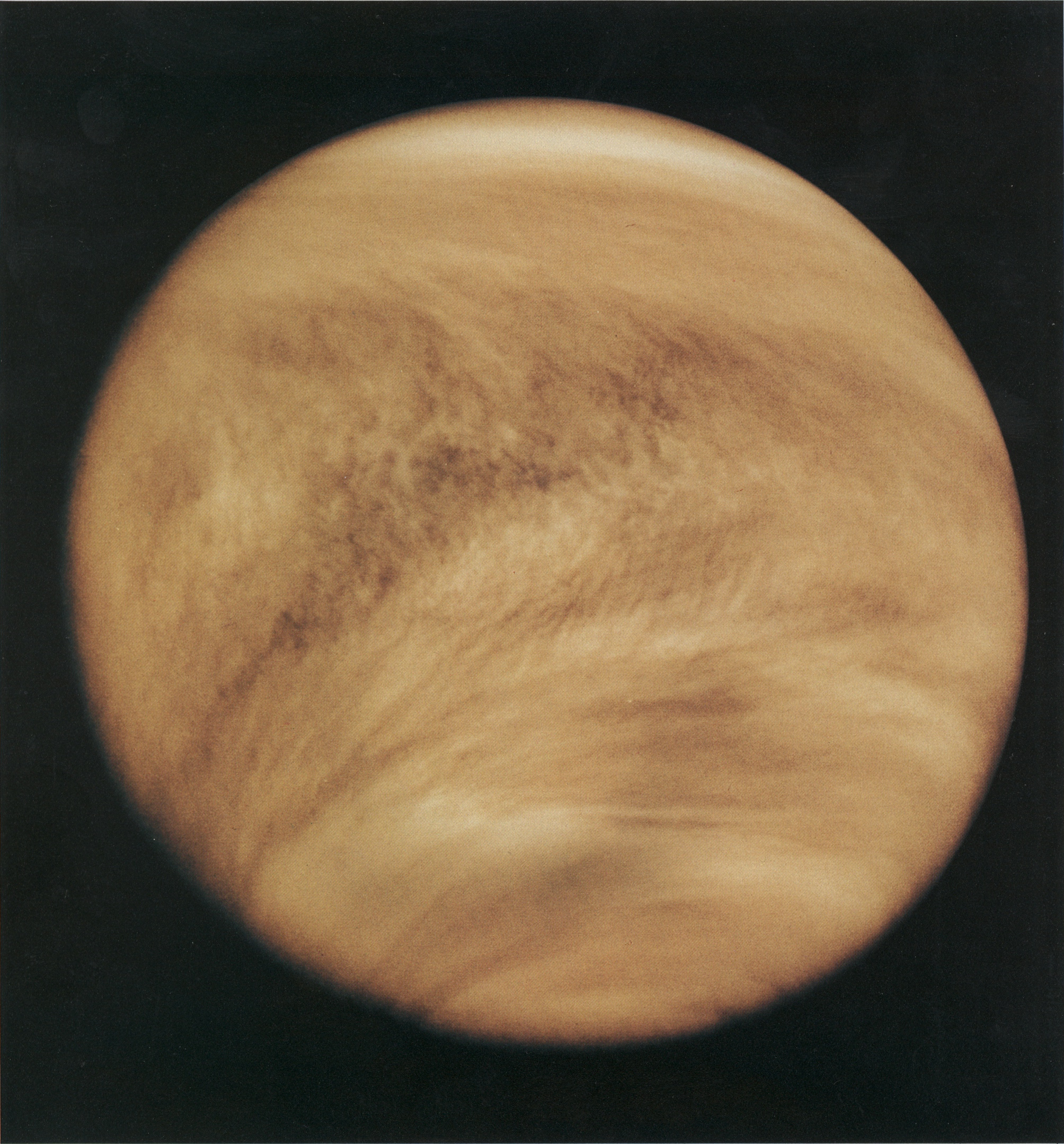
Atmosphere of Venus
图像
图注: This image of Venus was captured in ultraviolet light by the Pioneer Venus Orbiter and highlights features of the planet’s thick atmosphere that are not visible in ordinary light. Venus has a dense, cloudy atmosphere composed mainly of carbon dioxide. In ultraviolet wavelengths, patterns in the upper cloud layers become visible, revealing swirling structures and bright and dark bands caused by differences in the composition and motion of the atmosphere. These ultraviolet features help scientists map wind patterns, atmospheric circulation, and cloud dynamics high above Venus’s surface.
Unlike Earth’s atmosphere, which is relatively transparent in visible light, Venus’s atmosphere is so thick that no direct view of the surface is possible from space without special instruments. The extreme pressure and temperature near Venus’s surface are consequences of this dense gaseous envelope, making Venus a dramatic example of how different planetary atmospheres can be. This image demonstrates how observing a planet’s atmosphere in different wavelengths, such as ultraviolet, reveals details about its structure and behaviour.
来源: NASA
来源链接
词汇表:
大气层 , 金星
授权许可: 公共领域 公共领域 图标
文件
( 图像
8.09 MB)