文档与资源 - 搜索结果
搜索结果
The Hale Telescope
图像
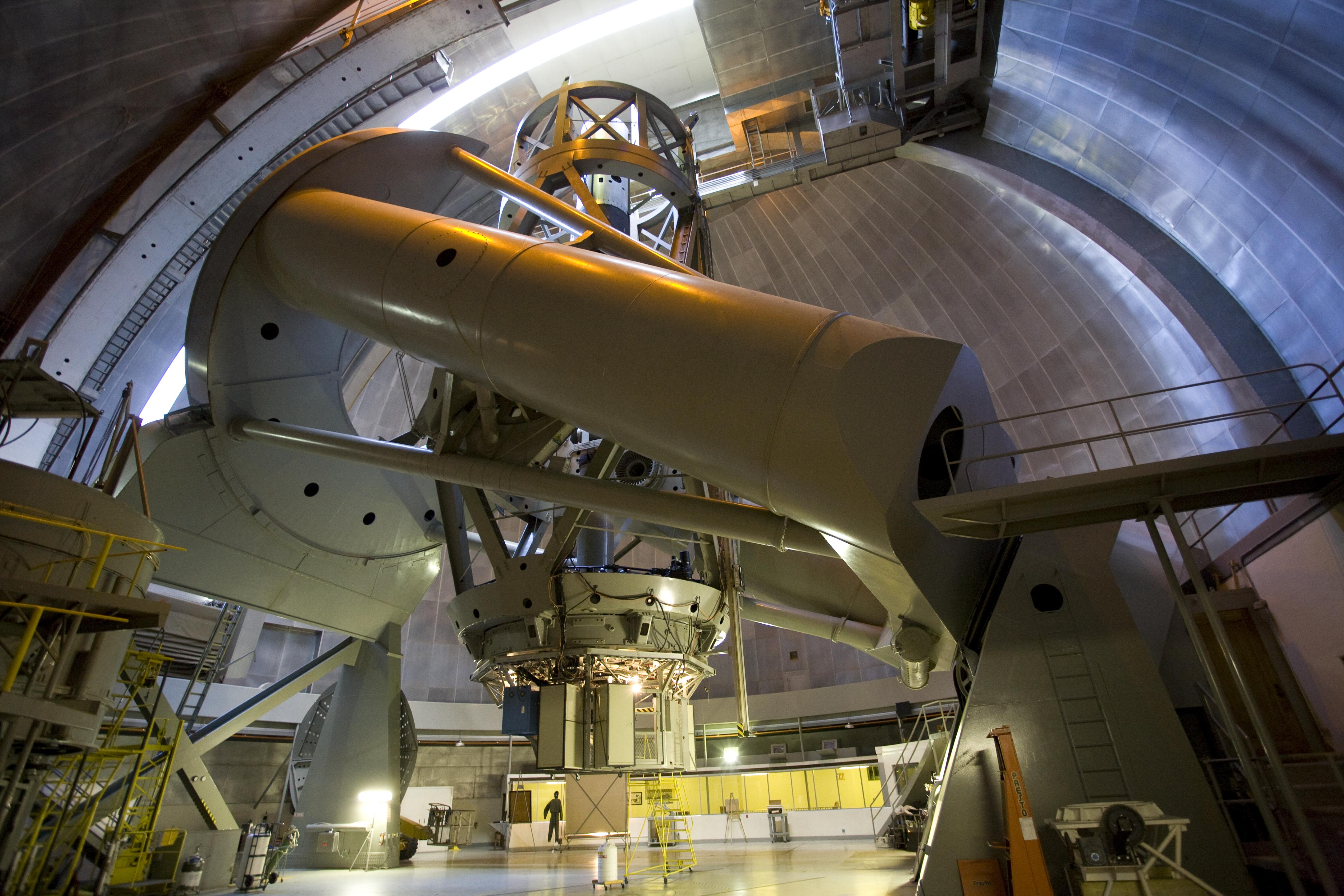
图注: This image shows the Hale Telescope at the Palomar Observatory in northern San Diego County, California, USA and operated by the California Institute of Technology (Caltech). With its 5.1 m primary mirror, the Hale Telescope was the largest effective optical telescope in the world from its first light in 1949 until 1993.
Here we see the Hale Telescope when not in operation. The telescope itself is the large, vertical, approximately cylindrical object in the centre of the image. Telescopes like this use mirrors to gather faint light and form clear images of distant targets, enabling scientists to study everything from nearby stars and planets to remote galaxies. The primary mirror, seen here at the bottom of the telescope, focusses light from the sky to the prime focus at the top of the telescope. Instruments such as cameras and spectrographs can be placed at this prime focus or alternatively a secondary mirror can reflect light back down the telescope and through a hole in the primary mirror to instruments.
The telescope is supported by a large mount, seen here at an angle to the telescope. This particular mount is a type of equatorial mount. This means that one of the rotation axes of the mount points to the celestial poles. When a star or galaxy moves across the sky due to the Earth's rotation, the telescope only has rotate on this axis to keep pointing at that star or galaxy. Most modern large telescopes use a different kind of mount and rely on computer calculations to accurately track an object across the sky.
The Hale Telescope is housed under a large rotating dome that opens at night so the telescope can track objects across the sky.
来源: JPL/Caltech/Palomar Observatory
来源链接
词汇表:
反射式望远镜 , 望远镜
分类:
观测天文学
, 望远镜、仪器与天文台
授权许可: 公共领域 公共领域 图标
文件
( 图像
12.65 MB)
The Callisto satellite
图像
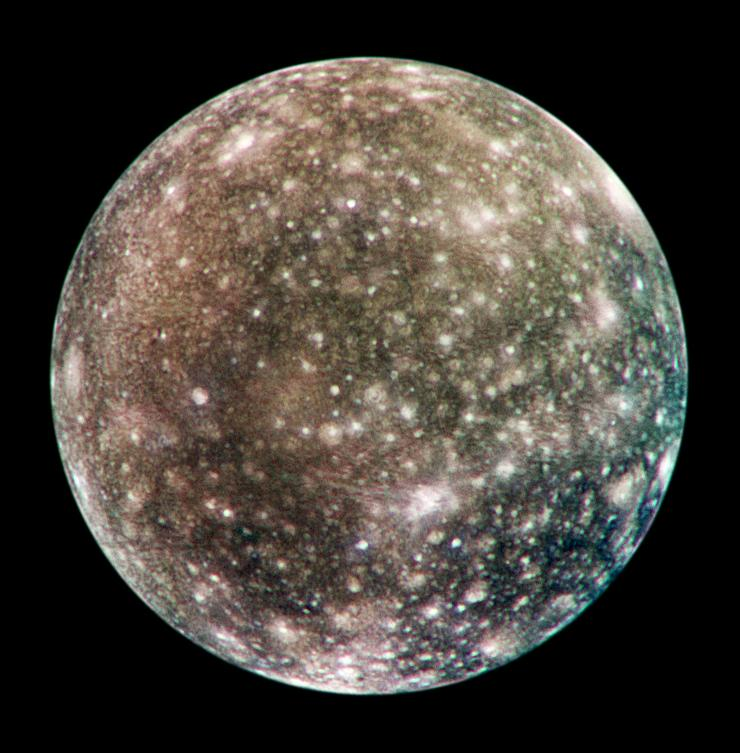
图注: Callisto is the outermost of the four large Galilean moons of Jupiter and the third largest in the whole solar system, falling behind only Ganymede and Saturn's moon Titan. It orbits Jupiter at an average distance of around 1.9 million kilometers, roughly six times the distance between Earth and the Moon.
With a diameter of nearly 5,000 kilometers, it is almost as large as Mercury, the smallest planet in our solar system, but has only a third of its mass as it is composed of approximately equal amounts of rock and ice.
Callisto orbits Jupiter in a tidally locked rotation, always showing the same side to Jupiter. In contrast to the other three Galilean satellites – Io, Europa, and Ganymede – it is not in orbital resonance due to its farther outward location and is thus not appreciably tidally heated. It does not show any signs of plate tectonics or volcanic activity. Its lack of geological processes means that surface features like craters remain unchanged for billions of years. It is thought to have evolved predominantly under the influence of impacts, as its surface is the oldest and most heavily cratered object in the solar system. In fact, it is so covered in craters that any new impact will likely erase a former one.
Callisto's internal structure is still subject to discussion; it may consist of a deep salty ocean. It is thought to be composed mainly of a mix of ice and rock, which are present in various states throughout the inner layers of the moon. Callisto hosts a very thin atmosphere composed mainly of carbon dioxide and some traces of oxygen. The moon has been studied by numerous space probes, such as the Pioneer and Voyager missions and the Galileo orbiter, and will be subject to further explorations by NASA, ESA, and China’s National Space Administration (CNSA).
来源: NASA/JPL/DLR
来源链接
词汇表:
伽利略卫星 , 卫星
授权许可: 公共领域 公共领域 图标
文件
( 图像
610.45 kB)

Apparatus for determining the gravitional constant
图像
图注: Observations of the motions of the planets around the Sun, or the Moon around the Earth, could not yield the gravitational constant, as in those cases, the mass of the central body is not initially known. Measuring the gravitational constant required a situation where the masses involved had been determined independent of measuring their gravitational attraction. The device shown here was built by John Michell (1724–1793), but Michell died before he could perform the experiment. Henry Cavendish (1731–1810) inherited the device, modified it so as to suppress external disturbances, and successfully completed the experiment. Cavendish's report to the Royal Society was under the title of "Experiments to determine the density of the Earth" as, from knowledge of the gravitational constant, the gravitational acceleration at Earth's surface and the Earth's radius, one can determine the Earth's mass and its mean density. From the modern perspective, what is now known as the "Cavendish experiment" is seen as a way of determining Newton's gravitational constant G.
The image shows a cross-section of the apparatus, which Cavendish had further isolated from environmental influences by putting it into a separate room and inside a wooden box. The devices allowing Cavendish to illuminate, observe and manipulate the experiment from the outside are pictured as well. The core of the experiment is a torsion balance using two small lead spheres. The restoring force of the torsion pendulum is deduced from its natural oscillation frequency in the absence of the large masses. The gravitational attraction of the small lead spheres to their larger counterparts can then be determined by measuring how far it makes the torsion pendulum masses deviate from their null position.
The image is a slightly modified (cropped, contrast and brightness adjusted) version of Fig. 1 in Cavendish's article in the Philosophical Transactions of the Royal Society, Volume 88 (December 1798), pp. 469–526 [DOI: 10.1098/rstl.1798.0022]. The permission of the Royal Society to publish this image under a CC BY licenses gratefully acknowledged.
来源: Henry Cavendish in Philosophical Transactions of the Royal Society, DOI: 10.1098/rstl.1798.0022
来源链接
词汇表:
引力常数 , 万有引力
分类:
物理学
授权许可: 知识共享许可协议 署名 4.0 国际 (CC BY 4.0) 知识共享许可协议 署名 4.0 国际 (CC BY 4.0) 图标
文件
( 图像
864.50 kB)