Glossar-Begriff: Rakete
Beschreibung: Raketen werden verwendet, um Raumfahrzeuge von der Erdoberfläche in den Weltraum zu bringen. Zu diesem Zweck besteht eine Rakete aus Raketentriebwerken sowie aus Treibstofftanks. Die Raketentriebwerke werden auch dazu verwendet, Raumfahrzeuge im Weltraum zu steuern, ihre Geschwindigkeit zu ändern oder Kurskorrekturen durchzuführen. Eine Raketentriebwerk funktioniert, indem es üblicherweise Raketentreibstoff verbrennt und so einen sehr schnellen Teilchenstrom erzeugt. Je nachdem, in welche Richtung dieser Strom gelenkt wird, wird das Raketentriebwerk in die entgegengesetzte Richtung beschleunigt. Das liegt an einem Grundgesetz der Physik: der Impulserhaltung. Wichtig ist, dass der Teilchenstrom nicht gegen irgendetwas stoßen muss, damit das klappt: Raketen funktionieren auch im beinahe perfekten Vakuum des Weltraums.
Ähnliche Begriffe:
Dieser Begriff in anderen Sprachen
Begriffs- und Definitionsstatus Die Originaldefinition dieses Begriffes auf Englisch wurden von einem forschenden Astronom und einer Lehrkraft bestätigt Die Übersetzung dieses Begriffs und seiner Definition warten auf Prüfung und Bestätigung
The OAE Multilingual Glossary is a project of the IAU Office of Astronomy for Education (OAE) in collaboration with the IAU Office of Astronomy Outreach (OAO). The terms and definitions were chosen, written and reviewed by a collective effort from the OAE, the OAE Centers and Nodes, the OAE National Astronomy Education Coordinators (NAECs) and other volunteers. You can find a full list of credits here. All glossary terms and their definitions are released under a Creative Commons CC BY-4.0 license and should be credited to "IAU OAE".
Wenn dir ein inhaltlicher oder Übersetzungsfehler in diesem Glossarbegriff oder dieser Definition auffallen, bitte kontaktiere uns.
Ähnliche Medien
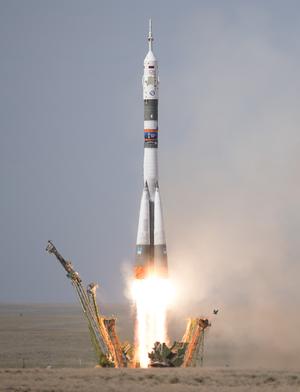
Start einer Sojus-Rakete
Unterschrift: Die Sojus MS-09-Rakete startete am 6. Juni 2018 vom Kosmodrom Baikonur in Kasachstan und brachte die Besatzung der Expedition 56 zur Internationalen Raumstation (ISS). Die Besatzung bestand aus dem Sojus-Kommandanten Sergej Prokopjew von Roskosmos, der Flugingenieurin Serena Auñón-Chancellor von der NASA und dem Flugingenieur Alexander Gerst von der ESA (European Space Agency).
Bild: NASA/Joel Kowsky
Quellenlink
License: CC-BY-NC-ND-2.0 Creative Commons Namensnennung - Nicht-kommerziell - Keine Bearbeitung 2.0 Generic Symbole

The Speed of Spacecraft
Unterschrift: This infographic is part of the "Simplifying Astronomy for Arabic Speakers" project, aiming to present scientific concepts in a simple and accessible way. The design focuses on the speed of spacecraft during the various stages of their launch, illustrating how velocity changes as the spacecraft progresses to reach the desired orbit.
Details of the Stages:
Stage One (Launch):
The spacecraft begins its journey by launching from the launch pad with an increasing speed. The velocity in this stage is influenced by Earth's gravity and atmospheric resistance.
After One Minute:
The spacecraft reaches a speed of approximately 1,600 kilometers per hour (km/h), reflecting a rapid acceleration powered by its engines.
After Two and a Half Minutes:
The rocket boosters are jettisoned, allowing the spacecraft to reach a speed of about 4,800 km/h. At this point, the spacecraft becomes lighter, enabling it to accelerate more efficiently.
Final Stage:
By the end of the ascent phase, the spacecraft achieves its final speed of approximately 28,000 km/h, allowing it to enter the desired orbit around Earth.
Through educational designs like this, the project provides enthusiasts with an opportunity to understand the intricate details of space missions in an engaging and simplified manner.
Bild: Ali Al-Edhari ; Background image credit - NASA
License: CC-BY-4.0 Creative Commons Namensnennung 4.0 International (CC BY 4.0) Symbole