Terme du glossaire : Galaxie à disque
Description : Une galaxie à disque est un type de galaxie qui présente une composante plate d'étoiles, de gaz et de poussières, toutes en mouvement circulaire coplanaire autour du centre de la galaxie. Les bras spiraux et l'activité de formation d'étoiles qui y est associée sont souvent présents dans ces disques. Dans la plupart des systèmes de classification des galaxies, les galaxies à disque se distinguent des galaxies elliptiques, irrégulières et naines.
Termes associés :
Voir ce terme dans d'autres langues
Statut du terme et de sa définition : La définition initiale de ce terme en anglais a été aprouvée par un·e spécialiste de la recherche en astronomie et un·e spécialiste de l’éducation La traduction de ce terme et de sa définition n'ont pas encore été aprouvées
Le glossaire multilangue de l'OAE est un projet du Bureau de l'IAU de l'Astronomie pour l'Education (OAE) en collaboration avec le Bureau de l'IAU de diffusion de l'Astronomie (OAO). Les termes et définitions ont été choisis, écrits et relues grâce à un effort collectif de l'OAE, les Centres et les Noeuds de l'OAE, les Coordinateurs Nationaux de l'Astronomie pour l'Education de l'OAE(NAECs) et d'autres volontaires. La liste complète des crédits pour ce projet est disponible ici . Tous les termes du glossaire et leur définition sont déposés sous licence Creative Commons CC BY-4.0 et doivent être créditées au nom de "IAU OAE".
Si vous constatez une erreur dans ce terme ou sa définition, veuillez nous contacter .
Dans d'autres langues
- Arabe: المجرة القرصية
- Allemand: Scheibengalaxie
- Anglais: Disk Galaxy
- Espagnol: Galaxia de disco
- Italien: Galassia a disco
- Japonais: 円盤銀河 (Liens externes)
- Coréen: 원반은하
- Portugais brésilien: Disco Galaxy
- Chinois simplifié: 盘状星系
- Chinois traditionnel: 盤狀星系
Media associé
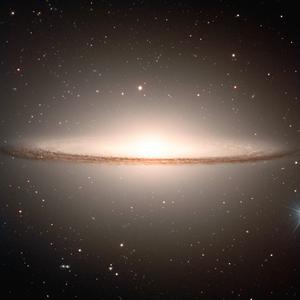
Sombrero galaxy
Légende : This prominent galaxy M 104 is often called the Sombrero galaxy due to its resemblance to the Mexican hat. This look is created by the thin disk oriented nearly edge-on, which appears illuminated by the dominant bulge. Both, the disk and bulge contain stars, but the stars in the bulge tend to be older, while the disk also harbors large amounts of dust and gas creating shadows. M 104 is located in the constellation Virgo approximately 50 light-years away. While some of the dots visible in the picture are foreground stars and others background galaxies, the majority are actually globular clusters, dense massive clusters of stars, associated with the Sombrero Galaxy.
Crédit : ESO/P. Barthel
Lien vers les crédits
License: CC-BY-4.0 Creative Commons (CC) Attribution 4.0 International (CC BY 4.0) Icônes

A visible light image of the Andromeda Galaxy
Légende : The Andromeda Galaxy viewed in visible light. Like our Milky Way, Andromeda is a barred spiral galaxy. Here we can see its bright core and spiral disk. The glow from the stars in the disk is interrupted by lanes of dust that form part of its spiral structure.
Andromeda is the largest galaxy in the Local Group of galaxies that includes the Milky Way.
To the left of the core and just above the disk we see the dwarf galaxy M32 and to the right and below the disk we see the dwarf galaxy M110. These are both satellite galaxies of the Andromeda Galaxy.
Crédit : Torben Hansen
Lien vers les crédits
License: CC-BY-2.0 Creative Commons (CC) Attribution 2.0 Générique Icônes

The Lenticular Galaxy NGC 2787
Légende : The lenticular galaxy NGC 2787. This galaxy is a disk galaxy but lacks the large, dominant spiral arm structure seen in the disks of spiral galaxies. Its core is very bright compared to the core of a spiral galaxy. Thin rings of dust can be seen in the galaxy's disk.
Crédit : NASA/ESA and The Hubble Heritage Team
Lien vers les crédits
License: CC-BY-4.0 Creative Commons (CC) Attribution 4.0 International (CC BY 4.0) Icônes

Spiral Galaxy UGC 2885
Légende : This image shows UGC 2885, a spiral galaxy located in the constellation Perseus, about 230 million light-years from Earth. Spiral galaxies have rotating disks of stars, gas, and dust, with spiral arms extending outward from the central region. In UGC 2885, these arms are very broad and faint, revealing the galaxy’s large size. This galaxy is tilted at an angle to the observer on Earth, meaning it does not appear as the circular "grand design" spiral it would look like if viewed face-on, nor as the thin line with a central bulge it would appear as if viewed edge-on.
UGC 2885 is remarkable because it is roughly twice the diameter of the Milky Way. It was studied by astronomer Vera Rubin, whose observations of how galaxies rotate — including systems like this one — played a key role in the search for dark matter.
The bright star which appears to the left of the galaxy's center is a foreground object not related to the galaxy.
Crédit : NASA, ESA, Benne Holwerda (University of Louisville)
Lien vers les crédits
License: PD Domaine Public Icônes








.jpg)

- Ressources
- Moteur de recherche des ressources pédagogiques
- Parcourir les ressources pédagogiques par Sujet
- Parcourir les images
- AstroEdu - Activités en classe
- Grandes Idées - Littéracie en astronomie
- Glossaire
- Rapports de l'OAE
- L'astronomie pour l'Education à travers le monde
- Sélection de ressources externes