Terme du glossaire : Galaxie elliptique
Description : Une galaxie elliptique est un type de galaxie qui a une apparence régulière et elliptique, comme une sphère écrasée sur un ou deux axes, contrairement aux galaxies à disque qui ont la forme d'une crêpe. Elle contient généralement de vieilles étoiles de couleur jaune-rouge. Par rapport aux galaxies spirales, les galaxies elliptiques ont généralement très peu de gaz et très peu de formation d'étoiles en cours.
Termes associés :
Voir ce terme dans d'autres langues
Statut du terme et de sa définition : La définition initiale de ce terme en anglais a été aprouvée par un·e spécialiste de la recherche en astronomie et un·e spécialiste de l’éducation La traduction de ce terme et de sa définition n'ont pas encore été aprouvées
Le glossaire multilangue de l'OAE est un projet du Bureau de l'IAU de l'Astronomie pour l'Education (OAE) en collaboration avec le Bureau de l'IAU de diffusion de l'Astronomie (OAO). Les termes et définitions ont été choisis, écrits et relues grâce à un effort collectif de l'OAE, les Centres et les Noeuds de l'OAE, les Coordinateurs Nationaux de l'Astronomie pour l'Education de l'OAE(NAECs) et d'autres volontaires. La liste complète des crédits pour ce projet est disponible ici . Tous les termes du glossaire et leur définition sont déposés sous licence Creative Commons CC BY-4.0 et doivent être créditées au nom de "IAU OAE".
Si vous constatez une erreur dans ce terme ou sa définition, veuillez nous contacter .
Dans d'autres langues
- Arabe: المجرة البيضوية
- Allemand: Elliptische Galaxie
- Anglais: Elliptical Galaxy
- Espagnol: Galaxia elíptica
- Italien: Galassia ellittica
- Japonais: 楕円銀河 (Liens externes)
- Coréen: 타원은하
- Portugais brésilien: Galáxia Elíptica
- Chinois simplifié: 椭圆星系
- Chinois traditionnel: 橢圓星系
Media associé

La galaxie elliptique géante ESO 325-G004
Légende : La galaxie elliptique géante ESO 325-G004 se trouve dans l'amas de galaxies Abell S0740. Cette énorme galaxie a une masse d'environ cent milliards de masses solaires. ESO 325-G004 est la plus brillante dans son noyau et sa luminosité diminue à mesure que l'on s'éloigne de son centre. Cette galaxie n'a pas de structure spirale visible ni de couloirs de poussière. ESO 325-G004 et de nombreuses galaxies plus petites autour d'elle sont membres de l'amas de galaxies Abell S0740.
Crédit : Recadré à partir de l'original par la NASA, l'ESA et l'équipe Hubble Heritage (STScI/AURA) ; J. Blakeslee (Washington State University)
Lien vers les crédits
License: PD Domaine Public Icônes

Jet Ejected from the Active Galaxy M87
Légende : A 3000-light-year-long jet streaming from the core of galaxy M87, as captured by the Hubble Space Telescope. The center of this image shows the core of the elliptical galaxy M87 (in the constellation Virgo) which hosts an active galactic nucleus (AGN).
An AGN is a very luminous region around a supermassive black hole. It is powered by matter falling towards the black hole and forming a hot accretion disk. Many galaxies host a supermassive black hole, but not all of them are accreting enough matter to appear as an AGN.
The strong gravity of the supermassive black hole in the heart of M87 has caused a huge jet of charges particles to be flung out from the accretion disk. This extends far out into the galaxy itself, beyond the core region. Here we see the jet as a whitish-blue line which gets wider the further it goes from the core. The light emission we see here is caused by the energetic electrons in the jet interacting with magnetic fields.
Crédit : NASA, ESA, A. Lessing (Stanford University), E. Baltz (Stanford University), M. Shara (AMNH), J. DePasquale (STScI)
Lien vers les crédits
License: CC-BY-4.0 Creative Commons (CC) Attribution 4.0 International (CC BY 4.0) Icônes
Diagrammes associés
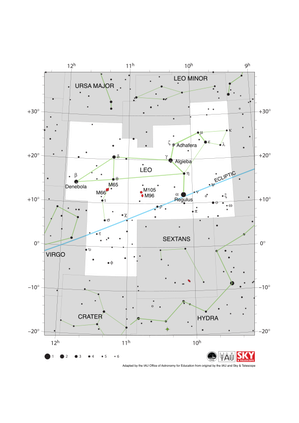
Leo Constellation Map
Légende : The zodiac constellation Leo and its surrounding constellations. Starting from the top of the diagram and going clockwise, these are Leo Minor, Cancer, Sextans, Hydra, Crater, Virgo and Ursa Major. The brightest star in Leo, Regulus, lies almost exactly on the ecliptic (shown here as a blue line): the path the Sun appears to take across the sky over the course of a year. The Sun spends the period from mid August to mid September in Leo. The other planets in the Solar System can often be found in Leo.
Leo spans the celestial equator and is thus part of it is visible at some time in the year from all of planet Earth with some of the constellation obscured for the most arctic and antarctic regions of the world. Leo is most visible in the evenings in the northern hemisphere spring and southern hemisphere autumn.
Several objects can be seen in Leo, including M65 and M66 – two galaxies in the Leo Triplet, a trio of galaxies including NGC 3628, not listed here. In addition, M96, a spiral galaxy, can be seen as a fuzzy object using a small telescope, and Messier 105, an elliptical galaxy. Each of these objects are labelled on the map as red ellipses.
The y-axis of this diagram is in degrees of declination with north as up and the x-axis is in hours of right ascension with east to the left. The sizes of the stars marked here relate to the star's apparent magnitude, a measure of its apparent brightness. The larger dots represent brighter stars. The Greek letters mark the brightest stars in the constellation. These are ranked by brightness with the brightest star being labelled alpha, the second brightest beta, etc., although this ordering is not always followed exactly. The dotted boundary lines mark the IAU's boundaries of the constellations and the solid green lines mark one of the common forms used to represent the figures of the constellations. Neither the constellation boundaries, nor the line marking the ecliptic, nor the lines joining the stars appear on the sky.
Crédit : Adapted by the IAU Office of Astronomy for Education from the original by IAU/Sky & Telescope
License: CC-BY-4.0 Creative Commons (CC) Attribution 4.0 International (CC BY 4.0) Icônes
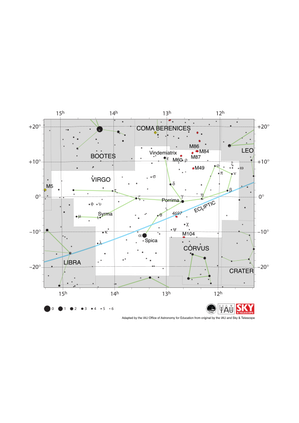
Virgo Constellation Map
Légende : The zodiac constellation Virgo and its surrounding constellations. Starting from the top of the diagram and going clockwise, these are Coma Berenices, Leo, Crater, Corvus, Libra, and Bootes. The brightest star in Virgo, Spica, lies just below the ecliptic (shown here as a blue line) in the middle of the map. One way of locating this star in the night sky is to follow the handle of the Big Dipper to the star Arcturus in Bootes and go along a line straight down to Spica (“arc to Arcturus and spike to Spica”). This star lies just below the ecliptic. The ecliptic is the path the Sun appears to take across the sky over the course of a year. The Sun is in Virgo from mid September to late October. The other planets of the Solar System can often be found in Virgo.
Virgo spans the celestial equator and is thus part of it is visible at some time in the year from all of planet Earth with some of the constellation obscured for the most arctic and antarctic regions of the world. Virgo is most visible in the evenings in the northern hemisphere spring and southern hemisphere autumn.
The constellation Virgo appears as a person lying with their back roughly against the ecliptic, arms outstretched, and feet pointed east. Several deep-sky objects are visible in Virgo, including NGC4697, M49, M87, M86, M84, and M60, all of which are labelled as red ellipses on the map. These are all spiral and elliptical galaxies located several millions of lightyears from Earth. Most notably, M87 is host to the supermassive black hole (Pōwehi) that was imaged by the Event Horizon Telescope in 2019. All of these galaxies are members of the Virgo Cluster, the nearest cluster of galaxies to the Milky Way.
The y-axis of this diagram is in degrees of declination with north as up and the x-axis is in hours of right ascension with east to the left. The sizes of the stars marked here relate to the star's apparent magnitude, a measure of its apparent brightness. The larger dots represent brighter stars. The Greek letters mark the brightest stars in the constellation. These are ranked by brightness with the brightest star being labelled alpha, the second brightest beta, etc., although this ordering is not always followed exactly. The dotted boundary lines mark the IAU's boundaries of the constellations and the solid green lines mark one of the common forms used to represent the figures of the constellations. Neither the constellation boundaries, nor the line marking the ecliptic, nor the lines joining the stars appear on the sky.
Crédit : Adapted by the IAU Office of Astronomy for Education from the original by IAU/Sky & Telescope
License: CC-BY-4.0 Creative Commons (CC) Attribution 4.0 International (CC BY 4.0) Icônes

Carte de la constellation Chevelure de Bérénice
Légende : La constellation Chevelure de Bérénice avec ses étoiles les plus brillantes et les constellations environnantes. La Chevelure de Bérénice est entourée de (dans le sens des aiguilles d'une montre à partir du haut) : les Chiens de chasse, La Grande Ourse, le Lion, la Vierge et le Bouvier. Cette constellation contient relativement peu d'étoiles brillantes.
La Chevelure de Bérénice est une constellation septentrionale proche de l'équateur céleste. En tant que telle, la constellation entière est visible à un moment ou à un autre de l'année partout sur Terre, à l'exception des régions les plus antarctiques. La constellation est plus facile à observer le soir à la fin du printemps dans l'hémisphère nord et à la fin de l'automne dans l'hémisphère sud.
La Chevelure de Bérénice abrite un grand amas de galaxies connu sous le nom de Super amas de la Chevelure de Bérénice. Cependant, aucune des galaxies de cet amas n'est indiquée sur ce diagramme car elles sont trop peu lumineuses pour être observées avec la plupart des télescopes amateurs. La galaxie elliptique M85 et la galaxie spirale M100 font partie de l'amas de galaxies de la Vierge, plus proche. Elles sont marquées par des ellipses rouges, tout comme les galaxies encore plus proches M64 et NGC 4565, qui sont toutes deux des galaxies spirales. L'amas globulaire M53, marqué ici d'un cercle jaune avec un signe plus superposé, se trouve également dans la Chevelure de Bérénice.
L'axe des y de ce diagramme est en degrés de déclinaison avec le nord en haut et l'axe des x est en heures d'ascension droite avec l'est à gauche. La taille des étoiles marquées ici correspond à la magnitude apparente de l'étoile, une mesure de sa luminosité apparente. Les points les plus gros représentent les étoiles les plus brillantes. Les lettres grecques indiquent les étoiles les plus brillantes de la constellation. Elles sont classées par ordre de luminosité, l'étoile la plus brillante étant étiquetée alpha, la deuxième plus brillante bêta, etc., bien que cet ordre ne soit pas toujours respecté à la lettre. Les lignes pointillées délimitent les frontières des constellations selon l'UAI et les lignes vertes pleines représentent l'une des formes couramment utilisées pour représenter les figures des constellations. La ligne bleue en bas à droite du diagramme marque l'écliptique. Ni les limites des constellations, ni la ligne marquant l'écliptique, ni les lignes reliant les étoiles n'apparaissent dans le ciel.
Crédit : Adapté par le Bureau de l'astronomie pour l'éducation de l'AIU à partir de l'original de l'AIU et de Sky & Telescope.
License: CC-BY-4.0 Creative Commons (CC) Attribution 4.0 International (CC BY 4.0) Icônes
Ceci pourrait vous intéresser également









- Ressources
- Moteur de recherche des ressources pédagogiques
- Parcourir les ressources pédagogiques par Sujet
- Parcourir les images
- AstroEdu - Activités en classe
- Grandes Idées - Littéracie en astronomie
- Glossaire
- Rapports de l'OAE
- L'astronomie pour l'Education à travers le monde
- Sélection de ressources externes