Glossar-Begriff: F-Stern
Beschreibung: Ein F-Stern gehört der Spektralklasse "F" an. Astronomen erkennen F-Sterne an ihren mäßig stark ionisierten Kalziumlinien und einigen anderen atomaren Metalllinien sowie an den schwachen Wasserstoff-Absorptionslinien in ihren Spektren. Sie haben typische (effektive) Temperaturen zwischen 6000 Kelvin (K) und 7400 K. Im Vergleich zu anderen Sternen erscheinen sie dem menschlichen Auge weiß oder gelblich-weiß, es sei denn, die interstellare oder atmosphärische Extinktion spielt eine Rolle. Ein Beispiel für einen F-Stern ist der Polarstern (Polaris) im Sternbild Kleiner Bär.
Ähnliche Begriffe:
Dieser Begriff in anderen Sprachen
Begriffs- und Definitionsstatus Die Originaldefinition dieses Begriffes auf Englisch wurden von einer*einem forschenden Astronom*in und einer Lehrkraft bestätigt Die Übersetzung dieses Begriffs und seiner Definition warten auf Prüfung und Bestätigung
Der mehrsprachige OAE-Glossar ist ein Projekt des IAU Office of Astronomy for Education (OAE) als Bildungsbüro der Internationalen Astronomischen Union in Zusammenarbeit mit dem IAU Office of Astronomy Outreach (OAO). Die Begriffe und Definitionen wurden gewählt, geschrieben und geprüft durch einen kollektiven Aufwand des OAE, des OAE Zentren und Knotenpunkte, des OAE National Astronomy Education Coordinators (NAECs, Nationale Koordinatoren für astronomische Bildungsarbeit) und anderen Freiwilligen. Die volle Liste an Mitarbeitenden ist hier. Alle Glossar-Begriffe und ihre Definitionen sind unter einer Creative Commons CC BY-4.0 Lizenz veröffentlicht und sollten "IAU OAE" zugeschrieben werden.
Wenn dir ein inhaltlicher oder Übersetzungsfehler in diesem Glossarbegriff oder dieser Definition auffallen, bitte kontaktiere uns.
Auf anderen Sprachen
- Arabisch: النجم من النوع الطيفي "F"
- Englisch: F-type Star
- Spanisch: Estrella de tipo F
- Französisch: Étoile de type F
- Italienisch: Stella di tipo F
- Japanisch: F型星 (externer Link)
- Koreanisch: 에프형별
- Brasilianisches Portugiesisch: Estrela tipo F
- Vereinfachtes Chinesisch: F 型星
- Traditionelles Chinesisch: F 型星
Ähnliche Diagramme
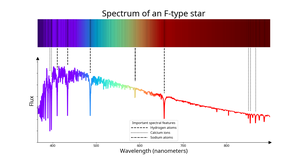
Spectrum of an F-type star
Unterschrift: The spectrum of the F-type star 2MASS J22243289+4937443. The colour of the line between 400 nm and 700 nm roughly corresponds to the colour the human eye would see light of that wavelength. Below 400 nm and above 700 nm, where the human eye can see little to no light, the lines are coloured blue and red respectively.
The black lines show spectral absorption lines caused by atoms and ions of different elements in the star’s atmosphere. These atoms and ions absorb at specific wavelengths, causing sharp, dark lines in the spectra. How strong these lines are depends on the temperature of the star’s atmosphere. Two stars made from the same mix of elements could have spectra with vastly different sets of lines in their spectra if they have different temperatures in their atmospheres. The lines from hydrogen atoms that are strongest in A-type stars are still relatively strong in F-type stars but lines from metals, particularly ionised calcium begin to become strong at this spectral type.
Bild: IAU OAE/SDSS/Niall Deacon
License: CC-BY-4.0 Creative Commons Namensnennung 4.0 International (CC BY 4.0) Symbole