Término del glosario: Géminis
Descripción: Géminis es una de las 13 constelaciones del zodíaco y una de las 88 constelaciones modernas reconocidas por la Unión Astronómica Internacional, pero su origen se remonta mucho más atrás: ya formaba parte de las 48 constelaciones nombradas por el astrónomo del siglo II Claudio Ptolomeo. La constelación debe su nombre a sus dos estrellas más brillantes, Cástor y Pólux, que en la mitología babilónica eran gemelos y dioses menores. Géminis es visible en el hemisferio norte durante el invierno, situada entre las constelaciones de Tauro y Cáncer. Diversas culturas alrededor del mundo tienen sus propias historias asociadas a esta constelación y a sus estrellas. Cástor y Pólux se encuentran a unos 50 y 30 años luz de la Tierra, respectivamente. En Géminis se pueden ver unas 80 estrellas a simple vista. Algunos objetos del cielo profundo destacados situados en la región de esta constelación son M35, NGC 2158, NGC 2392 y Abell 21.
Términos relacionados:
Ver este término en otros idiomas
Estado del término y la definición: La definición original de este término en inglés ha sido aprobada por unastrónomo o astrónoma investigadora y un docente La traducción de este término y su definición aún están pendientes de aprobación
El Glosario multilingüe de la OAE es un proyecto de la Oficina de Astronomía para la Educación de la UAI (OAE) en colaboración con la Oficina de Divulgación de Astronomía de la UAI (OAO). Los términos y definiciones fueron seleccionados, redactados y revisados gracias al esfuerzo colectivo de la OAE, los Centros y Nodos de la OAE, los Coordinadores Nacionales de Educación Astronómica (NAECs) y otros voluntarios. Puedes encontrar una lista completa de créditos aquí. Todos los términos del glosario y sus definiciones se publican bajo la licencia Creative Commons CC BY-4.0 y deben atribuirse a la "IAU OAE".
Si detectas algún error de contenido o de traducción en este término del glosario o en ladefinición, ponte en contacto con nosotros.
Contenidos relacionados
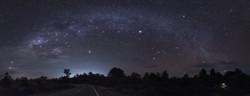
Most Brightest Stars of the Sky
Pie de foto: Honourable mention in the 2022 IAU OAE Astrophotography Contest, category Still images of celestial patterns.
Taken in March 2016 in Bromo-Tengger-Semeru National Park, Java Island, Indonesia, this image shows the arch of the Milky Way and many prominent constellations, including many of the brightest stars in the night sky.
In the lower-left corner, we see Rigil Kentaurus and Hadar, the first one lower and the other higher up, both located in the large constellation Centaurus. As pointers they point towards Crux, the Southern Cross, whose long axis points towards the southern pole, which is located roughly at the horizon because the Island of Java is almost at the equator. Crux is almost entirely obscured by clouds, with only the four bright stars visible in the photograph. Confusingly, the asterism of the False Cross (consisting of stars in Argo, The Ship) is clearly prominent a bit further up the Milky Way.
The pinkish spot between the true and the False Cross is the Carina Nebula, located about 8500 light-years from Earth, in the constellation Carina, and invisible to the unaided eye. In Carina we can also find Canopus, the second-brightest star in the night sky, seen just below the Galaxy and above the road on the ground.
Even brighter is Sirius, the brightest star in the night sky. Sirius lies in the constellation Canis Major, The Great Dog, one of the dogs that follow Orion, the Hunter, who is depicted in the right half of this image, just above the clouds at the horizon. Orion’s Belt of three bright stars points to Sirius in the upper left and to Aldebaran in the lower right, just above the horizon.
Orion contains some of the brightest stars in the sky, making it the most colourful constellation as it hosts Rigel, the bright bluish star below the Galaxy toward the right, and Betelgeuse, the reddish bright star higher up and to the right of Rigel. Between them we find the three stars that comprise the belt of Orion, a famous asterism. Just next to the belt we find the Great Orion Nebula, a star-forming region whose bright centre is visible to the unaided eye and also in this image.
Above Betelgeuse but on the opposite side of the Galaxy, we see the bright star Procyon, whose name means literally “Before the Dog”. It is mythologically often considered a tiny one-star dog asterism accompanying Orion, and transformed into the modern constellation of Canis Minor.
In the upper-right corner, the Beehive Star Cluster in the constellation Cancer is easily recognisable. Below it, we find the constellation Gemini with the stars Pollux and Castor, which are not prominent in this image. In contrast, the bright white star Capella in the constellation Auriga, the Charioteer, shines through the clouds at the middle-right edge of the image.
Some light pollution is visible along the road.
Crédito: Giorgia Hofer/IAU OAE
License: CC-BY-4.0 Creative Commons Reconocimiento 4.0 Internacional (CC BY 4.0) íconos
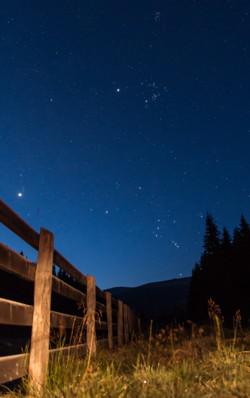
Romanian Orion
Pie de foto: Winner in the 2022 IAU OAE Astrophotography Contest, category Still images of celestial patterns.
Taken in Romania in August 2012, this image shows two of the most recognisable constellations in the sky, Orion and Taurus.
Orion, the Hunter, is found near the horizon. The most prominent star visible in this image is Betelgeuse, while the asterism of Orion’s belt is formed by three aligned bright stars. Just above Orion we can find Taurus, one of the constellations of the Zodiac. As the Zodiac is inherited from Babylon, The Bull of Heaven represents a mighty but dangerous creature that was defeated by King Gilgamesh and his friend Enkidu. They cut the Bull in half and sacrificed the animal to the gods in order to protect their people. Taurus is also home to the star cluster Pleiades, also known as the Seven Sisters. Two planets are visible: Venus, the bright spot near the fence, and Jupiter, the bright spot at the top, next to the Bull’s face.
Different cultures have included the stars of these constellations in their own mythology. The Romanians, for instance, after Christianisation identified four other constellations using some of the stars of Orion and others surrounding it. One such constellation is called Trisfetitele (the Three Saints), which is associated with the three stars comprising Orion's Belt, representing the Three Hierarchs Basil, Gregory and John. This same asterism is also called Three Wise Men, Kings from the East or just Three Kings — all of these names being rooted in the Christian religion.
The agricultural calendar, in contrast, led farmers to define two other constellations, the Little Plough and the Sickle. Both are seen in the southern half of the Orion rectangle; the Little Plough is drawn by connecting the southern quadrilateral with Orion’s left shoulder, and the Sickle is formed by connecting Orion’s left foot (Rigel) with the belt stars, forming an arch and completing the form of a hoe. In the cultural calendar, these constellations were used to announce the harvest of wheat/grain. Finally, the fourth Romanian constellation is the Great Auger, where Orion’s belt represents the handle of the auger, and Betelgeuse is the tip, facing towards Pollux in Gemini. This constellation is associated with treasure, as Romanian peasants believe that the Auger points to the treasure when they approach the end of the world.
Most of the official star names in Orion are Arabic; Mintaka (meaning “belt”) is at the waist; Alnitak (meaning “girdle”) and Alnilam (meaning “string”) are at the belt; and Rigel (meaning foot) is at the left foot. The star on the left shoulder is named Bellatrix, the Latin term for a female warrior. The star at the right leg is called Saiph, for the sword or sabre of the Arabic Orion.
Crédito: Alex Conu/IAU OAE
License: CC-BY-4.0 Creative Commons Reconocimiento 4.0 Internacional (CC BY 4.0) íconos

The Geminid Fireball
Pie de foto: Honorable mention in the 2023 IAU OAE Astrophotography Contest, category of Still images taken exclusively with smartphones/mobile devices.
Captured with a smartphone on 13 December 2022, a Geminid meteor illuminated the sky above Blue Moon Valley in Yunnan, China, casting a breathtaking display against the serene backdrop of the Jade Dragon Snow Mountain. Renowned for their dazzling brightness and vivid hues, the Geminids are among the most vibrant meteor showers, originating from the asteroid 3200 Phaethon. Each year, as our planet traverses Phaethon’s debris trail, fragments of dust and rock vaporise in the atmosphere, creating the stunning phenomenon of the Geminid meteor shower. In this stunning night sky image, the twin stars of Gemini (Castor and Pollux) are obscured by the silhouetted trees on the left. Mirrored in the calm waters are the stars that make up the constellation of Orion, which can be seen rising towards the bottom-centre of the image, while the radiant Mars retains its brilliance as the foremost celestial beacon in the scene, all before the moonrise takes over.
Crédito: Jianfeng Dai/IAU OAE (CC BY 4.0)
License: CC-BY-4.0 Creative Commons Reconocimiento 4.0 Internacional (CC BY 4.0) íconos
Diagramas relacionados
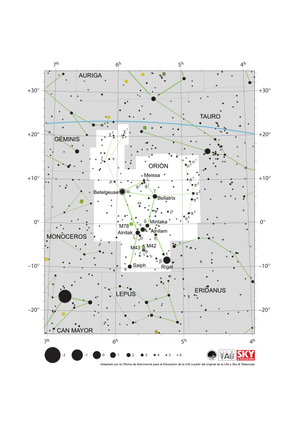
Mapa de la constelación de Orión
Pie de foto: La constelación de Orión junto con sus estrellas brillantes y las constelaciones circundantes. Orión está rodeada (en el sentido de las agujas del reloj desde arriba) por Tauro, Eridanus, Lepus, Monoceros y Géminis. Las estrellas más brillantes de Orión, Betelgeuse y Rígel, aparecen en los extremos norte (arriba en este diagrama) y sur (abajo) de la constelación, respectivamente, con el famoso "cinturón" de tres estrellas en el centro.
Orión atraviesa el ecuador celeste y, por tanto, es visible en algún momento del año desde todo el planeta Tierra. En las regiones más árticas o antárticas del mundo, algunas partes de la constelación pueden no ser visibles. Orión es más visible por las tardes en el invierno del hemisferio norte y en el verano del hemisferio sur. La línea azul sobre Orión marca la eclíptica, el camino que el Sol parece recorrer a través del cielo en el transcurso de un año. El Sol nunca pasa por Orión, pero ocasionalmente se pueden encontrar los demás planetas del Sistema Solar y la Luna en Orión.
Justo al sur del cinturón de Orión se encuentran dos objetos Messier, M42 (la nebulosa de Orión) y M43, marcados con cuadrados verdes. Estas nebulosas, junto con M78 (aquí el cuadrado verde a la izquierda del cinturón), forman parte del enorme Complejo de Nubes Moleculares de Orión. Éste cubre la mayor parte de la constelación e incluye regiones donde estas nubes moleculares están colapsando para formar estrellas jóvenes.
El eje-y de este diagrama está en grados de declinación con el norte hacia arriba y el eje-x está en horas de ascensión recta con el este a la izquierda. El tamaño de las estrellas marcadas aquí está relacionado con la magnitud aparente de la estrella, una medida de su brillo aparente. Los puntos más grandes representan estrellas más brillantes. Las letras griegas indican las estrellas más brillantes de la constelación. Están ordenadas según su brillo: la estrella más brillante se denomina alfa, la segunda más brillante beta, etc., aunque este orden no siempre se sigue con exactitud. El círculo alrededor de Betelgeuse indica que se trata de una estrella variable. Las líneas punteadas marcan los límites de las constelaciones de la UAI y las líneas verdes sólidas marcan una de las formas comunes utilizadas para representar las figuras de las constelaciones. Ni los límites de las constelaciones, ni la línea que marca la eclíptica, ni las líneas que unen las estrellas aparecen en el cielo.
Crédito: Adaptado por la Oficina de Astronomía para la Educación de la UAI a partir del original de UAI/Sky & Telescope
License: CC-BY-4.0 Creative Commons Reconocimiento 4.0 Internacional (CC BY 4.0) íconos
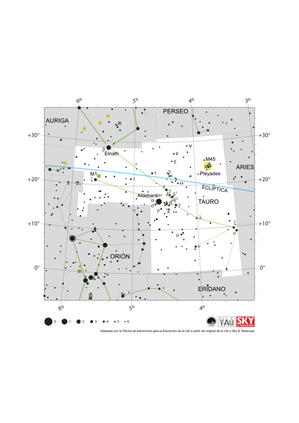
Mapa de la constelación de Tauro
Pie de foto: La constelación de Tauro junto con sus estrellas brillantes y las constelaciones circundantes. Tauro está rodeada por (en el sentido de las agujas del reloj desde arriba) Perseo, Aries, Cetus, Erídano, Orión, Géminis y Auriga. La estrella más brillante de Tauro, Aldebarán, aparece en el centro de la constelación. Tauro se encuentra en la eclíptica (mostrada aquí como una línea azul), que es la trayectoria que el Sol parece seguir a través del cielo en el transcurso de un año. El Sol está en Tauro desde mediados de mayo hasta finales de junio. Los demás planetas del Sistema Solar se encuentran a menudo en Tauro.
Tauro se encuentra principalmente al norte del ecuador celeste, con una pequeña parte en el hemisferio sur celeste. Toda la constelación es visible en algún momento del año para todo el planeta excepto la Antártida y una pequeña región alrededor del Polo Norte. Tauro es más visible por las tardes en invierno en el hemisferio norte y en verano en el hemisferio sur.
En la parte oriental de Tauro podemos encontrar el remanente de supernova M1 (comúnmente conocido como la Nebulosa del Cangrejo), marcado aquí con un cuadrado verde. En el noreste de Tauro se encuentra uno de los cúmulos abiertos de estrellas más famosos del cielo, M45 (las Pléyades), marcado aquí con un círculo amarillo. Muchas de las estrellas cercanas a Aldebarán (pero no Aldebarán) son miembros de otro cúmulo estelar, las Híades. Sin embargo, este cúmulo se encuentra cerca del Sistema Solar, por lo que está demasiado disperso en el cielo como para tener una designación de objeto Messier como la que tienen las Pléyades.
El eje-y de este diagrama está en grados de declinación con el norte hacia arriba y el eje-x está en horas de ascensión recta con el este a la izquierda. El tamaño de las estrellas marcadas aquí está relacionado con la magnitud aparente de la estrella, una medida de su brillo aparente. Los puntos más grandes representan estrellas más brillantes. Las letras griegas indican las estrellas más brillantes de la constelación. Están ordenadas según su brillo: la estrella más brillante se denomina alfa, la segunda más brillante beta, etc., aunque este orden no siempre se sigue con exactitud. Las líneas punteadas marcan los límites de las constelaciones según la UAI y las líneas verdes continuas marcan una de las formas habituales utilizadas para representar las figuras de las constelaciones. Ni los límites de las constelaciones, ni la línea que marca la eclíptica, ni las líneas que unen las estrellas aparecen en el cielo.
Crédito: Adaptado por la Oficina de Astronomía para la Educación de la UAI a partir del original de UAI/Sky & Telescope
License: CC-BY-4.0 Creative Commons Reconocimiento 4.0 Internacional (CC BY 4.0) íconos
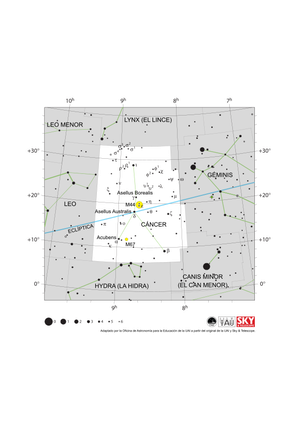
Mapa de la constelación de Cáncer
Pie de foto: La constelación zodiacal de Cáncer y las constelaciones que la rodean. Empezando por la parte superior del diagrama y siguiendo el sentido de las agujas del reloj, éstas son Lince, Géminis, Can Menor, Hidra, Leo y Leo Menor. La eclíptica (mostrada aquí como una línea azul), es decir, la trayectoria que el Sol parece seguir a través del cielo en el transcurso de un año, pasa casi exactamente por el centro de la constelación. El Sol está en Cáncer desde finales de julio hasta mediados de agosto. Los demás planetas del Sistema Solar se encuentran a menudo en Cáncer.
Cáncer se encuentra justo al norte del ecuador celeste y, por tanto, es visible en algún momento del año desde todo el planeta Tierra, excepto en las regiones más antárticas del mundo. Cáncer es más visible por la noche en primavera en el hemisferio norte y en otoño en el hemisferio sur.
Dos cúmulos estelares son visibles en Cáncer: M44, un cúmulo abierto a menudo llamado Cúmulo de la Colmena, y M46, un cúmulo abierto más denso con aproximadamente cuatro veces más estrellas que M67. Estos cúmulos se muestran en el mapa mediante círculos amarillos con un borde punteado.
El eje-y de este diagrama está en grados de declinación con el norte hacia arriba y el eje-x está en horas de ascensión recta con el este a la izquierda. El tamaño de las estrellas marcadas aquí está relacionado con la magnitud aparente de la estrella, una medida de su brillo aparente. Los puntos más grandes representan estrellas más brillantes. Las letras griegas indican las estrellas más brillantes de la constelación. Están ordenadas según su brillo: la estrella más brillante se denomina alfa, la segunda más brillante beta, etc., aunque este orden no siempre se sigue con exactitud. Las líneas punteadas marcan los límites de las constelaciones según la UAI y las líneas verdes continuas marcan una de las formas habituales utilizadas para representar las figuras de las constelaciones. Ni los límites de las constelaciones, ni la línea que marca la eclíptica, ni las líneas que unen las estrellas aparecen en el cielo.
Crédito: Adaptado por la Oficina de Astronomía para la Educación de la UAI a partir del original de UAI/Sky & Telescope
License: CC-BY-4.0 Creative Commons Reconocimiento 4.0 Internacional (CC BY 4.0) íconos
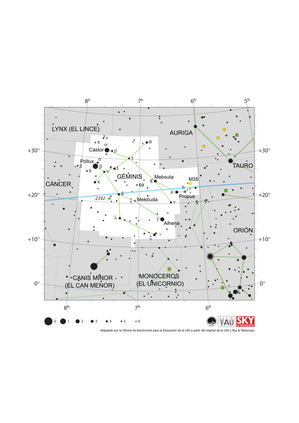
Mapa de la constelación de Géminis
Pie de foto: La constelación zodiacal de Géminis y las constelaciones que la rodean. Empezando por la parte superior del diagrama y siguiendo el sentido de las agujas del reloj, estas son Auriga, Tauro, Lince, Orión, Monoceros, Can Menor y Cáncer. Las estrellas más brillantes de Géminis, Cástor y Pólux, aparecen en la esquina superior izquierda (noreste) del diagrama. En la mitología griega, las estrellas de esta constelación se asemejan a dos gemelos que se rodean con los brazos, con Cástor y Pólux indicando sus cabezas. Géminis se encuentra en la eclíptica (mostrada aquí como una línea azul), que es la trayectoria que el Sol parece seguir a través del cielo en el transcurso de un año. El Sol está en Géminis desde finales de junio hasta finales de julio. Los demás planetas del Sistema Solar se encuentran a menudo en Géminis.
Géminis se encuentra al norte del ecuador celeste y es visible en todo el mundo, excepto en las regiones antárticas. Géminis es más visible por la noche en invierno en el hemisferio norte y en verano en el hemisferio sur.
Justo a la derecha del pie del gemelo Cástor se encuentra un cúmulo abierto de estrellas (mostrado aquí como un círculo amarillo con un borde de línea de puntos), Messier 35, también conocido como el Cúmulo de la Hebilla de Zapato. Este cúmulo se extiende sobre un área aproximadamente del tamaño de la Luna llena. Además de este cúmulo de estrellas, hay una nebulosa planetaria (mostrada aquí como un círculo verde con cuatro picos radiales) - NGC 2392 - cerca del ecuador celeste y justo a la izquierda del gemelo Pólux. Dos estrellas variables (Mekbuda y Propus; mostradas con dos círculos concéntricos) pueden encontrarse en las "piernas" de cada gemelo, pero son tan débiles que un observador necesitaría cielos oscuros para verlas.
El eje-y de este diagrama está en grados de declinación con el norte hacia arriba y el eje-x está en horas de ascensión recta con el este a la izquierda. El tamaño de las estrellas marcadas aquí está relacionado con la magnitud aparente de la estrella, una medida de su brillo aparente. Los puntos más grandes representan estrellas más brillantes. Las letras griegas indican las estrellas más brillantes de la constelación. Están ordenadas según su brillo: la estrella más brillante se denomina alfa, la segunda más brillante beta, etc., aunque este orden no siempre se sigue con exactitud. Las líneas punteadas marcan los límites de las constelaciones según la UAI y las líneas verdes continuas marcan una de las formas habituales utilizadas para representar las figuras de las constelaciones. Ni los límites de las constelaciones, ni la línea que marca la eclíptica, ni las líneas que unen las estrellas aparecen en el cielo.
Crédito: Adaptado por la Oficina de Astronomía para la Educación de la UAI a partir del original de UAI/Sky & Telescope
License: CC-BY-4.0 Creative Commons Reconocimiento 4.0 Internacional (CC BY 4.0) íconos
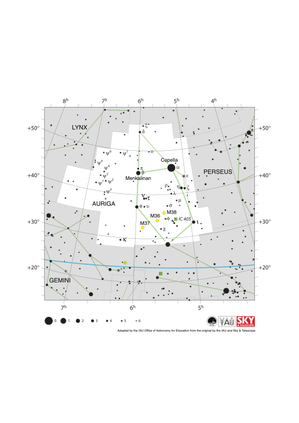
Auriga Constellation Map
Pie de foto: The constellation Auriga with its bright stars and surrounding constellations. Auriga is surrounded by (going clockwise from the top): Camelopardalis, Perseus, Taurus, Gemini and Lynx. Capella, the brightest star in Auriga, is the sixth brightest star in the night sky.
As a northern constellation, Auriga is visible from the whole of the northern hemisphere at some point in the year. The whole of the constellation is visible to equatorial regions of the southern hemisphere with parts of it visible to temperate southern regions. The whole constellation is circumpolar from arctic regions. The constellation is best viewed in the evening in the late northern hemisphere winter and late southern hemisphere summer.
Auriga lies in the plane of the Milky Way and thus hosts a number of open clusters. Of these M36, M37 and M38 are marked on this diagram with yellow circles. IC 405, also known as the flaming star nebula, is marked here with a green square.
The y-axis of this diagram is in degrees of declination with north as up and the x-axis is in hours of right ascension with east to the left. The sizes of the stars marked here relate to the star's apparent magnitude, a measure of its apparent brightness. The larger dots represent brighter stars. The Greek letters mark the brightest stars in the constellation. These are ranked by brightness with the brightest star being labeled alpha, the second brightest beta, etc., although this ordering is not always followed exactly. The dotted boundary lines mark the IAU's boundaries of the constellations and the solid green lines mark one of the common forms used to represent the figures of the constellations. The blue line at the bottom of the diagram marks the ecliptic. Neither the constellation boundaries, nor the line marking the ecliptic, nor the lines joining the stars appear on the sky.
Crédito: Adapted by the IAU Office of Astronomy for Education from the original by the IAU and Sky & Telescope
License: CC-BY-4.0 Creative Commons Reconocimiento 4.0 Internacional (CC BY 4.0) íconos