Glossary term: 거성
Description: 거성은 같은 색을 가진 다른 별에 비해 비정상적으로 크고 빛나는 별을 말합니다. 별은 처음부터 거성으로 시작하는 것이 아니라 진화의 여러 단계에서 간헐적으로 거성이 됩니다.
거성이 아닌 대부분의 별의 경우, 색과 광도(즉, 시간이 지남에 따라 방출하는 에너지) 사이에는 직접적인 관계가 있습니다. 이러한 별을 "주계열성"이라고 하며, 이러한 별의 에너지 방출은 핵에서 수소를 헬륨으로 핵융합하여 이루어집니다. 중심부의 수소 공급이 고갈되면 중심부 주변의 껍질에서 수소 핵융합이 계속되고 별은 팽창하여 훨씬 더 밝고 붉게 빛납니다. 결국 중심부의 온도가 충분히 높아져 수소보다 무거운 원소의 핵융합이 가능해져 별에 추가적인 에너지원을 제공할 수 있습니다. 이러한 전환 과정에서 이러한 별은 훨씬 더 큰 크기로 확장되고, 냉각되어 더 붉어지고, 전반적으로 훨씬 더 밝아지며, 적색거성이 됩니다. 예를 들어, 태양은 적색거성이 되기 위해 팽창할 때 수백 배 더 크고 밝아질 뿐만 아니라 훨씬 더 온도가 낮아집니다. 질량이 다른 별의 경우, 종종 수명이 짧은 진화 단계를 거치면 청색거성이 되거나 훨씬 더 빛나는 적색 또는 청색 초거성이 됩니다.
거성은 광도 3등급으로 분류되며, 준거성(4등급)보다 밝지만 밝은 거성(2등급)과 초거성(1등급)보다 희미합니다.
전반적으로 거성은 드문 편입니다. 이는 거성 단계의 기간이 상대적으로 짧기 때문입니다(태양과 같은 별의 경우 수억 년, 주계열성에서는 100억 년). 그러나 광도가 높기 때문에 밤하늘에서 육안으로 볼 수 있는 별 중에서 거성 차지하는 비중이 상당히 높습니다.
거성은 같은 색을 가진 다른 별들보다 훨씬 크고 밝은 별을 말합니다. 별은 처음부터 거성으로 태어나는 것이 아니라, 진화의 여러 단계를 거치면서 일시적으로 거성이 되는 시기가 있습니다. 거성이 아닌 대부분의 별에서는 색과 밝기, 즉 시간이 지나며 방출하는 에너지 사이에 뚜렷한 관계가 있습니다. 이런 별을 주계열성이라고 하며, 중심부에서 수소가 헬륨으로 핵융합되면서 에너지를 냅니다. 하지만 중심의 수소가 고갈되면, 별은 중심 바깥쪽의 껍질에서 수소 핵융합을 계속하게 됩니다. 그 결과 별은 팽창하고, 훨씬 더 밝고 붉게 변합니다. 이후 중심부의 온도가 충분히 높아지면 수소보다 무거운 원소들이 핵융합을 일으켜 추가적인 에너지를 만들어냅니다. 이 과정에서 별은 크기가 커지고, 온도는 낮아져 더 붉게 보이며, 훨씬 더 밝아집니다. 이런 별이 바로 적색거성입니다. 예를 들어 태양도 먼 미래에 적색거성이 될 때 지금보다 수백 배 더 크고 밝아지지만, 표면 온도는 오히려 낮아질 것입니다. 질량이 더 큰 별들은 짧은 진화 단계를 더 거쳐 청색거성이 되거나, 그보다 훨씬 더 밝은 적색 또는 청색 초거성이 되기도 합니다.
거성은 광도 등급 III으로 분류되며, 준거성(IV)보다 밝고, 밝은 거성(II)이나 초거성(I)보다는 어둡습니다.
전반적으로 거성은 비교적 드문 별입니다. 왜냐하면 거성 단계는 짧기 때문입니다. 예를 들어 태양 같은 별은 주계열성으로 약 100억 년을 보내지만, 거성 단계는 수억 년밖에 지속되지 않습니다. 그럼에도 불구하고 거성은 밝기가 매우 높기 때문에 밤하늘에서 눈으로 볼 수 있는 별들 중에서는 거성이 차지하는 비율이 높습니다.
대표적인 적색거성으로는 목동자리의 아크투루스(Arcturus)와 고래자리의 미라(Mira)가 있습니다.
Related Terms:
See this term in other languages
Term and definition status: The original definition of this term in English have been approved by a research astronomer and a teacher The translation of this term and its definition is still awaiting approval
The OAE Multilingual Glossary is a project of the IAU Office of Astronomy for Education (OAE) in collaboration with the IAU Office of Astronomy Outreach (OAO). The terms and definitions were chosen, written and reviewed by a collective effort from the OAE, the OAE Centers and Nodes, the OAE National Astronomy Education Coordinators (NAECs) and other volunteers. You can find a full list of credits here. All glossary terms and their definitions are released under a Creative Commons CC BY-4.0 license and should be credited to "IAU OAE".
If you notice a factual or translation error in this glossary term or definition then please get in touch.
In Other Languages
- 아랍어: النجم العملاق
- 독일어: Riesenstern
- 영어: Giant Star
- 스페인어: Estrella gigante
- 페르시아어: ستاره غول
- 프랑스어: Étoile géante
- 이탈리아어: Stella gigante
- 일본어: 巨星 (external link)
- 브라질 포르투갈어: Estrela gigante
- 중국어 간체: 巨星
- 중국어 번체: 巨星
Related Media

The red supergiant Betelgeuse
Caption: The image shows Betelgeuse, a red supergiant in the constellation Orion, observed by the Atacama Large Millimeter/submillimeter Array (ALMA). ALMA consists of many antennae spread across a plain in Northern Chile. The observations from all of these receivers is synthesised together by a central computer to form an image. The wide distances between the antennae mean that is can resolve very fine details.
Most stars we observe are just seen as points of light, but Betelgeuse is so large (with a radius about 1,400 times larger than the Sun) and is sufficiently nearby that it is one of the few stars to have been resolved to show it as an extended object.
Betelgeuse is a massive star, more than 14 times the mass of the Sun and is relatively young for a star (less than 14 million years old). However, its high mass led to it having a very hot core which burned through its hydrogen fuel quickly. It has since evolved through many stages and now appears as a red supergiant, it's final stage before exploding as a supernova. When such an explosion will happen is not known for certain, but it could be in around 100,000 years. Such an explosion would be visible from Earth, even during the day.
Credit: ALMA (ESO/NAOJ/NRAO)/E. O’Gorman/P. Kervella
credit link
License: CC-BY-4.0 Creative Commons 저작자표시 4.0 국제 (CC BY 4.0) icons
Related Diagrams
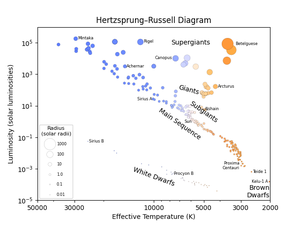
Hertzsprung-Russell diagram
Caption: This diagram shows the temperature and luminosity of different stars. The size of each point represents the star’s radius and its colour is the colour the human eye would see. The stars range in colour from a washed-out blue to a washed-out reddish-orange. No star has a pure colour like red, green or blue as stars’ spectra include light from lots of different colours. However the reddest stars are commonly referred to as red and the bluest stars as blue. The sample of stars used to make this diagram was chosen to show a wide range of stars of different types so the relative number of each type of star is not representative of how commonly each type is found.
From the top left to bottom right there is a long line of stars burning hydrogen in their cores. This is called the main sequence. On this line, one sees the stars Mintaka, Achernar, Sirius A, the Sun and Proxima Centauri. The objects around Proxima Centauri at the lower right end of the main sequence are known as red dwarfs. To the lower right of the red dwarfs are Teide 1 and Kelu-1 A. These two objects are brown dwarfs, objects too low in mass to have cores hot enough to fuse hydrogen for a sustained period of time. As they do not burn hydrogen, brown dwarfs are not considered main sequence stars. The name brown dwarf is unrelated to their colour.
Above the main sequence, we find subgiants, giants and supergiants. These are stars that have finished burning hydrogen in their core and have evolved into larger objects. A star’s brightness depends on its temperature and size so giant stars are brighter than stars with a smaller radius but the same temperature. In time these objects will move towards the end of their lives and undergo either a planetary nebula phase or become supernovae. Stars which end their lives with a planetary nebula phase become a type of stellar remnant called a white dwarf. Such objects are much smaller than stars of the same temperature and thus are fainter and are found significantly below the main sequence. Stars which end their lives as supernovae become either black holes or neutron stars. These are not shown on this plot.
Credit: IAU OAE/Niall Deacon
License: CC-BY-4.0 Creative Commons 저작자표시 4.0 국제 (CC BY 4.0) icons