بلغات أخرى
- الألمانيّة: Riesenstern
- الإنجليزيّة: Giant Star
- الإسبانيّة: Estrella gigante
- الفارسيّة: ستاره غول
- الفرنسيّة: Étoile géante
- الإيطاليّة: Stella gigante
- اليابانيّة: 巨星 (رابط خارجي)
- الكوريّة: 거성
- البرتغاليّة البرازيليّة: Estrela gigante
- الصينيّة المبسطة: 巨星
- الصينيّة التقليدية: 巨星
وسائط ذات صلة

The red supergiant Betelgeuse
الشرح: The image shows Betelgeuse, a red supergiant in the constellation Orion, observed by the Atacama Large Millimeter/submillimeter Array (ALMA). ALMA consists of many antennae spread across a plain in Northern Chile. The observations from all of these receivers is synthesised together by a central computer to form an image. The wide distances between the antennae mean that is can resolve very fine details.
Most stars we observe are just seen as points of light, but Betelgeuse is so large (with a radius about 1,400 times larger than the Sun) and is sufficiently nearby that it is one of the few stars to have been resolved to show it as an extended object.
Betelgeuse is a massive star, more than 14 times the mass of the Sun and is relatively young for a star (less than 14 million years old). However, its high mass led to it having a very hot core which burned through its hydrogen fuel quickly. It has since evolved through many stages and now appears as a red supergiant, it's final stage before exploding as a supernova. When such an explosion will happen is not known for certain, but it could be in around 100,000 years. Such an explosion would be visible from Earth, even during the day.
المصدر: ALMA (ESO/NAOJ/NRAO)/E. O’Gorman/P. Kervella
رابط المصدر
License: CC-BY-4.0 المشاع الإبداعي نَسب المُصنَّف 4.0 دولي (CC BY 4.0) أيقونات
الرسوم التوضيحية المرتبطة
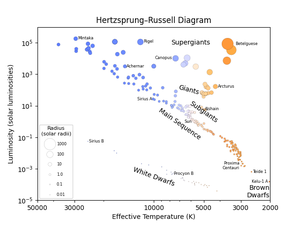
Hertzsprung-Russell diagram
الشرح: This diagram shows the temperature and luminosity of different stars. The size of each point represents the star’s radius and its colour is the colour the human eye would see. The stars range in colour from a washed-out blue to a washed-out reddish-orange. No star has a pure colour like red, green or blue as stars’ spectra include light from lots of different colours. However the reddest stars are commonly referred to as red and the bluest stars as blue. The sample of stars used to make this diagram was chosen to show a wide range of stars of different types so the relative number of each type of star is not representative of how commonly each type is found.
From the top left to bottom right there is a long line of stars burning hydrogen in their cores. This is called the main sequence. On this line, one sees the stars Mintaka, Achernar, Sirius A, the Sun and Proxima Centauri. The objects around Proxima Centauri at the lower right end of the main sequence are known as red dwarfs. To the lower right of the red dwarfs are Teide 1 and Kelu-1 A. These two objects are brown dwarfs, objects too low in mass to have cores hot enough to fuse hydrogen for a sustained period of time. As they do not burn hydrogen, brown dwarfs are not considered main sequence stars. The name brown dwarf is unrelated to their colour.
Above the main sequence, we find subgiants, giants and supergiants. These are stars that have finished burning hydrogen in their core and have evolved into larger objects. A star’s brightness depends on its temperature and size so giant stars are brighter than stars with a smaller radius but the same temperature. In time these objects will move towards the end of their lives and undergo either a planetary nebula phase or become supernovae. Stars which end their lives with a planetary nebula phase become a type of stellar remnant called a white dwarf. Such objects are much smaller than stars of the same temperature and thus are fainter and are found significantly below the main sequence. Stars which end their lives as supernovae become either black holes or neutron stars. These are not shown on this plot.
المصدر: IAU OAE/Niall Deacon
License: CC-BY-4.0 المشاع الإبداعي نَسب المُصنَّف 4.0 دولي (CC BY 4.0) أيقونات