Glossary term: 광학천문학
Description: 광학 천문학은 근적외선, 가시광선, 자외선 영역에서 별, 은하, 행성, 왜소행성, 소행성과 같은 우주를 관측하고 연구하는 학문입니다.이 세 가지 종류의 전자기파를 하나로 묶는 이유는 천문학자들이 천체의 가시광선을 관측하기 위해 원래 제작했던 유리 렌즈 및/또는 금속 거울을 사용한 광학 망원경이 근적외선이나 자외선 관측에도 적합하기 때문입니다. 또한 지구 대기는 가시광선뿐 아니라 그 주변의 적외선과 자외선도 통과시킵니다. 그래서 지상에서도 세 가지 영역의 관측이 모두 가능합니다. 게다가 천문학자들이 가시광선을 찍는 데 쓰는 카메라 센서는 근적외선과 자외선도 함께 감지할 수 있습니다. 이 모든 이유를 종합해 보면, 천문학자들이 가시광선 관측에 사용하는 망원경과 장비는 근적외선과 자외선 관측에도 그대로 효과적입니다. 따라서 전자기 스펙트럼의 이 영역에서 얻은 관측 결과를 하나로 묶어 광학 천문학이라고 부르는 것이 합리적입니다. 여기서 “광학”이라는 말은 “스펙트럼의 광학적 부분”을 뜻하며, 이 영역에서 얻은 자료를 "광학 관측"이라고 부릅니다.
Related Terms:
See this term in other languages
Term and definition status: The original definition of this term in English have been approved by a research astronomer and a teacher The translation of this term and its definition is still awaiting approval
The OAE Multilingual Glossary is a project of the IAU Office of Astronomy for Education (OAE) in collaboration with the IAU Office of Astronomy Outreach (OAO). The terms and definitions were chosen, written and reviewed by a collective effort from the OAE, the OAE Centers and Nodes, the OAE National Astronomy Education Coordinators (NAECs) and other volunteers. You can find a full list of credits here. All glossary terms and their definitions are released under a Creative Commons CC BY-4.0 license and should be credited to "IAU OAE".
If you notice a factual or translation error in this glossary term or definition then please get in touch.
In Other Languages
- 아랍어: علم الفلك البصري
- 독일어: Optische Astronomie
- 영어: Optical Astronomy
- 스페인어: Astronomía óptica
- 프랑스어: Astronomie optique
- 이탈리아어: Astronomia ottica
- 브라질 포르투갈어: Astronomia Óptica
- 중국어 간체: 光学天文学
- 중국어 번체: 光學天文學
Related Media
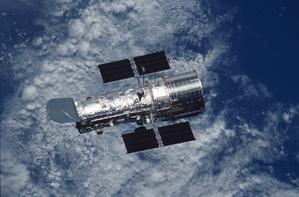
Hubble Space Telescope over Earth
Caption: The NASA/ESA Hubble Space Telescope orbiting Earth. This picture was taken by astronauts on board the space shuttle Columbia, right after the Servicing Mission 3B to the space telescope itself. The telescope has an opening that allows light in (seen here on the left). The light travels through the telescope optics to the cameras and spectrographs located in the bulge at the other end of the observatory (seen here on the right). Data from these instruments is then sent back to Earth using an antenna. The black rectangles on either side of the observatory are the solar panels that provide it with power.
Credit: NASA/ESA
credit link
License: CC-BY-4.0 Creative Commons 저작자표시 4.0 국제 (CC BY 4.0) icons
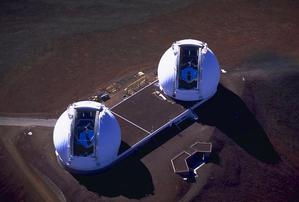
Keck Telescopes
Caption: The two Keck telescopes on Mauna Kea on the island of Hawai`i. These two telescopes are reflecting telescopes with primary mirrors 10m across.
Credit: NASA/JPL
credit link
License: PD Public Domain icons

The Pillars of Creation in comparison
Caption: The 'Pillars of Creation' are a renowned astronomical feature situated within the Eagle Nebula in the Serpens constellation. The illustration provides a direct comparison between images captured by the Hubble Space Telescope (HST) and the James Webb Space Telescope (JWST), showcasing the pillars, which span several light years in diameter, in both visible light (also known as optical light) and infrared light. On the left are the pillars as seen by Hubble in visual light, taken in 2014. It displays dark pillars against an opaque background, with only a handful of visible stars. Conversely, the counterpart on the right is Webb’s near-infrared view published in 2022, penetrating the dust and revealing numerous stars of varying sizes.
Their distance from Earth is approximately 6,500 to 7,000 light years. Within these pillars, new stars are constantly forming, making them a subject of extensive study by astronomers. Composed mostly of cool molecular hydrogen and small amounts of interstellar dust, they are subject to erosion by the intense ultraviolet radiation emitted by nearby massive and newborn stars, a process known as photoevaporation.
Credit: NASA, ESA, CSA, STScI
credit link







.png)