Glossary term: Rover
Description: A rover is a human-made machine that is sent to the surface of another planet or moon on a spacecraft to study that planet up close, and send the data it collects back to Earth using a communication method. Most can be operated from Earth and move around the surface of the planet or moon, although the Lunar Roving Vehicles of the Apollo mission were driven by astronauts on the Moon. A rover can carry a lot of scientific instruments such as small drills, a sample collecting tool, cameras, and even a small laboratory to analyze its air and ground samples and send the results back.
Related Terms:
See this term in other languages
Term and definition status: This term and its definition have been approved by a research astronomer and a teacher
The OAE Multilingual Glossary is a project of the IAU Office of Astronomy for Education (OAE) in collaboration with the IAU Office of Astronomy Outreach (OAO). The terms and definitions were chosen, written and reviewed by a collective effort from the OAE, the OAE Centers and Nodes, the OAE National Astronomy Education Coordinators (NAECs) and other volunteers. You can find a full list of credits here. All glossary terms and their definitions are released under a Creative Commons CC BY-4.0 license and should be credited to "IAU OAE".
If you notice a factual error in this glossary definition then please get in touch.
In Other Languages
- Arabic: المركبة الجوالة
- German: Rover
- Spanish: Rover
- French: Rover
- Italian: Rover
- Brazilian Portuguese: Veículo Explorador (Rover)
- Simplified Chinese: 漫游车
- Traditional Chinese: 漫遊車
Related Media
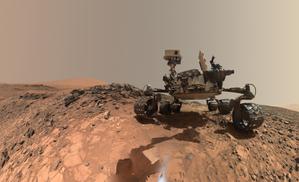
Mars rover Curiosity
Caption: This self-portrait of NASA's Curiosity Mars rover shows the vehicle at the site from which it reached down to drill into a rock target called "Buckskin" on lower Mount Sharp. The selfie combines several component images taken by Curiosity's Mars Hand Lens Imager (MAHLI) on 5 August 2015, during the 1,065th Martian day, or sol, of the rover's work on Mars.
Credit: NASA/JPL-Caltech/MSSS
credit link
License: PD Public Domain icons

Record-Breaking Off-Earth Driving: Rovers on Mars & the Moon
Caption: Part of the Simplifying Astronomy for Arabic Speakers project, this infographic highlights the longest distances traveled by rovers on Mars and the Moon, showcasing space exploration’s progress.
Top Rovers & Their Achievements
Mars: NASA’s Opportunity holds the record, covering 45.16 km between 2004–2018.
Moon: The Soviet Lunokhod 2 leads with 39 km, followed by Apollo rovers:
Apollo 17: 35.74 km
Apollo 15: 27.8 km
Apollo 16: 27.1 km
Mars vs. Moon: Different Challenges
1. Martian Terrain – Mars has a thin atmosphere, dust storms, and rugged landscapes, requiring durable, long-term rovers.
2. Lunar Terrain – The Moon’s cratered surface lacks an atmosphere, allowing easier movement but with shorter mission durations.
3. Mission Longevity – Mars rovers operate for years, while Apollo lunar rovers were used briefly.
Future Rovers & Expectations
Curiosity may reach 42.195 km, making it one of Mars' most traveled rovers.
Yutu-2 (China) continues exploring the Moon since 2019.
Conclusion
These record-breaking distances showcase technological advancements in planetary exploration. With continued innovation, future rovers will go even further, paving the way for ambitious human missions beyond Earth!
Credit: Ali Al-Edhari ; adapted from the original by NASA/JPL-Caltech
License: CC-BY-4.0 Creative Commons Attribution 4.0 International (CC BY 4.0) icons
Related Activities
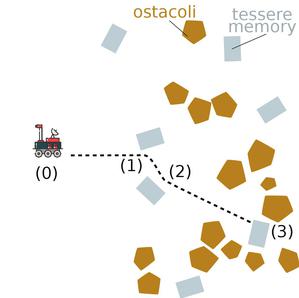
Driving on Mars
astroEDU educational activity (links to astroEDU website) Description: An educational interdisciplinary game to drive a rover on Mars
License: CC-BY-4.0 Creative Commons Attribution 4.0 International (CC BY 4.0) icons
Tags:
Game
, robot
, robotics
, simulation
, telecommunications
Age Ranges:
14-16
, 16-19
Education Level:
Middle School
, Secondary
Areas of Learning:
Guided-discovery learning
Costs:
Low Cost
Duration:
2 hours
Group Size:
Group
Skills:
Communicating information
, Developing and using models
, Using mathematics and computational thinking