Término del glosario: Titán
Descripción: Titán es la luna más grande de Saturno. Es más grande que la Luna de la Tierra y que Mercurio, y es la segunda luna más grande del Sistema Solar. Es el único cuerpo, aparte de la Tierra, del que se sabe que tiene océanos, mares y ríos en estado líquido en su superficie. Sin embargo, estos están formados por sustancias químicas llamadas hidrocarburos. Se cree que Titán tiene un núcleo rocoso y una corteza de hielo compuesta de agua. Se piensa que el agua líquida que se encuentra bajo la corteza de hielo podría albergar vida. Posee una atmósfera densa, compuesta principalmente de nitrógeno, que le da un aspecto muy liso en las imágenes.
Términos relacionados:
Ver este término en otros idiomas
Estado del término y la definición: La definición original de este término en inglés ha sido aprobada por unastrónomo o astrónoma investigadora y un docente La traducción de este término y su definición aún están pendientes de aprobación
El Glosario multilingüe de la OAE es un proyecto de la Oficina de Astronomía para la Educación de la UAI (OAE) en colaboración con la Oficina de Divulgación de Astronomía de la UAI (OAO). Los términos y definiciones fueron seleccionados, redactados y revisados gracias al esfuerzo colectivo de la OAE, los Centros y Nodos de la OAE, los Coordinadores Nacionales de Educación Astronómica (NAECs) y otros voluntarios. Puedes encontrar una lista completa de créditos aquí. Todos los términos del glosario y sus definiciones se publican bajo la licencia Creative Commons CC BY-4.0 y deben atribuirse a la "IAU OAE".
Si detectas algún error de contenido o de traducción en este término del glosario o en ladefinición, ponte en contacto con nosotros.
Contenidos relacionados
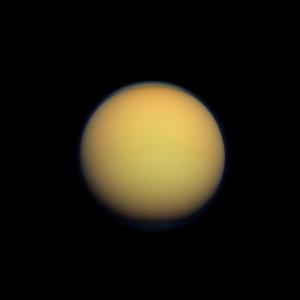
Titan in natural colours
Pie de foto: This image taken by NASA's Cassini spacecraft in January 2012 shows Saturn's moon Titan in near natural colours. The orange-yellowsh colour stems from a layer of partially charged hyodrocarbon compounds. In the visible light, Titan's surface remains largely hidden below the opaque atmosphere.
Crédito: NASA/JPL-Caltech/Space Science Institute
enlace de crédito
License: PD Dominio público íconos
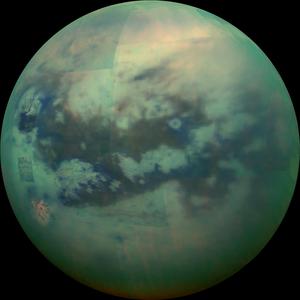
Titán con características superficiales
Pie de foto: Esta imagen compuesta, tomada por la sonda Cassini de la NASA en noviembre de 2015, muestra la radiación infrarroja procedente de Titán, la luna de Saturno. La luz infrarroja puede atravesar su atmósfera brumosa y revelar algunas de las características de su superficie. Durante su descenso hacia la superficie, el módulo de aterrizaje Huygens de la ESA, que viajaba a bordo de la sonda, descubrió lagos formados por hidrocarburos líquidos.
Crédito: NASA/JPL/Universidad de Arizona/Universidad de Idaho
enlace de crédito
License: PD Dominio público íconos
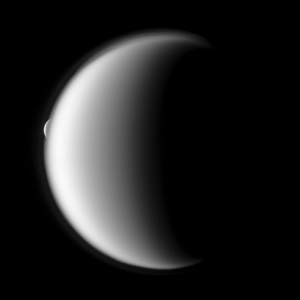
Rhea reappearing after occultation by Titan
Pie de foto: On October 27, 2009, NASA’s Cassini spacecraft orbiting around Saturn captured this view of Saturn's moon Rhea as it began to emerge after being hidden by Saturn's largest moon Titan during an occultation. An occultation is a celestial event in which one object moves in front of another and temporarily blocks the first object from view.
In this image, Titan — about 5,150 km across — was closer to the spacecraft at about 1 million km, while Rhea — roughly 1,528 km in diameter — was farther away at about 2.3 million km. Titan’s high-altitude atmospheric haze is visible as a faint glow around its limb, showing the difference in surface and atmospheric properties between these two moons.
Scientists study occultations like this because watching how one moon disappears behind or reappears from another helps refine our understanding of their orbits and physical characteristics.
Crédito: NASA/JPL/Space Science Institute
enlace de crédito
License: PD Dominio público íconos
Actividades relacionadas
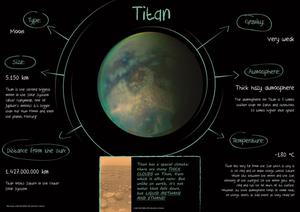
Children's Planetary Maps: Titan
astroEDU educational activity (links to astroEDU website) Description: Learn about the only other known body in the Solar System with Seas and Lakes
License: CC-BY-4.0 Creative Commons Reconocimiento 4.0 Internacional (CC BY 4.0) íconos
Etiquetas:
Maps
, Planetary cartography
, Spatial thinking
Rango de edades:
6-8
, 8-10
, 10-12
Nivel educativo:
Educación secundaria
, Primaria
, Secondary
Áreas de aprendizaje:
Aprendizaje basado en la investigación estructurada
Costos:
Bajo coste
Duración:
2 horas
Tamaño del grupo:
Grupo
Competencias:
Analizar e interpretar datos
, Plantear preguntas
, Comunicar información
, Elaborar explicaciones
, Desarrollar y utilizar modelos
, Participar en debates basados en pruebas
, Planificar y llevar a cabo investigaciones