Término del glosario: Luna
Descripción: La Luna es un cuerpo celeste que no emite luz propia, sino que refleja la luz solar que incide sobre ella. Esto da lugar a las fases características de la Luna. La Luna es el único satélite natural importante de la Tierra y ocupa el quinto lugar entre los satélites naturales del Sistema Solar en cuanto a tamaño y masa. La palabra «Luna» se escribe con mayúscula para distinguirla de otros satélites naturales, o lunas, del Sistema Solar y más allá. En comparación con otras lunas del Sistema Solar, la Luna tiene el mayor tamaño en relación con el tamaño del planeta al que orbita. La Luna sigue una órbita elíptica alrededor de la Tierra, a una distancia media de 384 000 kilómetros (km). No tiene atmósfera y está compuesta por materiales similares a los de la Tierra, con un núcleo rico en hierro y capas externas rocosas. Esta similitud no es casual: según nuestro conocimiento actual, la Luna se formó a partir de los restos de la colisión entre la Tierra y un planeta del tamaño de Marte hace unos 4500 millones de años; la mayor parte de su material proviene del manto de la Tierra original. La superficie de la Luna presenta zonas oscuras conocidas como mares, zonas elevadas más claras y está plagada de cráteres. La superficie de la Luna es de 3.79 x 10⁷ kilómetros cuadrados, su volumen es de 2.20 x 10¹⁰ kilómetros cúbicos y su masa es de 7.35 x 10²² kilogramos (kg). El valor exacto del período orbital de la Luna alrededor de la Tierra depende del sistema de referencia: en relación con las estrellas lejanas, completa una órbita cada 27.3 días («período sideral»). Para un observador en la Tierra, el tiempo entre dos lunas nuevas es de 29.5 días («período sinódico»).
Términos relacionados:
Ver este término en otros idiomas
Estado del término y la definición: La definición original de este término en inglés ha sido aprobada por unastrónomo o astrónoma investigadora y un docente La traducción de este término y su definición aún están pendientes de aprobación
El Glosario multilingüe de la OAE es un proyecto de la Oficina de Astronomía para la Educación de la UAI (OAE) en colaboración con la Oficina de Divulgación de Astronomía de la UAI (OAO). Los términos y definiciones fueron seleccionados, redactados y revisados gracias al esfuerzo colectivo de la OAE, los Centros y Nodos de la OAE, los Coordinadores Nacionales de Educación Astronómica (NAECs) y otros voluntarios. Puedes encontrar una lista completa de créditos aquí. Todos los términos del glosario y sus definiciones se publican bajo la licencia Creative Commons CC BY-4.0 y deben atribuirse a la "IAU OAE".
Si detectas algún error de contenido o de traducción en este término del glosario o en ladefinición, ponte en contacto con nosotros.
Contenidos relacionados
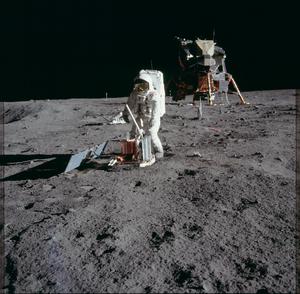
Apollo 11 lunar activity
Pie de foto: NASA astronaut Edwin 'Buzz' Aldrin installs a seismometer in front of the Apollo 11 Eagle lunar lander during an extravehicular activity (EVA) on the Moon. Neil Armstrong shot this photo during the first human mission to the surface of the Moon in 1969.
Crédito: NASA/Project Apollo Archive
enlace de crédito
License: PD Dominio público íconos
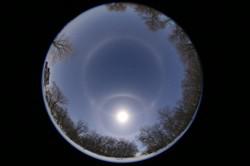
Selene meets the Moon, by Sheila Wiwchar, Canada
Pie de foto: First place in the 2021 IAU OAE Astrophotography Contest, category Sun/Moon haloes.
Photographed at Kaleida, Manitoba in Canada, this fisheye image beautifully captures the rare optical phenomena encircling the moon known as the “22° halo” and the horizontal white circle passing through the moon called the “paraselenic circle”. The white band circling the whole sky at the same altitude as the moon is named after Selene, the ancient Greek Titan, famously called the goddess of the moon. The more commonly observed counterpart produced by the sun is known as the parhelic circle, named after the Greek god of the sun, Helios. Both the 22° halo and the paraselenic circle are produced due to reflection of the moonlight from near vertical surfaces of ice crystals. Parts closer to the moon are caused due to external reflections, whereas those further away are created due to internal reflections. The constellation of the big dipper at the center makes this image even more spectacular. Can you spot it?
Crédito: Sheila Wiwchar/IAU OAE
License: CC-BY-4.0 Creative Commons Reconocimiento 4.0 Internacional (CC BY 4.0) íconos
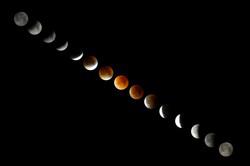
Red Moon, by Daniel Henrion, France
Pie de foto: Third place in the 2021 IAU OAE Astrophotography Contest, category Total lunar eclipse.
Time-lapse images of a total supermoon lunar eclipse that took place on 28 September 2015. The photos show the Moon during the time it moved through the Earth´s umbra: Earth´s umbra touched the Moon´s outer limb at 1.07 a.m. UTC (upper left corner) and left the Moon´s surface at 4.27 a.m. UTC (lower right corner).
Crédito: Daniel Henrion/IAU OAE
License: CC-BY-4.0 Creative Commons Reconocimiento 4.0 Internacional (CC BY 4.0) íconos
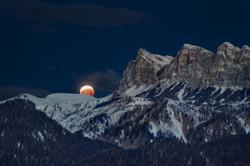
The eclipsed Moon sets near the Rochetta di Prendera, Dolomiti Unesco, by Alessandra Masi, Italy
Pie de foto: First place in the 2021 IAU OAE Astrophotography Contest, category Total lunar eclipse.
A lunar eclipse occurs when the full moon moves into the Earth`s shadow. This is the case when the Sun, Earth and Moon are exactly or very closely aligned. The reddish light reflected from the lunar surface is caused by sunlight that has been refracted on its way through Earth´s atmosphere in the direction of the Moon. It appears reddish because of the Rayleigh scattering of bluer light. The round shape of the Earth's shadow visible on the lunar surface was a proof for Aristotle that the Earth must be a sphere. This photo shows the eclipsed Moon that sets near the Rochetta di Prendera, Dolomiti Unesco, Italy, on 21 January 2019.
Crédito: Alessandra Masi/IAU OAE
License: CC-BY-4.0 Creative Commons Reconocimiento 4.0 Internacional (CC BY 4.0) íconos
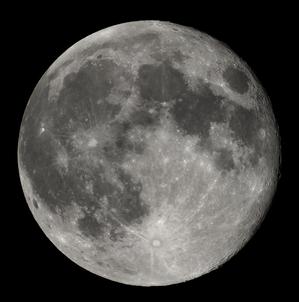
Full moon
Pie de foto: The image shows the nearly full Moon observed with a small telescope and a DSLR camera.
Crédito: Luc Viatour
enlace de crédito
License: CC-BY-SA-3.0 Creative Commons Atribución-CompartirIgual 3.0 No portada íconos
Diagramas relacionados
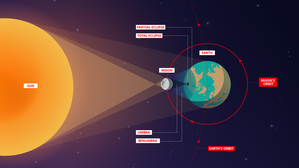
Total Solar Eclipse
Pie de foto: This not to scale diagram shows what happens during a total solar eclipse. The Moon orbits the Earth, but its orbit is slightly tilted with respect to the Earth’s orbit around the Sun. During the new moon lunar phase, the Moon lies between the Earth and the Sun, but due to the Moon’s tilted orbit around the Earth, the Moon normally lies above or below the Sun at this point. However twice a year the Moon’s orbit lines up in such a way that the Moon can lie in a direct line between the Earth and Sun. During each of these periods (each of which last roughly a month) solar (and lunar) eclipses can occur. The Moon is about 400 times smaller than the Sun, but is 400 times closer to the Earth than the Sun. Hence the Sun and Moon have approximately the same angular size when viewed from the Earth. This means that it is possible for the Moon to completely cover the Sun when viewed from Earth. This is known as a total solar eclipse.
Here we see a schematic of such and eclipse. The Moon casts a shadow on the Earth known as the umbra. This is a roughly circular shadow a few hundred kilometres across although its shape can be severely distorted when the eclipse is at the edge of the illuminated part of the Earth. Any region within the umbra will see the Moon completely cover the Sun and thus will experience a total solar eclipse. Outside of the umbra there are regions where the Moon will cover part of the Sun. This partial shadow is known as the penumbra. Regions in the penumbra will experience a partial solar eclipse.
An eclipse is a dynamic event with the Moon moving in its orbit and the Earth rotating. Hence the umbra and penumbra move across the Earth’s surface together. The path the umbra takes across the Earth is known as the path of totality. Let’s consider one particular region that lies in the path of totality: except in rare cases where an eclipse begins at sunrise, a region that experiences totality will first see the Moon cover part of the Sun and gradually move across Sun until it is totally covered. From outside the Earth this would appear as the penumbra moving over this particular region followed by the umbra moving over this region. Once the Moon moves so that it no longer completely covers the Sun, totality ends and the umbra moves away from this particular region. The Moon will continue to uncover the Sun until (unless the Sun sets before the end of the eclipse) the Sun is completely uncovered. From outside the Earth this would appear as the umbra moving away from our particular region and the edge of the penumbra approaching and eventually passing over the region.
Outside of the path or totality there is a much broader region that will lie in the penumbra but will be missed by the umbra. Such regions will not experience a total solar eclipse during this event, only a partial solar eclipse.
Crédito: Aneta Margraf/IAU OAE
License: CC-BY-4.0 Creative Commons Reconocimiento 4.0 Internacional (CC BY 4.0) íconos
Actividades relacionadas
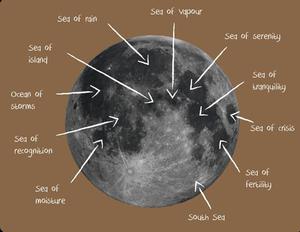
Lunar Landscape
astroEDU educational activity (links to astroEDU website) Description: Create craters and explore the lunar landscape with this hands-on activity.
License: CC-BY-4.0 Creative Commons Reconocimiento 4.0 Internacional (CC BY 4.0) íconos
Etiquetas:
Hands-on
, Model
, Lunar landscape
, Craters
Rango de edades:
4-6
, 6-8
, 8-10
Nivel educativo:
Primaria
Áreas de aprendizaje:
Modelización
Costos:
Coste medio
Tamaño del grupo:
Grupo
Competencias:
Plantear preguntas
, Comunicar información
, Desarrollar y utilizar modelos
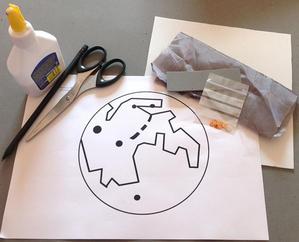
Meet Our Neighbours: Moon
astroEDU educational activity (links to astroEDU website) Description: Explore the tactile version of our moon with household materials.
License: CC-BY-4.0 Creative Commons Reconocimiento 4.0 Internacional (CC BY 4.0) íconos
Etiquetas:
Hands-on
, Model
, Visually Impaired
, Tactile
Rango de edades:
6-8
, 8-10
, 10-12
Nivel educativo:
Educación secundaria
, Primaria
, Secondary
Áreas de aprendizaje:
Clase interactiva
, Modelización
Costos:
Bajo coste
Tamaño del grupo:
Grupo
Competencias:
Analizar e interpretar datos
, Plantear preguntas
, Comunicar información
, Desarrollar y utilizar modelos
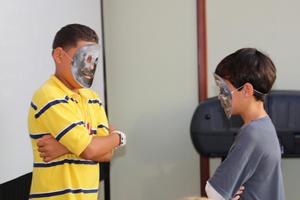
Lunar Day
astroEDU educational activity (links to astroEDU website) Description: Through a fun-learning activity, understand why moon always keeps the same face towards Earth.
License: CC-BY-4.0 Creative Commons Reconocimiento 4.0 Internacional (CC BY 4.0) íconos
Etiquetas:
Lunar day
Rango de edades:
4-6
, 6-8
Nivel educativo:
Primaria
, Secondary
Áreas de aprendizaje:
Modelización
, Centrado en la simulación
Costos:
Gratis
Duración:
30 minutos
Tamaño del grupo:
Grupo
Competencias:
Analizar e interpretar datos
, Plantear preguntas
, Comunicar información
, Elaborar explicaciones
, Desarrollar y utilizar modelos
Sun, Earth and Moon Model
astroEDU educational activity (links to astroEDU website) Description: Build an Earth-Moon-Sun mobile to learn about how they orbit.
License: CC-BY-4.0 Creative Commons Reconocimiento 4.0 Internacional (CC BY 4.0) íconos
Etiquetas:
Hands-on
, Model
Rango de edades:
8-10
Nivel educativo:
Primaria
Áreas de aprendizaje:
Aprendizaje mediado por juegos
, Modelización
, Aprendizaje basado en la investigación estructurada
Costos:
Coste medio
Duración:
1 hora y 30 minutos
Tamaño del grupo:
Grupo
Competencias:
Plantear preguntas
, Comunicar información
, Desarrollar y utilizar modelos
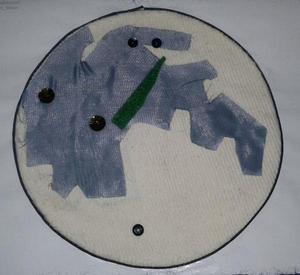
Children's Planetary Maps: The Moon
astroEDU educational activity (links to astroEDU website) Description: An up close look at our own satellite
License: CC-BY-4.0 Creative Commons Reconocimiento 4.0 Internacional (CC BY 4.0) íconos
Etiquetas:
Maps
, Planetary cartography
, Spatial thinking
Rango de edades:
6-8
, 8-10
, 10-12
, 12-14
Nivel educativo:
Educación secundaria
, Primaria
, Secondary
Áreas de aprendizaje:
Aprendizaje basado en la investigación estructurada
Costos:
Bajo coste
Duración:
2 horas
Tamaño del grupo:
Grupo
Competencias:
Analizar e interpretar datos
, Plantear preguntas
, Comunicar información
, Elaborar explicaciones
, Desarrollar y utilizar modelos
, Participar en debates basados en pruebas
, Planificar y llevar a cabo investigaciones