This page describes an image Orion Constellation Map
Download File ( image 147.68 kB)
Download PDF File (PDF file 220.54 kB)
Diagram caption:
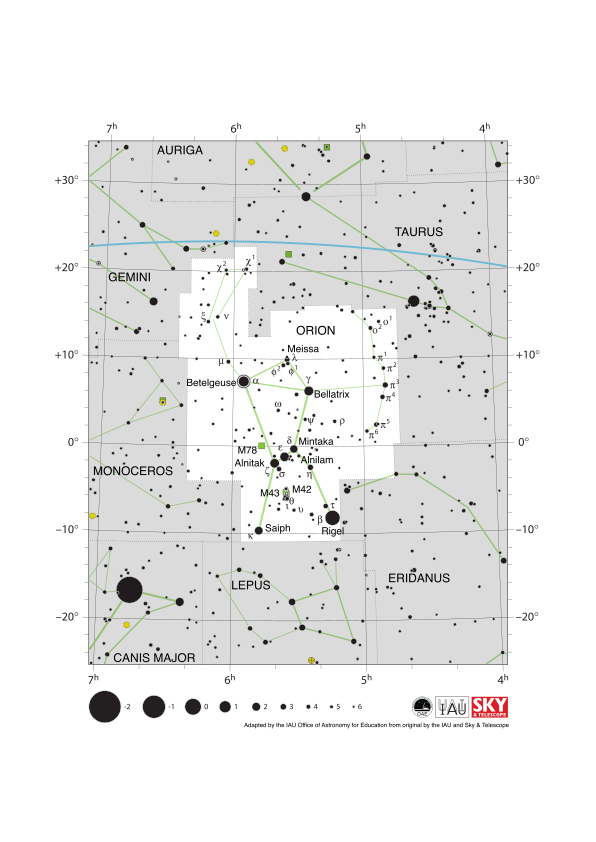
The constellation Orion along with its bright stars and surrounding constellations. Orion is surrounded by (going clockwise from the top) Taurus, Eridanus, Lepus, Monoceros and Gemini. Orion’s brightest stars Betelgeuse and Rigel appear at the northern (upper on this diagram) and southern (lower) end of the constellation respectively with the famous three star “belt” in the middle.
Orion spans the celestial equator and is thus visible at some time in the year from all of planet Earth. In the most arctic or antarctic regions of the world, some parts of the constellation may not be visible. Orion is most visible in the evenings in the northern hemisphere winter and southern hemisphere summer. The blue line above Orion marks the ecliptic, the path the Sun appears to travel across the sky over the course of a year. The Sun never passes through Orion, but one can occasionally find the other planets of the Solar System and the Moon in Orion.
Just south of Orion’s belt lie two Messier objects M42 (the Orion nebula) and M43, marked by green squares. These nebulae along with M78 (here the green square to the left of the belt) are part of the huge Orion Molecular Cloud Complex. This covers most of the constellation and includes regions where these molecular clouds are collapsing to form young starts.
The y-axis of this diagram is in degrees of declination with north as up and the x-axis is in hours of right ascension with east to the left. The sizes of the stars marked here relate to the star's apparent magnitude, a measure of its apparent brightness. The larger dots represent brighter stars. The Greek letters mark the brightest stars in the constellation. These are ranked by brightness with the brightest star being labeled alpha, the second brightest beta, etc., although this ordering is not always followed exactly. The circle around Betelgeuse indicates that it is a variable star. The dotted boundary lines mark the IAU's boundaries of the constellations and the solid green lines mark one of the common forms used to represent the figures of the constellations. Neither the constellation boundaries, nor the line marking the ecliptic, nor the lines joining the stars appear on the sky.
Diagram credit: Adapted by the IAU Office of Astronomy for Education from the original by IAU/Sky & Telescope. Credit Link
Diagram translation status: Not yet approved by a reviewer
Diagram license: Creative Commons 저작자표시 4.0 국제 (CC BY 4.0) Creative Commons 저작자표시 4.0 국제 (CC BY 4.0) icons
Related glossary terms:
Apparent Magnitude
, Constellation
, Gemini
, Right Ascension (RA)
, Taurus
, 변광성
, 오리온자리
, 적위
, 천구좌표
, 황도
Categories:
Naked Eye Astronomy
Want to make your own translation or version of this diagram? Then
download the SVG
version of this diagram in English (793.43 kB). You can edit this using
software like Inkscape (free) or Adobe Illustrator
(proprietary). Just remember to credit the author of the original appropriately.
You can also make your own version or translation of this diagram by adding adding text to a version of
this diagram with no text. Just download one of the following files:
Download Text-Free File ( image 130.72 kB)
Download Text-Free PDF File (PDF file 197.60 kB)
In Other Languages
영어: Orion Constellation Map중국어 번체: 獵戶座星圖
중국어 간체: 猎户座星图
이탈리아어: Mappa della costellazione di Orione
스페인어: Mapa de la constelación de Orión
독일어: Orion-Sternkarte
네팔어: तारामण्डलको नक्सा
The diagram captions presented on the OAE website were written, translated and reviewed by a collective effort from the OAE, the OAE Centers and Nodes, the OAE National Astronomy Education Coordinators (NAECs) and other volunteers. You can find a full list of credits for our translation project here. All media file captions are released under a Creative Commons CC BY-4.0 license and should be credited to "IAU OAE". The media files themselves may have different licenses (see above) and should be credited as listed above under "credit".
If you notice a error in this diagram or its caption then please get in touch.