Glossary term: 코로나
Description: 별의 코로나는 별의 대기를 둘러싼 영역으로, 온도가 매우 높고 밀도가 낮은 플라스마로 이루어져 있습니다. 이 영역은 수백만 km에 달하는 우주 공간까지 뻗어 나갈 수 있습니다. 별 내부에서 전기를 띤 (대전된)물질이 움직이면 다이나모 효과가 일어나는데, 이 때문에 강한 자기장을 가진 모든 별에는 코로나가 있을 것으로 생각됩니다. 태양의 코로나는 개기일식 때 맨눈으로 볼 수 있습니다. 이때 코로나는 가려진 태양 원반을 둘러싸고 있는, 희미하고 불규칙한 모양의 빛으로 보입니다. 일반적으로 별의 코로나 모양은 별의 자기장과 바깥쪽 가스의 압력에 의해 결정됩니다. 코로나는 온도가 매우 높습니다. 예를 들어 태양 코로나는 100만 켈빈(K)이 넘는데, 이는 태양 표면보다 훨씬 높은 온도입니다. 코로나가 왜 그렇게 온도가 높은지에 대해서는 아직 연구 중이지만, 코로나를 가로지르는 자기장이 중요한 역할을 한다는 점은 분명합니다. 태양 코로나의 모양은 수 초에서 수 개월 사이에도 변할 수 있습니다. 이런 변화는 주로 태양 활동에 의해 일어나는데, 예를 들어 플레어가 코로나로 플라스마를 방출하거나, 코로나질량방출(CME)이 많은 양의 전기를 띤 입자(하전입자)를 내보내는 현상입니다. 또한 코로나는 수 년 단위로도 변합니다. 이것은 약 11년을 주기로 태양 자기장의 세기와 방향이 바뀌는 태양 주기와 관련이 있습니다. 이런 변화는 다른 별들의 코로나에서도 비슷하게 일어날 것으로 예상됩니다.
Related Terms:
See this term in other languages
Term and definition status: The original definition of this term in English have been approved by a research astronomer and a teacher The translation of this term and its definition is still awaiting approval
The OAE Multilingual Glossary is a project of the IAU Office of Astronomy for Education (OAE) in collaboration with the IAU Office of Astronomy Outreach (OAO). The terms and definitions were chosen, written and reviewed by a collective effort from the OAE, the OAE Centers and Nodes, the OAE National Astronomy Education Coordinators (NAECs) and other volunteers. You can find a full list of credits here. All glossary terms and their definitions are released under a Creative Commons CC BY-4.0 license and should be credited to "IAU OAE".
If you notice a factual or translation error in this glossary term or definition then please get in touch.
Related Media
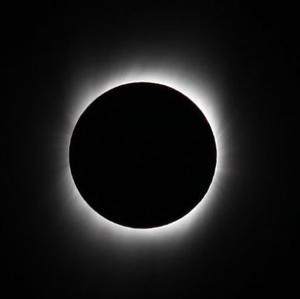
Total Solar Eclipse
Caption: This image represents the total solar eclipse as observed from Kurigram in Bangladesh. Solar eclipses occur when the moon, as seen from earth, passes in front of the Sun. The moon is much smaller than the Sun, it is closer by the night amount that the angular diameters of the Sun and moon are almost the same (~approximately 1/2 a fingertip). Therefore, the moon can cover up the Sun's disk when it passes directly between the Sun and the Earth. The ring of light around the black circle is called the corona.
Credit: Lutfar Rahman Nirjhar
credit link
License: CC-BY-3.0 Creative Commons 저작자표시 3.0 Unported icons

Total Solar Eclipse from Casper, Wyoming, USA
Caption: This video shows the total solar eclipse of the 21st of August 2017 observed from Casper, Wyoming, USA by a team of astronomers from the European Space Agency (ESA). This video has been sped up considerably, in reality the moment of totality lasted just under two and a half minutes while the time from the Moon first appearing to obscure the Sun until the Sun was completely unobscured was two hours and 48 minutes.
Before the eclipse we can see several sunspots on the Sun. The Moon moves across the Sun, covering the whole solar disk visible from the point on the Earth this video was taken from. At totality we can see the diffuse solar corona which is normally outshone by the bright solar disk.
Note that while edges of the Sun appear brighter just before and just after totality, this is due to exposure time of the camera being adjusted to make the features visible at totality more obvious. Towards the end of the video some thin cloud begins to affect the observations.
Credit: Video credit: ESA/CESAR ; Music copyright: Flight Of The Angel 3 by Chris Blackwell, audionetwork.com
credit link
License: CC-BY-SA-3.0-IGO Creative Commons 저작자표시-동일조건변경허락 3.0 정부간 국제 기구 icons