Termo do glossário: Marte
Descrição: Marte é o quarto planeta a partir do Sol no Sistema Solar. É um planeta rochoso e terrestre com um raio de pouco menos de 3400 quilômetros (km), pouco mais da metade do raio da Terra. Marte possui uma atmosfera muito fina, um grande sistema de cânions e a montanha mais alta do Sistema Solar: um vulcão extinto chamado Monte Olimpo (Olympus Mons). Acredita-se que tenha abrigado água líquida no início de sua existência.
Sua distância típica do Sol é de cerca de 228 milhões de km ou 1,52 unidades astronômicas (distâncias Terra-Sol). Leva 687 dias para completar uma órbita ao redor do Sol. Marte tem duas pequenas luas, Fobos e Deimos.
Seu nome é uma referência ao deus romano da guerra. É frequentemente chamado de “planeta vermelho” devido à sua coloração avermelhada. Cientistas enviaram muitas sondas e módulos de pouso a Marte ao longo dos anos para estudar sua composição e atmosfera.
Termos relacionados:
Ver este termo em outros idiomas
Status do termo e da definição: A definição original deste termo em inglês foi aprovada por um astrônomo(a) pesquisador(a) e um(a) professor(a) A tradução deste termo e de sua definição ainda aguarda aprovação
O Glossário Multilíngue da OAE é um projeto do Escritório da IAU de Astronomia para a Educação(OAE) em colaboração com o Escritório da IAU para Divulgação da Astronomia (OAO). Os termos e definições foram selecionados, escritos e revisados por meio de um esforço coletivo da OAE, dos Centros e Nós da OAE, dos Coordenadores Nacionais de Educação em Astronomia (NAECs) da OAE e de outros voluntários. Você pode encontrar uma lista completa dos créditos aqui. Todos os termos do glossário e suas definições são disponibilizados sob uma licença Creative Commons CC BY-4.0 e devem ser creditados à "IAU OAE".
Se você notar algum erro factual ou de tradução neste termo do glossário ou em sua definição, por favor entre em contato.
Mídia relacionada
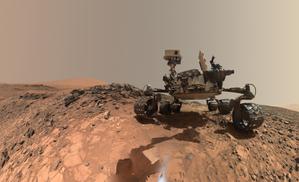
Veículo espacial Curiosity
Legenda: Este autorretrato do rover Curiosity da NASA mostra o veículo no local onde se posicionou para perfurar uma rocha chamada “Buckskin” na parte inferior do Monte Sharp. O autoretrato combina várias imagens capturadas pela Mars Hand Lens Imager (MAHLI) do Curiosity em 5 de agosto de 2015, durante o 1.065º dia marciano, ou sol, do atividades do rover em Marte.
Crédito: NASA/JPL-Caltech/MSSS
link do crédito
License: PD Domínio Público ícones
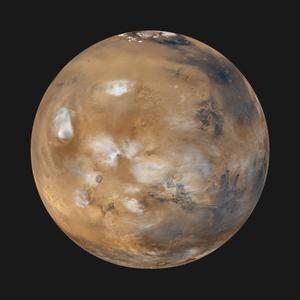
Marte
Legenda: Esta imagem do planeta Marte, capturada pela sonda Mars Global Surveyor Orbiter da NASA em 1999, mostra sua superfície árida. A imagem destaca as regiões geológicas mais espetaculares de Marte. Além do profundo Valles (vale) Marineris, vemos quatro vulcões. Enquanto três deles formam a cordilheira Tharsis, o Monte Olympus é o maior vulcão já descoberto no Sistema Solar. Nuvens de gelo cobrem partes da superfície marciana.
Crédito: NASA/JPL/MSSS
link do crédito
License: PD Domínio Público ícones

Equatorial Milky Way
Legenda: Honourable mention in the 2022 IAU OAE Astrophotography Contest, category Still images of celestial patterns: Equatorial Milky Way
Taken in Bromo-Tengger-Semeru National Park, Java Island, Indonesia, in March 2016, this image captures regions of the southern Milky Way and, at its left edge, the two planets Mars and Saturn. Mars appears orange and is similar in colour to the star Antares, whose Greek name — anti Ares — references this. Saturn is a little bit fainter than Mars, but clearly visible among the stars of Ophiuchus, above the Pipe Nebula and forming an isosceles triangle with Mars and Antares.
Mars is on the top and Saturn is vertically below. Visible to the naked eye, both planets have significance in many cultures around the world. In Roman mythology Mars is the god of war and fertility, and Saturn the god of sowing and agriculture. Its Greek equivalent, the god Kronos, is also considered the regent of completion. Indigenous Australians, including the Kamilaroi and Wailan people, associate Saturn with “wunygal”, a small bird. Mars is called Iherm-penh (something burnt in flames) by the Anmatyerre people of the Central Desert, while the Kokatha people of the Western Desert associate Mars and the star Anatres with the red-tailed black cockatoo (Kogolongo).
In the middle of this photograph, the most famous southern constellations are clearly recognisable: the Southern Cross (Crux), the pointer stars, Alpha and Beta Centauri, the dark Coalsack Nebula and the red Eta Carina Nebula, which is not visible to the unaided eye but is prominent in modern photographs. In the 19th century, the star eta Carinae had been the second-brightest star in the sky for some time, but since it varies irregularly, it has hardly been recognisable in recent decades, and its future visibility is unpredictable.
Triangulum Australe is visible between the pointer stars and the Scorpion, and in the constellation of Centaurus, the bright globular star cluster Omega Centauri is clearly displayed. It was considered a “nebulous star” since antiquity and, thus, was listed in star catalogues for at least 2000 years. Only within the last century did astronomers discover that globular star clusters are in the halo of our galaxy and that this one consists of roughly 10 million stars.
The dark regions in the Milky Way, which are cool, dense clouds of dust and gas, form the head and body of the Celestial Emu Tchingal. Together with the Southern Cross and the pointer stars, they appear in the Dreamtime stories of many Indigenous Australians. One story associated with the Djab Wurrung and the Jardwadjali people is part of a Dreamtime Story involving Tchingal, the Bram-bram-bult brothers (the pointer stars), their mother Druk (Delta Crux), and Bunya the hunter, who gets transformed into a possum (Gacrux, the red star at the top of the Southern Cross).
Crédito: Giorgia Hofer/IAU OAE
License: CC-BY-4.0 Creative Commons Attribution 4.0 International (CC BY 4.0) ícones
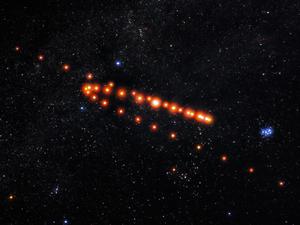
Retrograde Motion of Mars
Legenda: Winner in the 2023 IAU OAE Astrophotography Contest, category Still images with smartphones-mobile devices.
This image captures the celestial waltz of Mars as it demonstrates its intriguing retrograde motion against the background of fixed stars. This event, when Mars appears to backtrack in its orbit, arises from the different speeds at which Earth and Mars orbit the Sun. Earth’s faster movement occasionally positions it ahead of Mars, creating the illusion of the Red Planet moving in reverse from our perspective. This retrograde motion occurs when Mars is on the other side of the sky from the Sun, when it is said to be in opposition. Following Mars from 14 August 2022 to 5 April 2023, this smartphone image stands as a testament to perseverance and precision in the tranquil setting of Bataan, Philippines. Enduring unpredictable weather and ever-shifting celestial alignments, the photographer meticulously captured each shot at regular intervals of five to eight days. The process involved aligning 35 distinct images of Mars, taken without any external lens or telescope, alongside a stacked background image composed of 54 frames lasting 15 seconds each, portraying the starry expanse. Fusing these images involved precisely aligning them and cropping Mars in order to centre its position, revealing its retrograde movement against the backdrop of stars. This intricate process, blending the images seamlessly into the background by masking, highlights the planet’s unique motion. In the lower right corner, the Pleiades star cluster is visible.
Crédito: Rob Kerby Guevarra/IAU OAE (CC BY 4.0)
License: CC-BY-4.0 Creative Commons Attribution 4.0 International (CC BY 4.0) ícones

Trânsito de Fobos por Marte
Legenda: Este vídeo mostra o Sol visto de Marte, enquanto Fobos, a lua de Marte, transita pelo disco solar. Este vídeo é composto por imagens captadas da superfície marciana no dia 30 de setembro de 2024 pela câmera Mastcam-Z do rover Perseverance da NASA. Enquanto nossa Lua tem o tamanho perfeito para eclipsar o Sol quando vista da superfície da Terra, o tamanho e a órbita de Fobos fazem com que ele não consiga cobrir o disco solar completamente. Isso significa que este evento é um trânsito e não um eclipse.
Este vídeo é em tempo real, com o trânsito inteiro durando apenas 32 segundos. Isso contrasta com as várias horas que um eclipse solar na Terra pode durar, desde o momento em que a Lua começa a encobrir parte do Sol até que o Sol volte a ficar completamente visível. Isso se deve ao período orbital muito mais curto de Fobos, de pouco mais de sete horas e meia, em comparação com o período orbital da Lua, de 27 dias, bem como ao fato de o disco solar parecer ligeiramente menor visto de Marte do que da Terra. Observe a forma não esférica de Fobos enquanto cruza o disco solar.
Crédito: NASA/JPL-Caltech/ASU/MSSS
link do crédito
License: PD Domínio Público ícones
Atividades relacionadas
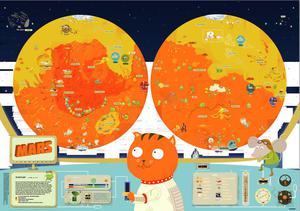
Children's Planetary Maps: Mars
astroEDU educational activity (links to astroEDU website) Description: Explore planet Mars, learning how to use planetary maps!
License: CC-BY-4.0 Creative Commons Attribution 4.0 International (CC BY 4.0) ícones
Tags:
Maps
, Planetary cartography
Faixas etárias:
6-8
, 8-10
, 10-12
, 12-14
Nível de ensino:
Ensino fundamental
, Básico
, Médio
Áreas de aprendizagem:
Aprendizagem por investigação estruturada
Custos:
Gratuito
Duração:
2 hours
Tamanho do grupo:
Grupo
Habilidades:
Analisar e interpretar dados
, Fazer perguntas
, Construir explicações
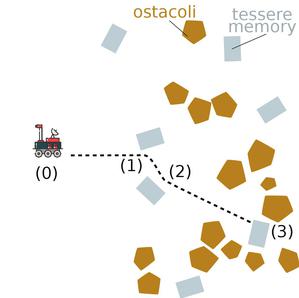
Driving on Mars
astroEDU educational activity (links to astroEDU website) Description: An educational interdisciplinary game to drive a rover on Mars
License: CC-BY-4.0 Creative Commons Attribution 4.0 International (CC BY 4.0) ícones
Tags:
Game
, robot
, robotics
, simulation
, telecommunications
Faixas etárias:
14-16
, 16-19
Nível de ensino:
Ensino fundamental
, Médio
Áreas de aprendizagem:
Aprendizagem por descoberta guiada
Custos:
Baixo custo
Duração:
2 hours
Tamanho do grupo:
Grupo
Habilidades:
Comunicar informações
, Desenvolver e usar modelos
, Usar matemática e pensamento computacional

Meet our neighbours: Mars
astroEDU educational activity (links to astroEDU website) Description: Build a tactile version of the red planet!
License: CC-BY-4.0 Creative Commons Attribution 4.0 International (CC BY 4.0) ícones
Faixas etárias:
6-8
, 8-10
, 10-12
Nível de ensino:
Básico
Áreas de aprendizagem:
Atividade divertida
, Modelagem
Custos:
Baixo custo
Duração:
1 hour
Tamanho do grupo:
Grupo
Habilidades:
Analisar e interpretar dados
, Desenvolver e usar modelos