Teaching Methods And Tools
Parallel Session
7th Shaw-IAU Workshop on Astronomy for Education
Session timeblocks
Tuesday Nov. 18, 2025
Part A:
UTC: 3 p.m. -
4:30 p.m.
America/New_York:
10 a.m.-
11:30 a.m.
Thursday Nov. 20, 2025
Part B:
UTC: 8 a.m. -
9:30 a.m.
America/New_York:
3 a.m.-
4:30 a.m.
Part B - repeated:
UTC: 8 p.m. -
9:30 p.m.
America/New_York:
3 p.m.-
4:30 p.m.
Friday Nov. 21, 2025
Part A - repeated:
UTC: 8 a.m. -
9:30 a.m.
America/New_York:
3 a.m.-
4:30 a.m.
Chair

Niall Deacon
Share on:


Dedicated to discussing and sharing effective teaching tools, digital resources, and pedagogical strategies that enhance astronomy education at different levels. This session covers a broad pedagogical range from online teaching, to teaching with art and other disciplines and teaching with museum exhibits.
Schedule
-
Staged reading as a genre suitable for planetariums
Tuesday Nov. 18, 2025
UTC: 3 p.m. - 3:10 p.m. America/New_York: 10 a.m.- 10:10 a.m.Friday Nov. 21, 2025
UTC: 8 a.m. - 8:10 a.m. America/New_York: 3 a.m.- 3:10 a.m."The sky above Opava in the changes of the ages" How the view of the night sky has changed over eight centuries of existence of our city? What happened in Opava in epochal times astronomical discoveries? Did the inhabitants of the Opava region become fascinated by the view of the sky less or more than it is today? The experimental show in the Unisphere will try to reflect on these questions in the form of a staged reading accompanied by a spherical projection of the night sky. /premiere in November 2024/

Tomáš Gráf (Silesian University, Opava)
For more information about this talk click here
-
The Museum of Science and Planetarium Goes to School
Tuesday Nov. 18, 2025
UTC: 3:10 p.m. - 3:25 p.m. America/New_York: 10:10 a.m.- 10:25 a.m.Friday Nov. 21, 2025
UTC: 8:10 a.m. - 8:25 a.m. America/New_York: 3:10 a.m.- 3:25 a.m.Within the Sánchez Cosmodom Educational Projects that we develop in Venezuela we have the innovative project “The Science Museum and Planetarium goes to School”. It is a traveling museum that was presented in more than 30 educational institutions from preschool to high school, reaching more than 15,000 students. The project brings together Astronomy, Paleontology and Recreational Science in exhibitions of Venezuelan mega fauna with real megatherium fossils, optics and electricity experiments, and a virtual and augmented reality tour. The activity culminates with functions in a mobile planetarium of our own design, safe solar observation with telescopes, a photo gallery, hydro-rocket launch and drone flight. The teaching staff is previously trained in the different areas.
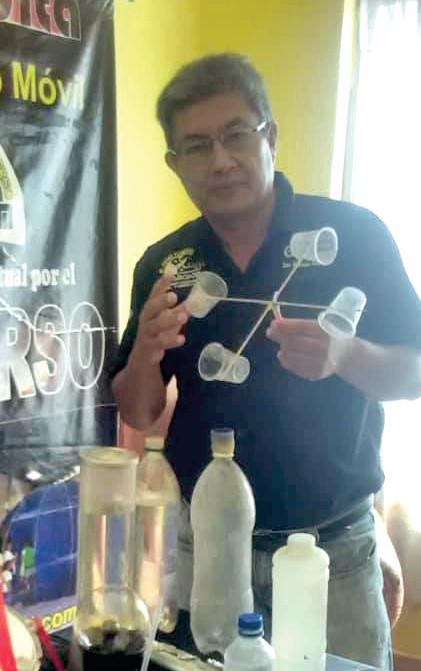
Gilbert Sánchez (Member of the Larense Astronomy Association, CEO of Sánchez Cosmodom Integral Educational Projects)
For more information about this talk click here
-
Back to Basics: Project-Based Astronomy Learning in Schools
Tuesday Nov. 18, 2025
UTC: 3:20 p.m. - 3:30 p.m. America/New_York: 10:20 a.m.- 10:30 a.m.Friday Nov. 21, 2025
UTC: 8:20 a.m. - 8:30 a.m. America/New_York: 3:20 a.m.- 3:30 a.m.The Indian Institute of Astrophysics has been developing innovative astronomy education methods through its outreach efforts, with a growing focus on middle and high school students, a community whose access to astronomy projects is either very limited or not rigorous. Hence, we started the Research Experience for School Students, a well-defined, non-curricular two-week summer school, where selected students engage in carefully designed computational or experimental projects, while using only manual techniques to arrive at solutions. We will discuss the goals and structure of the program, along with a novel Job Shadowing program, a project to facilitate the formation of astronomy clubs in resource-poor schools, and a recent collaboration for a space science congress for students.
Vikranth Pulamathi (Indian Institute of Astrophysics)
For more information about this talk click here
-
The Impact of Stargazing Events on Students’ Interest in STEM in Ethiopia
Tuesday Nov. 18, 2025
UTC: 3:30 p.m. - 3:45 p.m. America/New_York: 10:30 a.m.- 10:45 a.m.Friday Nov. 21, 2025
UTC: 8:30 a.m. - 8:45 a.m. America/New_York: 3:30 a.m.- 3:45 a.m.Ethiopia’s geographical location and favorable conditions make it an excellent place for astronomical observation and stargazing. Stargazing events contribute to STEM education in Ethiopia by transforming astronomy’s natural appeal into practical, engaging learning. Despite educational challenges, such events spark curiosity, connect science to culture, and empower girls through programs like SciGirls. They foster collaborations that extend STEM outreach to underserved areas and engage families in supporting students. These initiatives offer a promising path toward scientific literacy and national development in Ethiopia.
Nebiyu Suleyman Mohammed (Ethiopian Space Science Society)
For more information about this talk click here
-
AstroSandbox: learning astronomy through courses, competitions, and clubs
Tuesday Nov. 18, 2025
UTC: 3:45 p.m. - 3:55 p.m. America/New_York: 10:45 a.m.- 10:55 a.m.Friday Nov. 21, 2025
UTC: 8:45 a.m. - 8:55 a.m. America/New_York: 3:45 a.m.- 3:55 a.m.AstroSandbox is an educational initiative offering a diverse range of resources to engage Ukrainian high school students interested in advanced astronomy and/or astronomy school competitions. We have created a 100-hour video course covering topics from spherical geometry to observational confirmations of general relativity, produce concise Blitz videos that answer focused questions, and organize annual team competitions - AstroBattles - where students present solutions to astronomy problems before a jury and an opposing team. In partnership with Kvanta project, we also run an astronomy club for middle-schoolers, where we foster problem-solving skills through interactive lessons.

Taisiia Karasova (Massachusetts Institute of Technology)
For more information about this talk click here
-
Discussion Panel: Teaching Methods and Tools
Tuesday Nov. 18, 2025UTC: 3:55 p.m. - 4:30 p.m. America/New_York: 10:55 a.m.- 11:30 a.m.
Friday Nov. 21, 2025
UTC: 8:55 a.m. - 9:30 a.m. America/New_York: 3:55 a.m.- 4:30 a.m.Chair:
Niall Deacon
Panel: Tomáš Gráf , Gilbert Sánchez
(Member of the Larense Astronomy Association, CEO of Sánchez Cosmodom Integral Educational Projects), Vikranth Pulamathi
(Indian Institute of Astrophysics), Taisiia Karasova
(Massachusetts Institute of Technology), Nebiyu Suleyman Mohammed
(Ethiopian Space Science Society) -
3o4cosas: A JavaScript-Based Simulation Platform for Astronomy, Astrophysics, and Cosmology
Thursday Nov. 20, 2025
UTC: 8 a.m. - 8:15 a.m. America/New_York: 3 a.m.- 3:15 a.m.Thursday Nov. 20, 2025
UTC: 8 p.m. - 8:15 p.m. America/New_York: 3 p.m.- 3:15 p.m.We present www.3o4cosas.com, a free educational platform with JavaScript-based simulations designed to teach astronomy, astrophysics, and cosmology. It includes visual, interactive tools on topics such as celestial motion, planetary models, and the future of the universe, making it ideal for secondary education and teacher training. The simulations, designed to be accessible without prior training in physics, have been used in the Peruvian national selection for the International Olympiad on Astronomy and Astrophysics and in general science courses at the university level. We aim to establish the platform as a key resource for educators worldwide, and we welcome feedback and collaboration to adapt the content further for school settings and teacher training initiatives.
Saneli Alcides Carbajal Vigo (Universidad del Pacífico)
For more information about this talk click here
-
Radio helps the Video star: reimaging astronomy education in local language radio.
Thursday Nov. 20, 2025
UTC: 8:15 a.m. - 8:25 a.m. America/New_York: 3:15 a.m.- 3:25 a.m.Thursday Nov. 20, 2025
UTC: 8:15 p.m. - 8:25 p.m. America/New_York: 3:15 p.m.- 3:25 p.m.As a part of the outreach project of the upcoming LED Dome planetarium (COSMOS in Mysuru) by the Indian Institute of Astrophysics, we have a weekly astronomy program on the Radio Manasa FM channel of the University of Mysore, called Nakshatravani, in the Kannada language. This is uniquely tailored for local audiences and combines recent astronomy and space news, a monthly sky calendar, and explanations of basic astronomy concepts. It also features regular interviews with visiting astronomers in Kannada and English. These episodes are also archived as podcasts on Spotify and Amazon Music. This project makes astronomy accessible to non-digital, rural, and regional-language listeners. In this talk, I will describe our program, methodology, and its efficacy and end with upcoming plans.
Amoghavarsha N (Indian Institute of Astrophysics)
For more information about this talk click here
-
Preliminary Exploration of Astronomy Popularization Experimental Activities
Thursday Nov. 20, 2025
UTC: 8:25 a.m. - 8:35 a.m. America/New_York: 3:25 a.m.- 3:35 a.m.Thursday Nov. 20, 2025
UTC: 8:25 p.m. - 8:35 p.m. America/New_York: 3:25 p.m.- 3:35 p.m.To satisfy the needs of the public, especially teenagers, for both rich and profound astronomical knowledge, we have initially established the ”Astronomy Science Creative Laboratory”—an astronomy popularization experimental platform. This report will briefly introduce the series of astronomy-themed experimental activities developed on this platform, and then take the classic activity "Hide-and-Seek with Light" as a case study to further analyze the design features and implementation effects of these activities. The classic activity utilizes teaching tools including a mirror maze, Newtonian reflector, and Schlieren device to guide teenagers in exploring light reflection and its applications in telescopes through a structured approach: observing, gameplaying, experiment, and interpret.

Guo Yilin
For more information about this talk click here
-
Musical Filters: A Multi-sensory Approach to Teaching the Electromagnetic Spectrum
Thursday Nov. 20, 2025
UTC: 8:35 a.m. - 8:45 a.m. America/New_York: 3:35 a.m.- 3:45 a.m.Thursday Nov. 20, 2025
UTC: 8:35 p.m. - 8:45 p.m. America/New_York: 3:35 p.m.- 3:45 p.m.Musical Filters implements universal design to teach the electromagnetic spectrum (EMS) and astronomical filters by using a combination of music and 3D printed tactiles to demonstrate the basic mechanics and usage of filters for analyzing light at different wavelengths. The EMS is pivotal to studying the distance, composition, and temperature of astronomical objects. This two-part project includes a demonstration and data application of infrared filters. Both parts involve a sensor that translates the detected colors into songs. In Part One, students use filters to separate a complete song into three layers, and, in Part Two, students use the sensor to discover how light outside the visible spectrum is used to study objects in space.
Maire Lucero (GLAS Education, UW Madison)
For more information about this talk click here
-
Stars, Colors, and Children: Teaching Astronomy Creatively at the Art Narty Festival
Thursday Nov. 20, 2025
UTC: 8:45 a.m. - 9 a.m. America/New_York: 3:45 a.m.- 4 a.m.Thursday Nov. 20, 2025
UTC: 8:45 p.m. - 9 p.m. America/New_York: 3:45 p.m.- 4 p.m.The Art Narty Festival is a long-running artistic initiative in remote areas of Egypt that lack access to cultural and artistic services. Since its launch 8 years ago, it has reached over 15,000 children all over Egypt. The festival offers hands-on workshops in painting, fashion design, voice-over, filmmaking, & more. In 2024, it adopted the theme "تأمل، تفكر، تدبر" (“Contemplate, Reflect, Understand”) and, for the first time, integrated astronomy into its programming. Ola, as a science communicator, joined the 7th edition in Aswan and Siwa, delivering workshops to children aged 4 to 12. Working with artists, she introduced astronomy through creative activities. Children painted planets using color theory, created constellations by connecting dots, and designed clothing inspired by space.
Ola Ali (Assistant Researcher, National Research institute of Astronomy & Geophysics)
For more information about this talk click here
-
Discussion Panel: Teaching Methods and Tools
Thursday Nov. 20, 2025UTC: 9 a.m. - 9:30 a.m. America/New_York: 4 a.m.- 4:30 a.m.
Thursday Nov. 20, 2025
UTC: 9 p.m. - 9:30 p.m. America/New_York: 4 p.m.- 4:30 p.m.Chair:
Niall Deacon
Panel: Saneli Alcides Carbajal Vigo
(Universidad del Pacífico), Amoghavarsha N
(Indian Institute of Astrophysics), Guo Yilin , Ola Ali
(National Research Institute of Astronomy & Geophysics), Maire Lucero
(GLAS Education, UW Madison)
Posters
-
AI-Enhanced Strategies and Digital Tools for Teaching Astronomy and Cosmology: A Comparative Study
Abd El Fady Morcos (National Research Institute of Astronomy and Geophysics ( NRIAG ))
AI and digital tools play an important role in teaching astronomy and cosmology across IGCSE, Egyptian national, and American K–12 systems. A comparison including curricula, teaching methods, and technology use, highlighting strengths and challenges is done. Tools like Stellarium, PhET, GeoGebra, and NASA/ESA resources are presented alongside AI-powered platforms that support personalized learning. Special focus is given to Arabic-language content for Egyptian classrooms. The study offers practical, inclusive strategies for future-ready, tech-enhanced science education.
-
Astronomy Education in Egypt: Methods and Tools.
Somaya Saad (National Research Institute of Astronomy and geophysics, NRIAG)
In the past decade, astronomy Education in Egypt showed significant development. The establishment of the center of astronomy education OAE-Egypt and the work in cooperation with the IAU-OAE helped us to be visible and to cooperate widely on an international, regional and national level. The Talk therefore focuses on the role of the center of astronomy education in Egypt in contributing to astronomy education development utilizing different tools and methods and will highlight on the current astronomy educational programs and projects.
-
Empowering Astronomy Education through the SPACETOPIA portal
Mila Mitra (STEM & Space), Gautam Agawari (STEM & Space), Hema Verma (STEM & Space)
We present a comprehensive astronomy education portal, 'Spacetopia'. Designed to minimize teacher preparation time, it streamlines the integration of astronomy into classrooms. The portal features grade-specific lessons, engaging videos and hands-on activities, accessible through a user-friendly interface that allows teachers with basic science training to deliver astronomy content, opening possibilities for widespread astronomy education. A teacher training workshop showcasing this portal, along with observing and expert led discussions was held from November 25-27, 2024, at ARIES observatory, Nainital, India. Jointly organised by ARIES and STEM & Space and supported by the Office of Astronomy Education (OAE), India, the workshop offered participants an immersive astronomy experience.
-
Exploring Exoplanets: A Card Game to Introduce Students to Planetary Formation
Carla Hernández (Universidad de Santiago de Chile (USACH); Center for Interdisciplinary Research in Astrophysics and Space Science (CIRAS); Millennium Nucleus on Young Exoplanets and their Moons (YEMS))
This proposal presents the card game Exploring Exoplanets (Explorando Exoplanetas in Spanish), designed to introduce children and young people to exoplanetary science through play and gamification. To support its use in schools, a companion booklet provides suggested activities for primary and secondary science classes. The game has generated strong interest in planetary formation among teachers, students, and the general public during outreach events. Both the game and the booklet are freely available in Spanish, with plans to develop versions in other languages and to expand the card set as research in this area progresses.
-
Exploring New Breakthroughs in Astronomical Science Popularization at the Sci-Tech Museum's Dome The
Zhao Ranzi (China Science and Technology Museum, Dome Theater)
The CSTM's Dome Theater organized a science popularization observation live stream in 2024 during the arrival of C/2023 A3. Co-hosted by five observatories, the event spanned China from east to west, allowing global audiences to observe the comet continuously for 2.5 hours. Viewers interacted with hosts and experts live from the Dome Theater, generating 2.4 million views.In 2025, we held a dome concert on the Chinese traditional "Five Elements" (ancient names for the five planets). Leveraging the Digistar system's、Laser Show and film clips, a Chinese traditional folk orchestra performed live, leading audiences through an immersive experience of astronomy and traditional cultural art. Both activities achieved exceptional communication effects, offering valuable references for other domes.
-
Humour and cartoons to communicate astronomy
Shylaja B S (Visiting Scientist, Jawaharlal Nehru Planetarium, High Grounds, Bengaluru, India)
Humorous cartoons offer a very effective means of communication of a difficult concept. There are plenty of such ideas centred around the sun and the moon, generally based on the misconceptions and superstitions. Some authors are known for their special skill in this art. We made an attempt introduce cartoons in an otherwise serious book covering all astrophysical aspects of astronomy. This was for an encyclopedia, the first of its kind in the regional language, covering from historical aspects to gravitational waves, with contributions from scientists. Every chapter commenced with a cartoon which added to the attraction of the book. Some of the cartoons will be shown and the evolution of the theme will be discussed.
-
Innovative Strategies and Resources for Teaching with Authentic Data
José Antonio D'Santiago García (Universidad Nacional Experimental Rafael María Baralt)
In the digital age, teaching with authentic data opens new possibilities for transforming the educational experience. This work explores how rigorous data collection and refinement, along with innovative methodologies such as Flipped Classroom, Storytelling, Gamification, and Astronomical Peripateticism, create a dynamic and evidence-based learning environment. It proposes that after thorough research to filter and select high-quality information, students can learn theoretical content at home and then apply it through real-time observations.
-
Innovative Teaching Tools for Lunar Science Lessons through Meteorite Labs and Historic Artifacts
Exodus Chun-Long Sit (Chair of IAU-NAEC & Co-NOC Hong Kong, Starrix, Hong Kong)
This session highlights the "Outer Space Classroom in Meteorite Lab" program, which transforms traditional lunar education by integrating interactive tools and historic artifacts. Moving beyond textbook-based instruction, students engage with 3D-printed lunar models, spacecraft replicas, lunar meteorite samples, and scaled spacesuit models. These hands-on resources, combined with official lunar mission photos and interactive crater displays, foster a deeper understanding of human Moon exploration history. By offering multi-sensory, STEAM-focused experiences, this approach enriches astronomy and planetary science education, promoting active learning and inspiring curiosity across diverse educational levels and settings.
-
Introducing Radio Astronomy with Paper Circuits
Carlos Alberto Pereira da Silva (Brazilian Educational Radioastronomy Group)
This educational proposal is based on the paper circuits technique to teach basic concepts of radio astronomy, aligned with STEAM methodologies and maker culture. The activity involves hands-on assembly and playful exploration of the components that make up a traditional radio astronomy system, fostering active and interdisciplinary learning. This presentation shares the foundational aspects of the approach and its potential developments as part of an ongoing project aimed at producing innovative educational materials.
-
The Role of Visual Content and Social Media in Engaging Students with Astronomy
Mohammad Sadegh Faghanpour (Behshahr Student Research Center)
Visual content and social media have become powerful tools for science communication. This presentation shares our experience using a Persian Instagram page to support astronomy learning for students and the public. We focus on concepts like the night sky’s apparent motion, Earth’s rotation and revolution, and seasonal changes. Using infographics, videos, and interactive stories, we explain phenomena such as planetary alignments, lunar phases, and crescent Moon observation. We also discuss designing engaging visuals, connecting with young audiences, and evaluating impact. This shows how localized visual storytelling enhances astronomy education.
-
The Tamarind Galaxy series: a teaching aid.
''Natty'' Mark Samuels
Many of the documented celestial objects are known by numbers or letters, or a combination of both, which some people may find hard to remember; or by names, which they find hard to pronounce, so the objects in the Tamarind Galaxy series are named after plants; plants associated with Africa and the Caribbean. During the workshop for the Oxford Sudanese Supplementary School, at the inauguration of their Astronomy in Africa project, I used Tarhaqa Dream and Starlit Chant, from the seventh instalment; and Guava Dust, from instalment eight. Guava Dust is about the dust storms on Planet Guava, one of the ten planets in the Tamarind Galaxy.
-
Using a physics-based space flight simulation game as an alternative to classroom learning
Matipon Tangmatitham (National Astronomical Research Institute of Thailand (NARIT))
"Space Youth Challenge" is a competition in which teams of 5 students use the game "Kerbal Space Program" to dream up their space missions and then execute them, according to the real laws of physics. Participants get to put the knowledge they learn in schools from physics, celestial mechanics, newton's law of motions, vectors, torque, aerodynamics, etc. into practice. Over the 3 seasons of Space Youth Challenge we have received nearly 1,997 participants from 472 teams. The responses to the competition are overwhelmingly positive and have proven that video game can also be a powerful alternative to conventional formal education in schools on top of allowing artistic freedom and teaching basic video editing skills which is arguable one of the most important skills in this era.