Glossary term: 合
Description: 從地球上的觀測者的角度來看,當兩個天體在天空中看起來非常接近時,它們被稱為處於合相(合)。合相不一定是肉眼可見的——例如,每當新月時,月亮和太陽近似在一條直線上,但在此時,我們看不到月亮,除非發生日食。在這種情況下,或者兩個天體非常接近(合)以至於一個天體看起來遮住另一個天體時,天文學家就會將其描述為凌日或食。
Related Terms:
See this term in other languages
Term and definition status: The original definition of this term in English have been approved by a research astronomer and a teacher The translation of this term and its definition is still awaiting approval
This is an automated transliteration of the simplified Chinese translation of this term
The OAE Multilingual Glossary is a project of the IAU Office of Astronomy for Education (OAE) in collaboration with the IAU Office of Astronomy Outreach (OAO). The terms and definitions were chosen, written and reviewed by a collective effort from the OAE, the OAE Centers and Nodes, the OAE National Astronomy Education Coordinators (NAECs) and other volunteers. You can find a full list of credits here. All glossary terms and their definitions are released under a Creative Commons CC BY-4.0 license and should be credited to "IAU OAE".
If you notice a factual or translation error in this glossary term or definition then please get in touch.
In Other Languages
- 阿拉伯語: الاقتران
- 德語: Konjunktion
- 英語: Conjunction
- 西班牙語: Conjunción
- 法語: Conjonction
- 義大利語: Congiunzione
- 日語: 合 (external link)
- 韓語: 합
- 巴西葡萄牙語: Conjunção
- 簡體中文: 合
Related Media
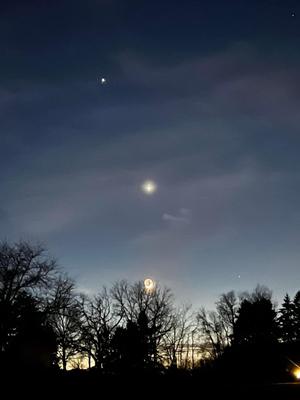
木星、金星、月亮合相
Caption: 這張照片是 2023 年 2 月在美國賓夕法尼亞州盧澤恩縣上空用智能手機拍攝的,讓我們得以一窺合相現象,這是一種迷人的天文現象,當從我們的視角看到兩個或兩個以上的天體在天空中緊緊相鄰時就會發生這種現象,儘管這些天體實際上並不靠近彼此。在這張照片中,木星(上面)的光輝、金星的魅力(中間)和月亮熟悉的光芒(下麵)在微妙的雲層和樹線輪廓的背景下翩翩起舞,這一刻值得珍藏。
Credit: Joslynn Appel/IAU OAE (CC BY 4.0)
License: CC-BY-4.0 Creative Commons 姓名標示 4.0 國際 (CC BY 4.0) icons
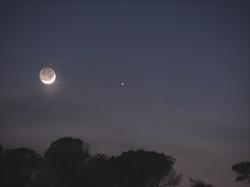
月球-水星-昴星團相合
Caption: 2022年國際天文學聯合會(IAU)OAE天文攝影比賽靜態天體圖案類別榮譽獎作品。
這張照片展示了年輕的月牙,其右側是昴星團中的九顆最亮的恆星(其中一顆被雲層遮擋)。照片中央是水星,看上去略帶紅色。
這幅圖片更傾向於表明昴星團可能由七顆星組成。然而,觀察者被雲層誤導了——五顆星組成了一輛小戰車,一顆緊挨著車把,另外三顆在四邊形的另一端。如果沒有雲層,八顆星將清晰可見。
蛾眉月與昴星團相伴的這種天象僅在北半球的春天才能看到。因此,古巴比倫人利用它來確定一年中的第二個月,並判斷是否需要閏月。至少早在公元前第二個千年,巴比倫人就利用多個星群來確定月份。每隔五天,下一個星群就會在隱沒於日光後再次出現。為了確定閏年的必要性,使太陽年和陰曆年同步,巴比倫人使用了多個星群,而不僅僅是昴星團。例如,他們還利用了明亮的心宿二和天狼星,並觀測到了它們伴月的天象以及偕日昇的天象。現代猶太教和現代伊斯蘭教仍在遵循傳統,使用巴比倫的一些天文規則。然而,鑑於星座由於歲差而發生了移動,而且如今我們也有了計算曆法的手段,這種蛾眉月和昴星團相伴的天象就不再那麼有用了,儘管它依然如此優美。因此,古巴比倫和中巴比倫的傳統僅存留了基本的形式。此外,長期以來一直聲稱青銅時代歐洲的內布拉星盤上描繪了這種天象,但這種說法不太可能屬實。
本照片於2022年5月在意大利厄爾巴島拍攝。
Credit: Giulio Colombo/ IAU OAE
License: CC-BY-4.0 Creative Commons 姓名標示 4.0 國際 (CC BY 4.0) icons

Conjunction of Mercury and Venus above the Moon
Caption: From the observing deck at the European Southern Observatory’s Paranal site in Chile, in March 2008, astronomers captured a conjunction of celestial objects—a moment when two or more astronomical objects appear close together in the sky as seen from Earth. In this scene, the innermost planets Mercury and Venus appear aligned above the Moon, forming a pattern against the sky just before dawn. Although they are at very different distances from Earth, the geometry of their orbits brought them into almost the same line of sight, creating this beautiful cosmic alignment.
In the image, the bright crescent Moon is visible low in the sky near the horizon, forming the most prominent object in the lower part of the scene. Just above the Moon, the brighter planet Venus can be seen, while Mercury, fainter and further from the horizon, appears nearby in the upper part of the image.
Credit: ESO/Y. Beletsky
credit link
License: CC-BY-4.0 Creative Commons 姓名標示 4.0 國際 (CC BY 4.0) icons
Related Diagrams

Opposition and Conjunction
Caption: This diagram shows the Earth's orbit around the Sun and the orbits of two other planets, one orbiting the Sun outside the Earth's orbit and one orbiting the Sun inside the Earth's orbit. At different times in the orbits of both of these planets, their positions appear to line up with the Earth and the Sun. At these points each planet would appear close to the Sun when viewed from Earth. When this happens each planet is said to be in conjunction with the Sun.
For the planet that orbits the Sun within the Earth's orbit it can be in conjunction with the Sun twice in its orbit, once when it is between the Sun and the Earth and once when it is on the other side of the Sun from the Earth. When the planet is in conjunction between the the Sun and Earth it is said to be in inferior conjunction and when it is in conjunction on the far side of the Sun from the Earth it is said to be in superior conjunction.
For the planet orbiting the Sun outside the Earth's orbit, it can sometimes be on the other side of the sky. At this point the Earth lies between the planet and the Sun. The planet in this case is said to be in opposition.
Opposition and conjunction are not just limited to planets and other types of solar system objects such as dwarf planets, comets and asteroids can also be in opposition and conjunction. However only those objects that have an orbit that takes them outside the Earth's orbit can be in opposition.
Conjunction is also used to refer to alignments in the sky between planets in the Solar System. For example when Jupiter and Venus appear very close on the sky when viewed from Earth they are said to be in conjunction with each other.
Credit: Aneta Margraf/IAU OAE
License: CC-BY-4.0 Creative Commons 姓名標示 4.0 國際 (CC BY 4.0) icons