Glossary term: 矮星系
Description: 矮星系是一種小星系,由於體積非常小,或者表面亮度非常低(或者兩者兼而有之),而異常暗淡。通常情況下,矮星系的亮度最多是太陽亮度的十億倍,相當於我們的銀河系亮度的不到百分之一。矮星系有許多不同的類型,包括矮橢圓星系、矮球星系、矮漩渦星系和矮不規則星系。其中最重要的矮星系之一就是小麥哲倫雲,它是我們的銀河系的一顆矮不規則衛星星系。
Related Terms:
See this term in other languages
Term and definition status: The original definition of this term in English have been approved by a research astronomer and a teacher The translation of this term and its definition is still awaiting approval
This is an automated transliteration of the simplified Chinese translation of this term
The OAE Multilingual Glossary is a project of the IAU Office of Astronomy for Education (OAE) in collaboration with the IAU Office of Astronomy Outreach (OAO). The terms and definitions were chosen, written and reviewed by a collective effort from the OAE, the OAE Centers and Nodes, the OAE National Astronomy Education Coordinators (NAECs) and other volunteers. You can find a full list of credits here. All glossary terms and their definitions are released under a Creative Commons CC BY-4.0 license and should be credited to "IAU OAE".
If you notice a factual or translation error in this glossary term or definition then please get in touch.
In Other Languages
- 阿拉伯語: المجرة القزمة
- 德語: Zwerggalaxie
- 英語: Dwarf Galaxy
- 西班牙語: Galaxia enana
- 法語: Galaxie naine
- 義大利語: Galassia nana
- 日語: 矮小銀河 (external link)
- 韓語: 왜소은하
- 巴西葡萄牙語: Galáxia anã
- 簡體中文: 矮星系
Related Media

A visible light image of the Andromeda Galaxy
Caption: The Andromeda Galaxy viewed in visible light. Like our Milky Way, Andromeda is a barred spiral galaxy. Here we can see its bright core and spiral disk. The glow from the stars in the disk is interrupted by lanes of dust that form part of its spiral structure.
Andromeda is the largest galaxy in the Local Group of galaxies that includes the Milky Way.
To the left of the core and just above the disk we see the dwarf galaxy M32 and to the right and below the disk we see the dwarf galaxy M110. These are both satellite galaxies of the Andromeda Galaxy.
Credit: Torben Hansen
credit link
License: CC-BY-2.0 Creative Commons Attribution 2.0 Generic icons

NGC 5264 - An irregular island
Caption: The dwarf irregular galaxy NGC 5264 is located 15 million light years away. It is only about 11,000 light years across, much smaller than our Milky Way, and consists of approximately a billion stars. It lacks the spiral structure of our home Galaxy. The small blue patches in NGC 5264 mark groups of young hot blue stars. This suggests that stars formation in this galaxy is still on-going.
Credit: ESA/Hubble and NASA
credit link
License: CC-BY-4.0 Creative Commons 姓名標示 4.0 國際 (CC BY 4.0) icons
Related Diagrams
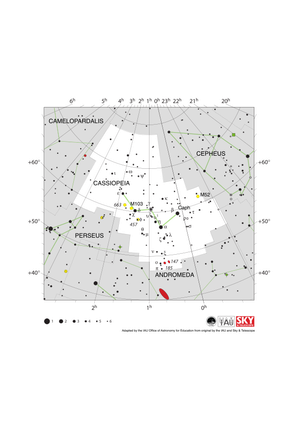
Cassiopeia Constellation Map
Caption: The constellation Cassiopeia along with its bright stars and its surrounding constellations. Cassiopeia is surrounded by (going clockwise from the top):Cepheus, Andromeda, Perseus and Camelopardalis.
Cassiopeia is a northern constellation that is visible from all of the northern hemisphere and equatorial regions of the southern hemisphere. It is most visible in the evenings in the northern hemisphere late autumn and southern hemisphere late spring.
The open star clusters M52, M103, NGC 457 and NGC 663 all lie in this constellation. These are marked with yellow circles. Two dwarf elliptical galaxies NGC 147 and NGC 185 lie in the southern part of the constellation. These are marked with red ellipses and are gravitationally bound to the larger Andromeda galaxy which lies to the south in the constellation of Andromeda.
The y-axis of this diagram is in degrees of declination with north as up and the x-axis is in hours of right ascension with east to the left. The sizes of the stars marked here relate to the star's apparent magnitude, a measure of its apparent brightness. The larger dots represent brighter stars. The Greek letters mark the brightest stars in the constellation. These are ranked by brightness with the brightest star being labeled alpha, the second brightest beta, etc., although this ordering is not always followed exactly. The dotted boundary lines mark the IAU's boundaries of the constellations and the solid green lines mark one of the common forms used to represent the figures of the constellations. Neither the constellation boundaries, nor the lines joining the stars appear on the sky.
Credit: Adapted by the IAU Office of Astronomy for Education from the original by IAU/Sky & Telescope
License: CC-BY-4.0 Creative Commons 姓名標示 4.0 國際 (CC BY 4.0) icons








.jpg)
