وسائط ذات صلة
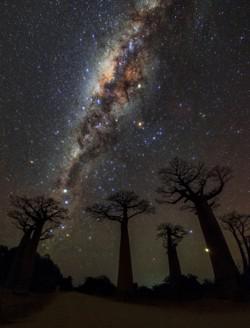
Milky Way over Avenue of Baobabs
الشرح: Winner in the 2022 IAU OAE Astrophotography Contest, category Still images of celestial patterns.
This image, taken from the Avenue of Baobabs, Morondava, Madagascar, in July 2017, shows the majestic band of the Milky Way, our home galaxy, together with a rich collection of constellations and asterisms: Crux, Centaurus, Scorpius, Sagittarius and the Teapot asterism. Towards the bottom left of the image we can see the Southern Cross and the pointer stars Alpha (the brighter of the two) and Beta Centauri, which help to distinguish it from similar-looking configurations. Some cultures in Africa associate the Southern Cross with a giraffe, while others associate the constellations with a pride of lions or even with the Tree of Life.
Antares, the brightest star in the constellation Scorpius, is the orange-red star straight up from the middle baobab tree.
To the Pokomo people from southwestern Kenya, Africa, the Milky Way is associated with the smoke emanating from a campfire lit by ancient people. The various people in South Africa, in contrast, have different star tales; the Khoikhoi from the region around Cape Town explained the colours of the red and white stars as red and white roots that were roasted on a fire and thrown towards the sky together with the ashes of the fire. The Xhosa from further east consider the Milky Way the raised bristle of a huge angry dog, while the Zulu from near Johannesburg interpret it as a stream of spears of their strongest warriors.
Polynesian people, who were adept seafarers and navigators, see the constellation Scorpius as a fish hook, and refer to it as the demigod Maui’s Fish Hook. For the Djab Wurrung and the Jardwadjali people, the Southern Cross is part of a Dreamtime Story involving Tchingal, the Bram-bram-bult brothers (the pointer stars), their mother Druk (Delta Crux), and Bunya, the hunter who gets changed into a possum (Gacrux, red star at the top of the Southern Cross).
In this image, the planets Saturn (the bright point above Antares) and Jupiter (the bright point at the bottom-right of the image close to the trunk of the baobab tree) are visible. Indigenous cultures have various stories associated with the planets, for example Kamilaroi and Wailan people associate Saturn with wunygal, a small bird. The Boorong people of Western Victoria associate Jupiter with Ginabongbearp, the chief of the old spirits (Nurrumbunguttias), who takes the totemic form of the sulphur-crested white cockatoo.
المصدر: Amirreza Kamkar/IAU OAE
License: CC-BY-4.0 المشاع الإبداعي نَسب المُصنَّف 4.0 دولي (CC BY 4.0) أيقونات

Drive
الشرح: Honourable mention in the 2022 IAU OAE Astrophotography Contest, category Still images of celestial patterns.
This image shows the Milky Way crossing the sky above the historical Bixby Bridge in Big Sur, a mountainous region in California, USA, in May 2021.
The star directly above the shore is Antares, a red supergiant in the heart of the Scorpion. To its left, the clouds of the Milky Way seem to emerge from the same point of the horizon as the rocky landmass. Above the land, below the Milky Way in the left quarter of the image, is another bright star, Altair, the bright star in Aquila, the Eagle.
The scorpion is considered a dangerous animal, so scorpion-men (human-scorpion hybrids) guarded the gate to the Netherworld in ancient Babylonian stories, as reported in the Gilgamesh saga. The Eagle, in contrast, appears in the Babylonian saga of King Etana who was taken to the sky by an Eagle and describes the world that he sees below him with increasing distance. Both heroes, Gilgamesh and Etana, are searching for the “herb of life” but one of them by going down, the other by travelling upwards. Gilgamesh aims to get back his dead friend Enkidu and to become immortal himself, while Etana is seeking the herb to help his wife become pregnant. The scorpion and the eagle are the animals supporting these heroes in their search, that ultimately remained unsuccessful. Gilgamesh finally learned that humans can only become immortal by their good deeds for humanity. The Eagle was also recognised in Greek culture, but it was only in Roman times that it became a messenger of a dead soul, carrying it towards the eternal stars. This was when Ptolemy created a constellation to represent the soul of Antinuous below the classical Eagle. This young friend and consultant of the Roman emperor Hadrian drowned in the Nile only seven years before the completion of the Almagest, and the whole Roman empire observed a state of national mourning.
The Milky Way is seen as a “pathway of souls” by many cultures, but in the Babylonian culture, this is not the case. Still, in Greco-Roman philosophy, the bright white parts of it between Antares and Altair, at the intersection of the Milky Way and the Zodiac do have a meaning: Plato, Macrobius and other philosophers refer to it as “the X in the sky”, and the second Celestial Gate was probably considered to be here (the first one being the gate formed by the Hyades and Pleiades).
These celestial pathways and gates, depicted above a gigantic bridge in the landscape and a site where the realms of land and ocean meet, make for an incredibly charged photograph. Additionally, the dark clouds in the Milky Way directly above the land form one of the two large dark constellations of the crocodiles, as interpreted by some people in southern Australia.
المصدر: Marcin Zajac/IAU OAE
License: CC-BY-4.0 المشاع الإبداعي نَسب المُصنَّف 4.0 دولي (CC BY 4.0) أيقونات
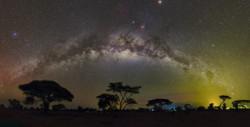
قوس درب التبانة فوق حديقة أمبوسيلي الوطنية
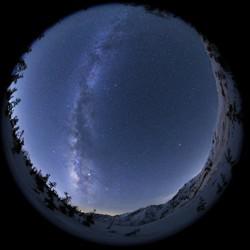
The Milky Way Across the Zenith
الشرح: Winner in the 2022 IAU OAE Astrophotography Contest, category Still images of celestial patterns.
This all-sky image shows our home galaxy, the Milky Way, crossing the zenith, the point just above the observer as seen from Nagano, Japan, in May 2019. Such images of the whole sky can be taken either with a fish-eye lens or with a convex mirror on the ground, the latter of which would show the photographer as well.
Some of the brightest stars in the night sky can be seen in this image, as well as two of the giant planets of our Solar System: Jupiter, the brightest point in the bottom of this image, and Saturn, another bright point just to the opposite side of the Galaxy, to the bottom and next to the horizon.
Directly right of the Milky Way and below Jupiter, we can spot the bright red star Antares, the primary star of the Japanese asterism of The Heart. Japanese constellations derive from ancient Chinese constellations, which were adopted with only slight or no changes. In this tradition, The Heart is the heart of the “Azure Dragon”, a super-constellation that represents the spring. In the Babylonian and Greco-Roman traditions, this area is considered the heart of the Scorpion. In Babylonian religion, the star is associated with Lisi, the child of the mother goddess, but in Greek mythology it is related to the planet Mars, because of its colour. The reddish colour also led to the star’s Chinese name “The Fire Star”. We know that this colour is caused by its relatively cool temperature.
Going from Antares to the right of the image, we find the more northern parts of the sky. The bright star in the lower-right of the image, close to the horizon, is Arcturus, located in the modern constellation Boötes. While Antares and its surrounding area are considered the heart of the Azure Dragon, Arcturus and Spica (below the horizon) are two single-star asterisms forming its huge horn. Pointing towards it from above, at the right-hand edge of the image’s horizon, we can see the handle of the Big Dipper, or Plough, which is part of the constellation Ursa Major.
The bright point to the right of the galaxy and just above the middle of the image is Vega, located in the modern constellation Lyra. Extending a line to the other side of the Galaxy and a bit lower in the image we can find Altair, in the constellation Aquila. From that point we extend another line to Deneb, the brightest star in the constellation of the Swan, also a bit higher in this image and completely flooded by the Milky Way. These three bright stars comprise the asterism known as the Summer Triangle in the northern hemisphere.
المصدر: Ohnishi Kouji/IAU OAE
License: CC-BY-4.0 المشاع الإبداعي نَسب المُصنَّف 4.0 دولي (CC BY 4.0) أيقونات
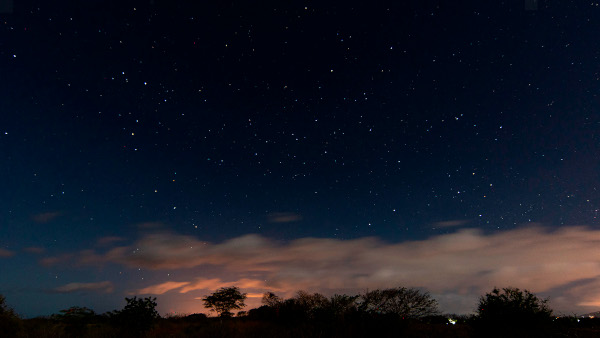
Sky Over the Town of Nindirí, in Masaya, Nicaragua
الشرح: Honourable mention in the 2022 IAU OAE Astrophotography Contest, category Still images of celestial patterns.
This image was taken in Tisma, Nicaragua, in April 2022 during a night illuminated by the Moon. Still, some constellations are visible, but the Milky Way, which runs through the image with some of its brightest regions, hides in the celestial background, partially obscured by terrestrial clouds.
The Scorpion, one of the constellations of the Zodiac, is seen on the left side. We can first spot the brightest star, Antares, in the middle of a group of three in an asterism that looks like the stem of a flower growing from the clouds upwards. Its petals are the head of the scorpion. In the brightness of moonlight, the orange colour of Antares is not clearly visible. The three stars that comprise the head of the scorpion are called Acrab, Dschubba and Fang. They were recently named by the IAU in order to show the global diversity of constellations. Acrab is the Arabic term for the scorpion and Fang (The Room) is the name of the Chinese constellation made out of these stars. The Scorpion’s tail extends to the bottom of the image with the sting just above the horizon in the gap between clouds.
The constellation Centaurus is visible in the middle of this image. We can first recognise Crux and the two pointer stars, Alpha and Beta Centauri right above the clouds. The pointers are the front hooves of the centaur, while the stars of Crux were originally (before Christanity, in antiquity) considered one of the rear legs of the centaur. The stars in the front hooves are Rigil Kentaurus (mixed Arabic and Latin meaning The Foot of the Centaur), to the left, and Hadar, to the right. With Crux at the rear they comprise the legs of the mythological creature’s horse body. The humanoid torso is represented by two bright stars on the shoulders and three fainter stars for the head. The star tale says that this figure represents Chiron, the only decent one among the centaurs who was well educated and the teacher of all great heroes.
The Christian navigators who sailed to the New World around 1500 used these asterisms, although they had never seen them before in Europe. These included explorer Amerigo Vespucci whose name was given to the continent America. His shipmate Andrea Corsali, who came from Florence, where the poet Dante Alighieri was famous for his Divine Comedy written two centuries earlier, was reminded of Dante's poem by the four bright stars of Crux. It was probably in this context that they happened to invent the constellation Crux. Originally, the navigators only used the asterism for practical purposes but some time later, in the period of Christian religious wars between several new churches, celestial cartographers used the cross as a symbol of unity and against war.
المصدر: René Antonio Urroz Álvarez/IAU OAE
License: CC-BY-4.0 المشاع الإبداعي نَسب المُصنَّف 4.0 دولي (CC BY 4.0) أيقونات
الرسوم التوضيحية المرتبطة
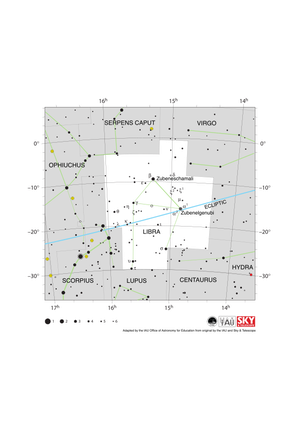
Libra Constellation Map
الشرح: The constellation Libra along with its bright stars and surrounding constellations. Libra is surrounded by (going clockwise from the top) Serpens Caput, Virgo, Hydra, Centaurus, Lupus, Scorpius and Ophiuchus. Libra lies on the ecliptic (shown here as a blue line), this is the path the Sun appears to take across the sky over the course of a year. The Sun is in Libra from late October to late November. The other planets of the Solar System can often be found in Libra.
Libra lies just south of the celestial equator and is thus visible at some time in all but the most arctic regions. Libra is most visible in the evenings in the northern hemisphere late spring/early summer and southern hemisphere late autumn/early winter.
The y-axis of this diagram is in degrees of declination with north as up and the x-axis is in hours of right ascension with east to the left. The sizes of the stars marked here relate to the star's apparent magnitude, a measure of its apparent brightness. The larger dots represent brighter stars. The Greek letters mark the brightest stars in the constellation. These are ranked by brightness with the brightest star being labeled alpha, the second brightest beta, etc., although this ordering is not always followed exactly. The dotted boundary lines mark the IAU's boundaries of the constellations and the solid green lines mark one of the common forms used to represent the figures of the constellations. Neither the constellation boundaries, nor the line marking the ecliptic, nor the lines joining the stars appear on the sky.
المصدر: Adapted by the IAU Office of Astronomy for Education from the original by IAU/Sky & Telescope
License: CC-BY-4.0 المشاع الإبداعي نَسب المُصنَّف 4.0 دولي (CC BY 4.0) أيقونات
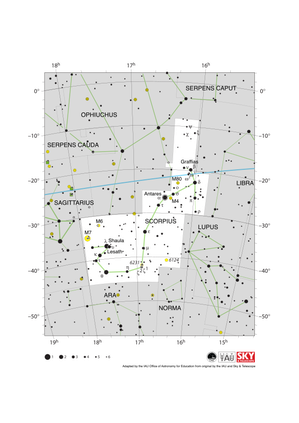
Scorpius Constellation Map
الشرح: The constellation Scorpius (often commonly called Scorpio) along with its bright stars and surrounding constellations. Scorpius is surrounded by (going clockwise from the top) Ophiuchus, Serpens Caput, Libra, Lupus, Norma, Ara, Corona Australis and Sagittarius. Scorpius’s brightest star Antares appears in the heart of the constellation with the famous tail of Scoprius in the south-east (lower left). Scorpius lies on the ecliptic (shown here as a blue line), this is the path the Sun appears to take across the sky over the course of a year. The Sun only spends a short amount of time in late November in Scorpius. The other planets of the Solar System can often be found in Scorpius.
Scorpius lies south of the celestial equator. The whole constellation is not visible from the most arctic regions of the world with parts of Scorpius obscured for observers in northern parts of Asia, Europe and North America. Scorpius is most visible in the evenings in the northern hemisphere summer and southern hemisphere winter.
The yellow circles mark the positions of the open clusters M6, M7 & NGC 6231 while the yellow circles with plus signs superimposed on them mark the globular clusters M4 and M80.
The y-axis of this diagram is in degrees of declination with north as up and the x-axis is in hours of right ascension with east to the left. The sizes of the stars marked here relate to the star's apparent magnitude, a measure of its apparent brightness. The larger dots represent brighter stars. The Greek letters mark the brightest stars in the constellation. These are ranked by brightness with the brightest star being labeled alpha, the second brightest beta, etc., although this ordering is not always followed exactly. The circle around Antares indicates that it is a variable star. The dotted boundary lines mark the IAU's boundaries of the constellations and the solid green lines mark one of the common forms used to represent the figures of the constellations. The blue line marks the ecliptic, the path the Sun appears to travel across the sky over the course of one year. Neither the constellation boundaries, nor the line marking the ecliptic, nor the lines joining the stars appear on the sky.
المصدر: Adapted by the IAU Office of Astronomy for Education from the original by IAU/Sky & Telescope
License: CC-BY-4.0 المشاع الإبداعي نَسب المُصنَّف 4.0 دولي (CC BY 4.0) أيقونات
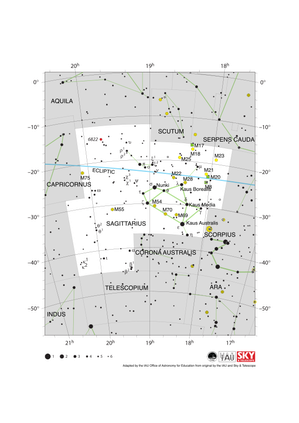
Sagittarius Constellation Map
الشرح: The constellation Sagittarius along with its bright stars and surrounding constellations. Sagittarius is surrounded by (going clockwise from the top) Aquila, Scutum, Serpens Cauda, Ophiuchus, Scorpius, Corona Australis, Telescopium, Microscopium and Capricornus. The brighter stars in Sagittarius form a distinctive teapot shape. Sagittarius lies on the ecliptic (shown here as a blue line), this is the path the Sun appears to take across the sky over the course of a year. The Sun is in Sagittarius from mid December to mid January. The other planets of the Solar System can often be found in Sagittarius.
Sagittarius lies south of the celestial equator. The famous teapot asterism is visible for all but the most arctic regions of the world but the most southerly parts of the constellation are not visible in northern parts of Asia, Europe and North America. Sagittarius is most visible in the evenings in the northern hemisphere summer and southern hemisphere winter.
The supermassive black hole Sagittarius A* which lies at the center of our Milky Way Galaxy is sits on the western (here right-hand) edge of Sagittarius. Due to it covering an area at the center of our Galaxy, Sagittarius is home to many star clusters including open clusters (marked here with yellow circles) and globular clusters (marked here with yellow circles with + signs superimposed on them). Three nebulae are also marked here with green squares.
The y-axis of this diagram is in degrees of declination with north as up and the x-axis is in hours of right ascension with east to the left. The sizes of the stars marked here relate to the star's apparent magnitude, a measure of its apparent brightness. The larger dots represent brighter stars. The Greek letters mark the brightest stars in the constellation. These are ranked by brightness with the brightest star being labeled alpha, the second brightest beta, etc., although this ordering is not always followed exactly. The dotted boundary lines mark the IAU's boundaries of the constellations and the solid green lines mark one of the common forms used to represent the figures of the constellations. Neither the constellation boundaries, nor the line marking the ecliptic, nor the lines joining the stars appear on the sky.
المصدر: Adapted by the IAU Office of Astronomy for Education from the original by IAU/Sky & Telescope
License: CC-BY-4.0 المشاع الإبداعي نَسب المُصنَّف 4.0 دولي (CC BY 4.0) أيقونات
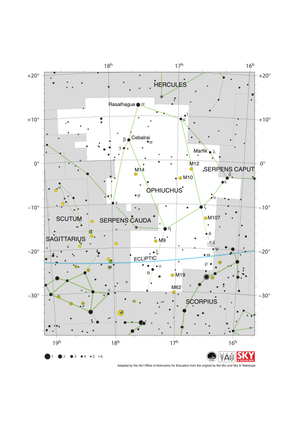
Ophiuchus Constellation Map
الشرح: The constellation Ophiuchus along with its bright stars and its surrounding constellations. Ophiuchus is surrounded by (going clockwise from the top): Hercules, Serpens Caput, Scorpius, Sagittarius and Serpens Cauda. Ophiuchus is not part of the traditional twelve zodiac constellations but it lies on the ecliptic (shown here as a blue line), this is the path the Sun appears to take across the sky over the course of a year. The Sun is in Ophiuchus from late November to mid December. The other planets of the Solar System can often be found in Ophiuchus.
Ophiuchus spans the celestial equator and thus part of the constellation is visible across the whole of the earth at some point in the year. However during the time it is most visible in the evenings (the southern hemisphere winter and northern hemisphere summer) much of the arctic is in perpetual daylight making the stars in the constellation impossible to see. The whole constellation is visible from equatorial and temperate regions of both hemispheres.
As Ophiuchus lies close to the galactic center it contains many globular clusters such as M9, M10, M12, M14, M19, M62, and M107. These are marked as yellow circles with plus symbols superimposed.
The y-axis of this diagram is in degrees of declination with north as up and the x-axis is in hours of right ascension with east to the left. The sizes of the stars marked here relate to the star's apparent magnitude, a measure of its apparent brightness. The larger dots represent brighter stars. The Greek letters mark the brightest stars in the constellation. These are ranked by brightness with the brightest star being labeled alpha, the second brightest beta, etc., although this ordering is not always followed exactly. The dotted boundary lines mark the IAU's boundaries of the constellations and the solid green lines mark one of the common forms used to represent the figures of the constellations. Neither the constellation boundaries, nor the line marking the ecliptic, nor the lines joining the stars appear on the sky.
المصدر: Adapted by the IAU Office of Astronomy for Education from the original by IAU/Sky & Telescope
License: CC-BY-4.0 المشاع الإبداعي نَسب المُصنَّف 4.0 دولي (CC BY 4.0) أيقونات
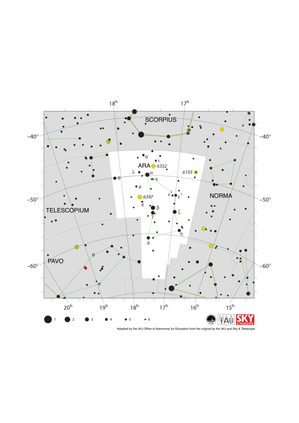
Ara Constellation Map
الشرح: The constellation Ara along with its bright stars and surrounding constellations. Ara is surrounded by (going clockwise from the top): Scorpius, Norma, Triangulum Australe, Apus, Pavo, Telescopium and Corona Australis.
Ara is a southern constellation that is visible from the entire southern hemisphere at some point in the year and is visible from equatorial with parts of the constellation visible from some temperate parts of the northern hemisphere. It is best viewed in the evening in the northern hemisphere summer and southern hemisphere winter.
The globular clusters NGC 6352 and NGC 6397 lie in Ara. These are marked here with yellow circles with plus symbols superimposed on them. The open cluster NGC 6193 also lies in Ara, this is marked here with a yellow circle that is partially obscured by the dot marking the brightest member of the cluster which is visible to the naked eye under good conditions.
The y-axis of this diagram is in degrees of declination with north as up and the x-axis is in hours of right ascension with east to the left. The sizes of the stars marked here relate to the star's apparent magnitude, a measure of its apparent brightness. The larger dots represent brighter stars. The Greek letters mark the brightest stars in the constellation. These are ranked by brightness with the brightest star being labeled alpha, the second brightest beta, etc., although this ordering is not always followed exactly. The dotted boundary lines mark the IAU's boundaries of the constellations and the solid green lines mark one of the common forms used to represent the figures of the constellations. Neither the constellation boundaries, nor the lines joining the stars appear on the sky.
المصدر: Adapted by the IAU Office of Astronomy for Education from the original by IAU/Sky & Telescope
License: CC-BY-4.0 المشاع الإبداعي نَسب المُصنَّف 4.0 دولي (CC BY 4.0) أيقونات