Término del glosario: Escorpio
Descripción: Escorpio (el Escorpión, conocido comúnmente como «Scorpio») es una de las 13 constelaciones del zodíaco. Las estrellas que componen esta constelación se encuentran en la parte del cielo que se cruza con la eclíptica (el plano definido por la trayectoria de la Tierra alrededor del Sol). De hecho, todas las constelaciones que componen el zodíaco se cruzan con la eclíptica. Desde la Tierra, podemos ver habitualmente el Sol, y también los demás planetas del Sistema Solar, en la constelación de Escorpio. Es una de las 88 constelaciones reconocidas por la Unión Astronómica Internacional. Escorpio fue también una de las 48 constelaciones originales identificadas por Ptolomeo; ya había sido identificada por los sumerios más de mil años antes que él. Otras culturas tienen nombres diferentes para Escorpio: se conoce como «el anzuelo de Maui» en las culturas maorí y polinesias, y grupos indígenas australianos como el pueblo Yolngu de la Tierra de Arnhem identifican a Escorpio tanto como un cocodrilo como un escorpión. La estrella más brillante de la constelación es Antares (conocida como Alfa Scorpii), una estrella gigante roja situada a unos 550 años luz de la Tierra.
Términos relacionados:
Ver este término en otros idiomas
Estado del término y la definición: La definición original de este término en inglés ha sido aprobada por unastrónomo o astrónoma investigadora y un docente La traducción de este término y su definición aún están pendientes de aprobación
El Glosario multilingüe de la OAE es un proyecto de la Oficina de Astronomía para la Educación de la UAI (OAE) en colaboración con la Oficina de Divulgación de Astronomía de la UAI (OAO). Los términos y definiciones fueron seleccionados, redactados y revisados gracias al esfuerzo colectivo de la OAE, los Centros y Nodos de la OAE, los Coordinadores Nacionales de Educación Astronómica (NAECs) y otros voluntarios. Puedes encontrar una lista completa de créditos aquí. Todos los términos del glosario y sus definiciones se publican bajo la licencia Creative Commons CC BY-4.0 y deben atribuirse a la "IAU OAE".
Si detectas algún error de contenido o de traducción en este término del glosario o en ladefinición, ponte en contacto con nosotros.
Contenidos relacionados
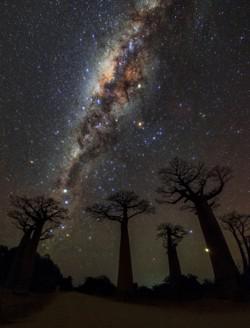
Milky Way over Avenue of Baobabs
Pie de foto: Winner in the 2022 IAU OAE Astrophotography Contest, category Still images of celestial patterns.
This image, taken from the Avenue of Baobabs, Morondava, Madagascar, in July 2017, shows the majestic band of the Milky Way, our home galaxy, together with a rich collection of constellations and asterisms: Crux, Centaurus, Scorpius, Sagittarius and the Teapot asterism. Towards the bottom left of the image we can see the Southern Cross and the pointer stars Alpha (the brighter of the two) and Beta Centauri, which help to distinguish it from similar-looking configurations. Some cultures in Africa associate the Southern Cross with a giraffe, while others associate the constellations with a pride of lions or even with the Tree of Life.
Antares, the brightest star in the constellation Scorpius, is the orange-red star straight up from the middle baobab tree.
To the Pokomo people from southwestern Kenya, Africa, the Milky Way is associated with the smoke emanating from a campfire lit by ancient people. The various people in South Africa, in contrast, have different star tales; the Khoikhoi from the region around Cape Town explained the colours of the red and white stars as red and white roots that were roasted on a fire and thrown towards the sky together with the ashes of the fire. The Xhosa from further east consider the Milky Way the raised bristle of a huge angry dog, while the Zulu from near Johannesburg interpret it as a stream of spears of their strongest warriors.
Polynesian people, who were adept seafarers and navigators, see the constellation Scorpius as a fish hook, and refer to it as the demigod Maui’s Fish Hook. For the Djab Wurrung and the Jardwadjali people, the Southern Cross is part of a Dreamtime Story involving Tchingal, the Bram-bram-bult brothers (the pointer stars), their mother Druk (Delta Crux), and Bunya, the hunter who gets changed into a possum (Gacrux, red star at the top of the Southern Cross).
In this image, the planets Saturn (the bright point above Antares) and Jupiter (the bright point at the bottom-right of the image close to the trunk of the baobab tree) are visible. Indigenous cultures have various stories associated with the planets, for example Kamilaroi and Wailan people associate Saturn with wunygal, a small bird. The Boorong people of Western Victoria associate Jupiter with Ginabongbearp, the chief of the old spirits (Nurrumbunguttias), who takes the totemic form of the sulphur-crested white cockatoo.
Crédito: Amirreza Kamkar/IAU OAE
License: CC-BY-4.0 Creative Commons Reconocimiento 4.0 Internacional (CC BY 4.0) íconos

Drive
Pie de foto: Honourable mention in the 2022 IAU OAE Astrophotography Contest, category Still images of celestial patterns.
This image shows the Milky Way crossing the sky above the historical Bixby Bridge in Big Sur, a mountainous region in California, USA, in May 2021.
The star directly above the shore is Antares, a red supergiant in the heart of the Scorpion. To its left, the clouds of the Milky Way seem to emerge from the same point of the horizon as the rocky landmass. Above the land, below the Milky Way in the left quarter of the image, is another bright star, Altair, the bright star in Aquila, the Eagle.
The scorpion is considered a dangerous animal, so scorpion-men (human-scorpion hybrids) guarded the gate to the Netherworld in ancient Babylonian stories, as reported in the Gilgamesh saga. The Eagle, in contrast, appears in the Babylonian saga of King Etana who was taken to the sky by an Eagle and describes the world that he sees below him with increasing distance. Both heroes, Gilgamesh and Etana, are searching for the “herb of life” but one of them by going down, the other by travelling upwards. Gilgamesh aims to get back his dead friend Enkidu and to become immortal himself, while Etana is seeking the herb to help his wife become pregnant. The scorpion and the eagle are the animals supporting these heroes in their search, that ultimately remained unsuccessful. Gilgamesh finally learned that humans can only become immortal by their good deeds for humanity. The Eagle was also recognised in Greek culture, but it was only in Roman times that it became a messenger of a dead soul, carrying it towards the eternal stars. This was when Ptolemy created a constellation to represent the soul of Antinuous below the classical Eagle. This young friend and consultant of the Roman emperor Hadrian drowned in the Nile only seven years before the completion of the Almagest, and the whole Roman empire observed a state of national mourning.
The Milky Way is seen as a “pathway of souls” by many cultures, but in the Babylonian culture, this is not the case. Still, in Greco-Roman philosophy, the bright white parts of it between Antares and Altair, at the intersection of the Milky Way and the Zodiac do have a meaning: Plato, Macrobius and other philosophers refer to it as “the X in the sky”, and the second Celestial Gate was probably considered to be here (the first one being the gate formed by the Hyades and Pleiades).
These celestial pathways and gates, depicted above a gigantic bridge in the landscape and a site where the realms of land and ocean meet, make for an incredibly charged photograph. Additionally, the dark clouds in the Milky Way directly above the land form one of the two large dark constellations of the crocodiles, as interpreted by some people in southern Australia.
Crédito: Marcin Zajac/IAU OAE
License: CC-BY-4.0 Creative Commons Reconocimiento 4.0 Internacional (CC BY 4.0) íconos
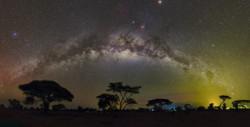
Milky Way Arch over Amboseli National Park
Pie de foto: Winner in the 2022 IAU OAE Astrophotography Contest, category Still images of celestial patterns.
This image was taken in July 2016 from the Amboseli National Park in Kenya, located close to the equator.
In Egyptian mythology from northern Africa, the Milky Way was associated with a river sailed by gods and souls. The Zulu in South Africa interpret this pattern of dark and bright clouds of stars as an animal with black and white skin, whereas the South African Khoikhoi and San considered it “The Star’s Road”. In several South African cultures, the arch of the Milky Way is a pathway to the heavens formed by a mother goddess, according to a South African creation myth that was adopted in the 19th century from early ethnological research, but has vanished today.
In the middle-right of the image we find the bright red star Antares in the modern constellation of the Scorpion and at the upper-left edge is the white star Vega that is considered a Male Steenbok by the peoples around Cape Town.
Indigenous Australians have many names for the Milky Way. The Yolnu people of Arnhem Land in Australia’s Northern Territory refer to the Milky Way as Milnguya, the sky river. One of the prominent patterns in this image is associated with the contrast between the light and dark regions of the Milky Way.
These dark regions are cool dense clouds of interstellar dust and gas, which block the light from stars behind them. One of the prominent patterns is that of the Celestial Emu referred to as Tchingal by several Indigenous peoples of south Australia. The head and beak of the emu (the Coalsack Nebula) lie to the bottom-left of the Southern Cross (seen in the far bottom-right of the image), and the body and legs stretch leftward from it. Other indigenous groups associate the dark regions with caves or waterways. The orientation of the emu over the year provides important clues as to when it is time to pick emu eggs, and when the eggs are hatching. In some months, when these clouds of the Milky Way are close to the horizon, they are not considered as emu at all but as two creeping crocodiles.
The modern figure of the dark Pipe Nebula is clearly visible above the centre of the Galaxy; the smoke of this pipe reaches the colourful rho Ophiuchi region next to Antares in Scorpius, the orange-red star just above the Milky Way. Antares is referred to by the Boorong people as Djuit, the red-rumped parrot, while the Kokatha people of the Western Desert refer to Antares as Kogolongo, the red-tailed black cockatoo.
In addition, some notable constellations can be seen: Cygnus, Aquila, Lyra, Scorpius, Sagittarius, Crux, and Centaurus. The pointer stars, Alpha and Beta Centauri, are occasionally interpreted as The Eyes of the Beast in some South African traditions.
Crédito: Amirreza Kamkar/IAU OAE
License: CC-BY-4.0 Creative Commons Reconocimiento 4.0 Internacional (CC BY 4.0) íconos
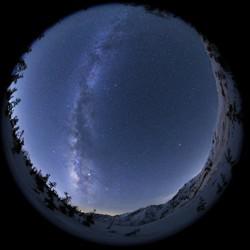
The Milky Way Across the Zenith
Pie de foto: Winner in the 2022 IAU OAE Astrophotography Contest, category Still images of celestial patterns.
This all-sky image shows our home galaxy, the Milky Way, crossing the zenith, the point just above the observer as seen from Nagano, Japan, in May 2019. Such images of the whole sky can be taken either with a fish-eye lens or with a convex mirror on the ground, the latter of which would show the photographer as well.
Some of the brightest stars in the night sky can be seen in this image, as well as two of the giant planets of our Solar System: Jupiter, the brightest point in the bottom of this image, and Saturn, another bright point just to the opposite side of the Galaxy, to the bottom and next to the horizon.
Directly right of the Milky Way and below Jupiter, we can spot the bright red star Antares, the primary star of the Japanese asterism of The Heart. Japanese constellations derive from ancient Chinese constellations, which were adopted with only slight or no changes. In this tradition, The Heart is the heart of the “Azure Dragon”, a super-constellation that represents the spring. In the Babylonian and Greco-Roman traditions, this area is considered the heart of the Scorpion. In Babylonian religion, the star is associated with Lisi, the child of the mother goddess, but in Greek mythology it is related to the planet Mars, because of its colour. The reddish colour also led to the star’s Chinese name “The Fire Star”. We know that this colour is caused by its relatively cool temperature.
Going from Antares to the right of the image, we find the more northern parts of the sky. The bright star in the lower-right of the image, close to the horizon, is Arcturus, located in the modern constellation Boötes. While Antares and its surrounding area are considered the heart of the Azure Dragon, Arcturus and Spica (below the horizon) are two single-star asterisms forming its huge horn. Pointing towards it from above, at the right-hand edge of the image’s horizon, we can see the handle of the Big Dipper, or Plough, which is part of the constellation Ursa Major.
The bright point to the right of the galaxy and just above the middle of the image is Vega, located in the modern constellation Lyra. Extending a line to the other side of the Galaxy and a bit lower in the image we can find Altair, in the constellation Aquila. From that point we extend another line to Deneb, the brightest star in the constellation of the Swan, also a bit higher in this image and completely flooded by the Milky Way. These three bright stars comprise the asterism known as the Summer Triangle in the northern hemisphere.
Crédito: Ohnishi Kouji/IAU OAE
License: CC-BY-4.0 Creative Commons Reconocimiento 4.0 Internacional (CC BY 4.0) íconos
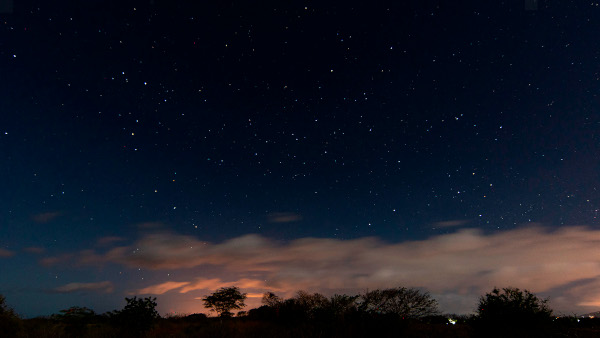
Sky Over the Town of Nindirí, in Masaya, Nicaragua
Pie de foto: Honourable mention in the 2022 IAU OAE Astrophotography Contest, category Still images of celestial patterns.
This image was taken in Tisma, Nicaragua, in April 2022 during a night illuminated by the Moon. Still, some constellations are visible, but the Milky Way, which runs through the image with some of its brightest regions, hides in the celestial background, partially obscured by terrestrial clouds.
The Scorpion, one of the constellations of the Zodiac, is seen on the left side. We can first spot the brightest star, Antares, in the middle of a group of three in an asterism that looks like the stem of a flower growing from the clouds upwards. Its petals are the head of the scorpion. In the brightness of moonlight, the orange colour of Antares is not clearly visible. The three stars that comprise the head of the scorpion are called Acrab, Dschubba and Fang. They were recently named by the IAU in order to show the global diversity of constellations. Acrab is the Arabic term for the scorpion and Fang (The Room) is the name of the Chinese constellation made out of these stars. The Scorpion’s tail extends to the bottom of the image with the sting just above the horizon in the gap between clouds.
The constellation Centaurus is visible in the middle of this image. We can first recognise Crux and the two pointer stars, Alpha and Beta Centauri right above the clouds. The pointers are the front hooves of the centaur, while the stars of Crux were originally (before Christanity, in antiquity) considered one of the rear legs of the centaur. The stars in the front hooves are Rigil Kentaurus (mixed Arabic and Latin meaning The Foot of the Centaur), to the left, and Hadar, to the right. With Crux at the rear they comprise the legs of the mythological creature’s horse body. The humanoid torso is represented by two bright stars on the shoulders and three fainter stars for the head. The star tale says that this figure represents Chiron, the only decent one among the centaurs who was well educated and the teacher of all great heroes.
The Christian navigators who sailed to the New World around 1500 used these asterisms, although they had never seen them before in Europe. These included explorer Amerigo Vespucci whose name was given to the continent America. His shipmate Andrea Corsali, who came from Florence, where the poet Dante Alighieri was famous for his Divine Comedy written two centuries earlier, was reminded of Dante's poem by the four bright stars of Crux. It was probably in this context that they happened to invent the constellation Crux. Originally, the navigators only used the asterism for practical purposes but some time later, in the period of Christian religious wars between several new churches, celestial cartographers used the cross as a symbol of unity and against war.
Crédito: René Antonio Urroz Álvarez/IAU OAE
License: CC-BY-4.0 Creative Commons Reconocimiento 4.0 Internacional (CC BY 4.0) íconos
Diagramas relacionados

Mapa de la constelación de Libra
Pie de foto: La constelación de Libra junto con sus estrellas brillantes y las constelaciones circundantes. Libra está rodeada por (en el sentido de las agujas del reloj desde arriba) Serpens Caput, Virgo, Hidra, Centaurus, Lupus, Escorpio y Ofiuco. Libra se encuentra en la eclíptica (que aquí se muestra como una línea azul), que es la trayectoria que el Sol parece seguir a través del cielo en el transcurso de un año. El Sol está en Libra desde finales de octubre hasta finales de noviembre. Los demás planetas del Sistema Solar se encuentran a menudo en Libra.
Libra se encuentra justo al sur del ecuador celeste, por lo que es visible en algún momento en todas las regiones, excepto en las más árticas. Libra es más visible por la noche a finales de primavera y principios de verano en el hemisferio norte y a finales de otoño y principios de invierno en el hemisferio sur.
El eje-y de este diagrama está en grados de declinación con el norte hacia arriba y el eje-x está en horas de ascensión recta con el este a la izquierda. El tamaño de las estrellas marcadas aquí está relacionado con la magnitud aparente de la estrella, una medida de su brillo aparente. Los puntos más grandes representan estrellas más brillantes. Las letras griegas indican las estrellas más brillantes de la constelación. Están ordenadas según su brillo: la estrella más brillante se denomina alfa, la segunda más brillante beta, etc., aunque este orden no siempre se sigue con exactitud. Las líneas punteadas marcan los límites de las constelaciones según la UAI y las líneas verdes continuas marcan una de las formas habituales utilizadas para representar las figuras de las constelaciones. Ni los límites de las constelaciones, ni la línea que marca la eclíptica, ni las líneas que unen las estrellas aparecen en el cielo.
Crédito: Adaptado por la Oficina de Astronomía para la Educación de la UAI a partir del original de UAI/Sky & Telescope
License: CC-BY-4.0 Creative Commons Reconocimiento 4.0 Internacional (CC BY 4.0) íconos
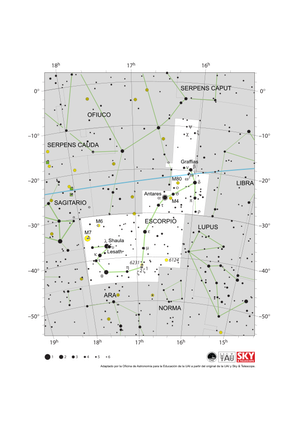
Mapa de la constelación de Escorpio
Pie de foto: La constelación de Escorpio con sus estrellas brillantes y las constelaciones que la rodean. Escorpio está rodeada por (en el sentido de las agujas del reloj desde arriba) Ofiuco, Serpens Caput, Libra, Lupus, Norma, Ara, Corona Australis y Sagitario. La estrella más brillante de Escorpio, Antares, aparece en el corazón de la constelación, con la famosa cola de Escorpio al sureste (abajo a la izquierda). Escorpio se encuentra en la eclíptica (que aquí se muestra como una línea azul), que es la trayectoria que el Sol parece seguir a través del cielo en el transcurso de un año. A finales de noviembre, el Sol pasa poco tiempo en Escorpio. Los demás planetas del Sistema Solar se encuentran a menudo en Escorpio.
Escorpio se encuentra al sur del ecuador celeste. La constelación no es visible en su totalidad desde las regiones más árticas del mundo, y algunas partes de Escorpio quedan ocultas para los observadores de las zonas septentrionales de Asia, Europa y Norteamérica. Escorpio es más visible por la noche en verano en el hemisferio norte y en invierno en el hemisferio sur.
Los círculos amarillos marcan las posiciones de los cúmulos abiertos M6, M7 y NGC 6231, mientras que los círculos amarillos con signos de más superpuestos marcan los cúmulos globulares M4 y M80.
El eje-y de este diagrama está en grados de declinación con el norte hacia arriba y el eje-x está en horas de ascensión recta con el este a la izquierda. El tamaño de las estrellas marcadas aquí está relacionado con la magnitud aparente de la estrella, una medida de su brillo aparente. Los puntos más grandes representan estrellas más brillantes. Las letras griegas indican las estrellas más brillantes de la constelación. Están ordenadas según su brillo: la estrella más brillante se denomina alfa, la segunda más brillante beta, etc., aunque este orden no siempre se sigue con exactitud. El círculo alrededor de Antares indica que se trata de una estrella variable. Las líneas punteadas marcan los límites de las constelaciones según la UAI y las líneas verdes continuas marcan una de las formas habituales utilizadas para representar las figuras de las constelaciones. La línea azul marca la eclíptica, el camino que el Sol parece recorrer a través del cielo en el transcurso de un año. Ni los límites de las constelaciones, ni la línea que marca la eclíptica, ni las líneas que unen las estrellas aparecen en el cielo.
Crédito: Adaptado por la Oficina de Astronomía para la Educación de la UAI a partir del original de UAI/Sky & Telescope
License: CC-BY-4.0 Creative Commons Reconocimiento 4.0 Internacional (CC BY 4.0) íconos

Mapa de la constelación de Sagitario
Pie de foto: La constelación de Sagitario junto con sus estrellas brillantes y las constelaciones circundantes. Sagitario está rodeada por (en el sentido de las agujas del reloj desde arriba) Aquila, Scutum, Serpens Cauda, Ofiuco, Scorpius, Corona Australis, Telescopio, Microscopio y Capricornio. Las estrellas más brillantes de Sagitario dibujan una característica forma de tetera. Sagitario se encuentra en la eclíptica (mostrada aquí como una línea azul), que es la trayectoria que el Sol parece seguir a través del cielo en el transcurso de un año. El Sol está en Sagitario desde mediados de diciembre hasta mediados de enero. Los demás planetas del Sistema Solar se encuentran a menudo en Sagitario.
Sagitario se encuentra al sur del ecuador celeste. La famosa constelación de la tetera es visible en todas las regiones del mundo excepto en las más árticas, pero las partes más meridionales de la constelación no son visibles en las zonas septentrionales de Asia, Europa y Norteamérica. Sagitario es más visible por la noche en verano en el hemisferio norte y en invierno en el hemisferio sur.
El agujero negro supermasivo Sagitario A*, que se encuentra en el centro de nuestra Vía Láctea, está situado en el borde occidental (aquí a la derecha) de Sagitario. Debido a que cubre un área en el centro de nuestra Galaxia, Sagitario alberga muchos cúmulos estelares, incluyendo cúmulos abiertos (marcados aquí con círculos amarillos) y cúmulos globulares (marcados aquí con círculos amarillos con signos + superpuestos). También hay tres nebulosas marcadas aquí con cuadrados verdes.
El eje-y de este diagrama está en grados de declinación con el norte hacia arriba y el eje-x está en horas de ascensión recta con el este a la izquierda. El tamaño de las estrellas marcadas aquí está relacionado con la magnitud aparente de la estrella, una medida de su brillo aparente. Los puntos más grandes representan estrellas más brillantes. Las letras griegas indican las estrellas más brillantes de la constelación. Están ordenadas según su brillo: la estrella más brillante se denomina alfa, la segunda más brillante beta, etc., aunque este orden no siempre se sigue con exactitud. Las líneas punteadas marcan los límites de las constelaciones según la UAI y las líneas verdes continuas marcan una de las formas habituales utilizadas para representar las figuras de las constelaciones. Ni los límites de las constelaciones, ni la línea que marca la eclíptica, ni las líneas que unen las estrellas aparecen en el cielo.
Crédito: Adaptado por la Oficina de Astronomía para la Educación de la UAI a partir del original de UAI/Sky & Telescope
License: CC-BY-4.0 Creative Commons Reconocimiento 4.0 Internacional (CC BY 4.0) íconos

Mapa de la constelación de Ofiuco
Pie de foto: La constelación de Ofiuco junto con sus estrellas brillantes y las constelaciones que la rodean. Ofiuco está rodeada por (en el sentido de las agujas del reloj desde arriba): Hércules, Serpens Caput, Escorpión, Sagitario y Serpens Cauda. Ofiuco no forma parte de las doce constelaciones zodiacales tradicionales, pero se encuentra en la eclíptica (mostrada aquí como una línea azul), que es la trayectoria que el Sol parece seguir a través del cielo en el transcurso de un año. El Sol se encuentra en Ofiuco desde finales de noviembre hasta mediados de diciembre. Los demás planetas del Sistema Solar se encuentran a menudo en Ofiuco.
Ofiuco se extiende a lo largo del ecuador celeste, por lo que parte de la constelación es visible en toda la Tierra en algún momento del año. Sin embargo, durante la época en la que es más visible por las tardes (invierno en el hemisferio sur y verano en el hemisferio norte), gran parte del Ártico se encuentra bajo la luz perpetua del día, lo que hace imposible ver las estrellas de la constelación. Toda la constelación es visible desde las regiones ecuatoriales y templadas de ambos hemisferios.
Como Ofiuco se encuentra cerca del centro galáctico, contiene muchos cúmulos globulares como M9, M10, M12, M14, M19, M62 y M107. Estos están marcados como círculos amarillos con símbolos más superpuestos.
El eje-y de este diagrama está en grados de declinación con el norte hacia arriba y el eje-x está en horas de ascensión recta con el este a la izquierda. El tamaño de las estrellas marcadas aquí está relacionado con la magnitud aparente de la estrella, una medida de su brillo aparente. Los puntos más grandes representan estrellas más brillantes. Las letras griegas indican las estrellas más brillantes de la constelación. Están ordenadas según su brillo: la estrella más brillante se denomina alfa, la segunda más brillante beta, etc., aunque este orden no siempre se sigue con exactitud. Las líneas punteadas marcan los límites de las constelaciones según la UAI y las líneas verdes continuas marcan una de las formas habituales utilizadas para representar las figuras de las constelaciones. Ni los límites de las constelaciones, ni la línea que marca la eclíptica, ni las líneas que unen las estrellas aparecen en el cielo.
Crédito: Adaptado por la Oficina de Astronomía para la Educación de la UAI a partir del original de UAI/Sky & Telescope
License: CC-BY-4.0 Creative Commons Reconocimiento 4.0 Internacional (CC BY 4.0) íconos
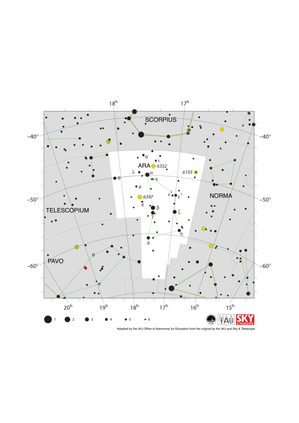
Ara Constellation Map
Pie de foto: The constellation Ara along with its bright stars and surrounding constellations. Ara is surrounded by (going clockwise from the top): Scorpius, Norma, Triangulum Australe, Apus, Pavo, Telescopium and Corona Australis.
Ara is a southern constellation that is visible from the entire southern hemisphere at some point in the year and is visible from equatorial with parts of the constellation visible from some temperate parts of the northern hemisphere. It is best viewed in the evening in the northern hemisphere summer and southern hemisphere winter.
The globular clusters NGC 6352 and NGC 6397 lie in Ara. These are marked here with yellow circles with plus symbols superimposed on them. The open cluster NGC 6193 also lies in Ara, this is marked here with a yellow circle that is partially obscured by the dot marking the brightest member of the cluster which is visible to the naked eye under good conditions.
The y-axis of this diagram is in degrees of declination with north as up and the x-axis is in hours of right ascension with east to the left. The sizes of the stars marked here relate to the star's apparent magnitude, a measure of its apparent brightness. The larger dots represent brighter stars. The Greek letters mark the brightest stars in the constellation. These are ranked by brightness with the brightest star being labeled alpha, the second brightest beta, etc., although this ordering is not always followed exactly. The dotted boundary lines mark the IAU's boundaries of the constellations and the solid green lines mark one of the common forms used to represent the figures of the constellations. Neither the constellation boundaries, nor the lines joining the stars appear on the sky.
Crédito: Adapted by the IAU Office of Astronomy for Education from the original by IAU/Sky & Telescope
License: CC-BY-4.0 Creative Commons Reconocimiento 4.0 Internacional (CC BY 4.0) íconos