This page describes an image Opposition und Konjunktion
Datei runterladen ( Bild 1.38 MB)
PDF Datei runterladen (PDF file 132.63 kB)
Auch in Schwarzweiß verfügbar
Datei runterladen ( Bild 1.38 MB)
PDF Datei runterladen (PDF file 157.20 kB)
Untertitel Diagramm:
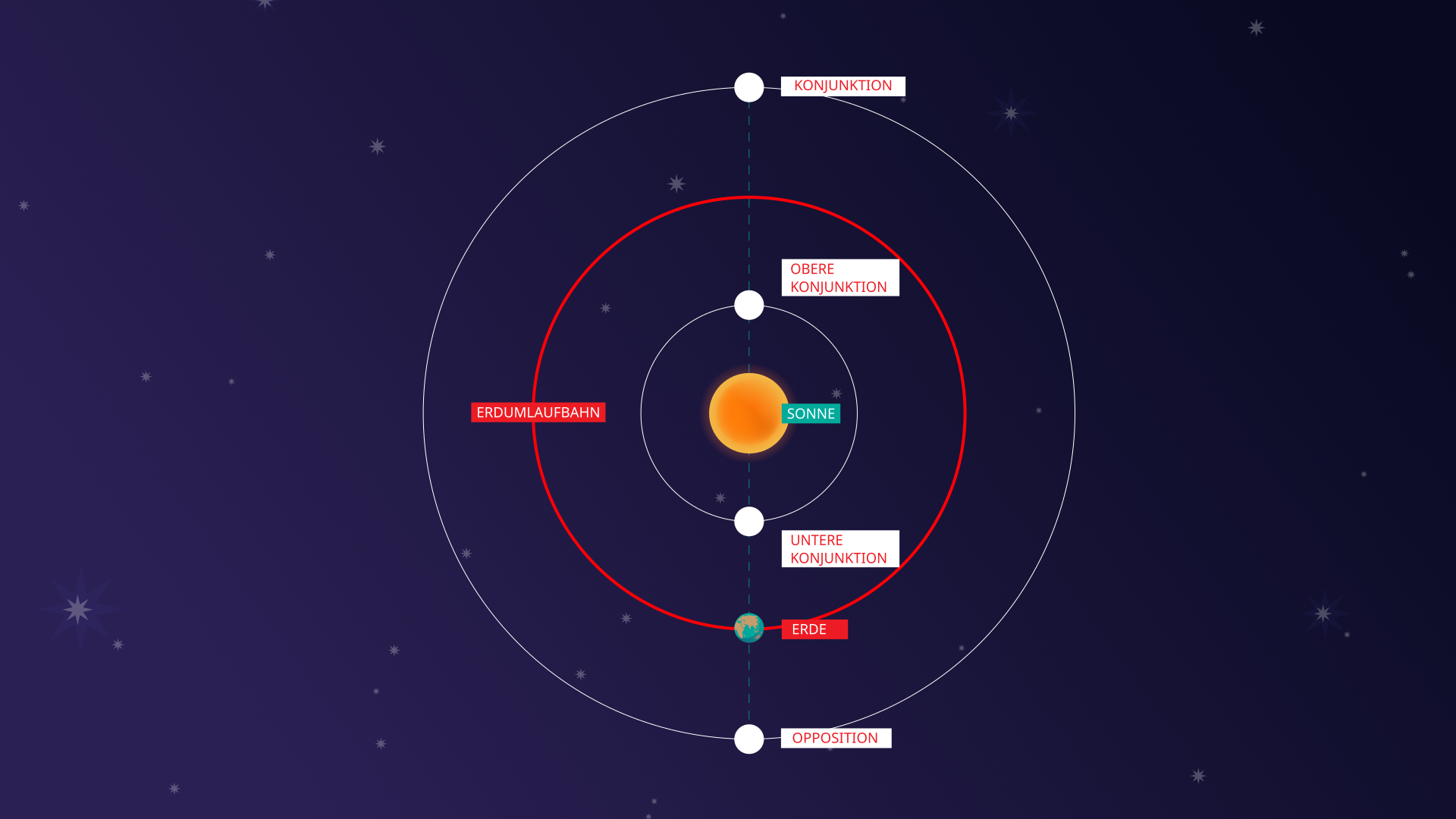
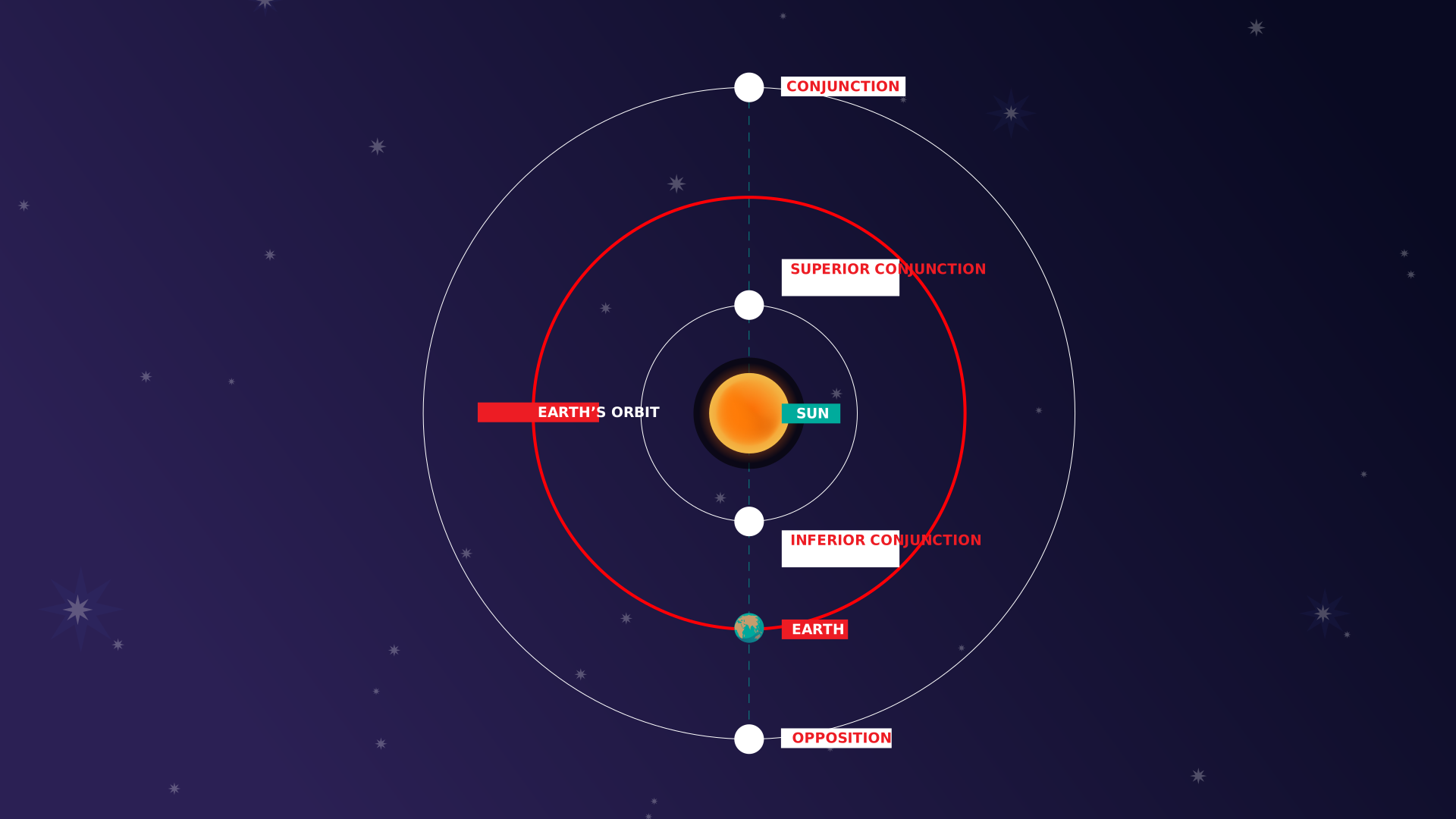
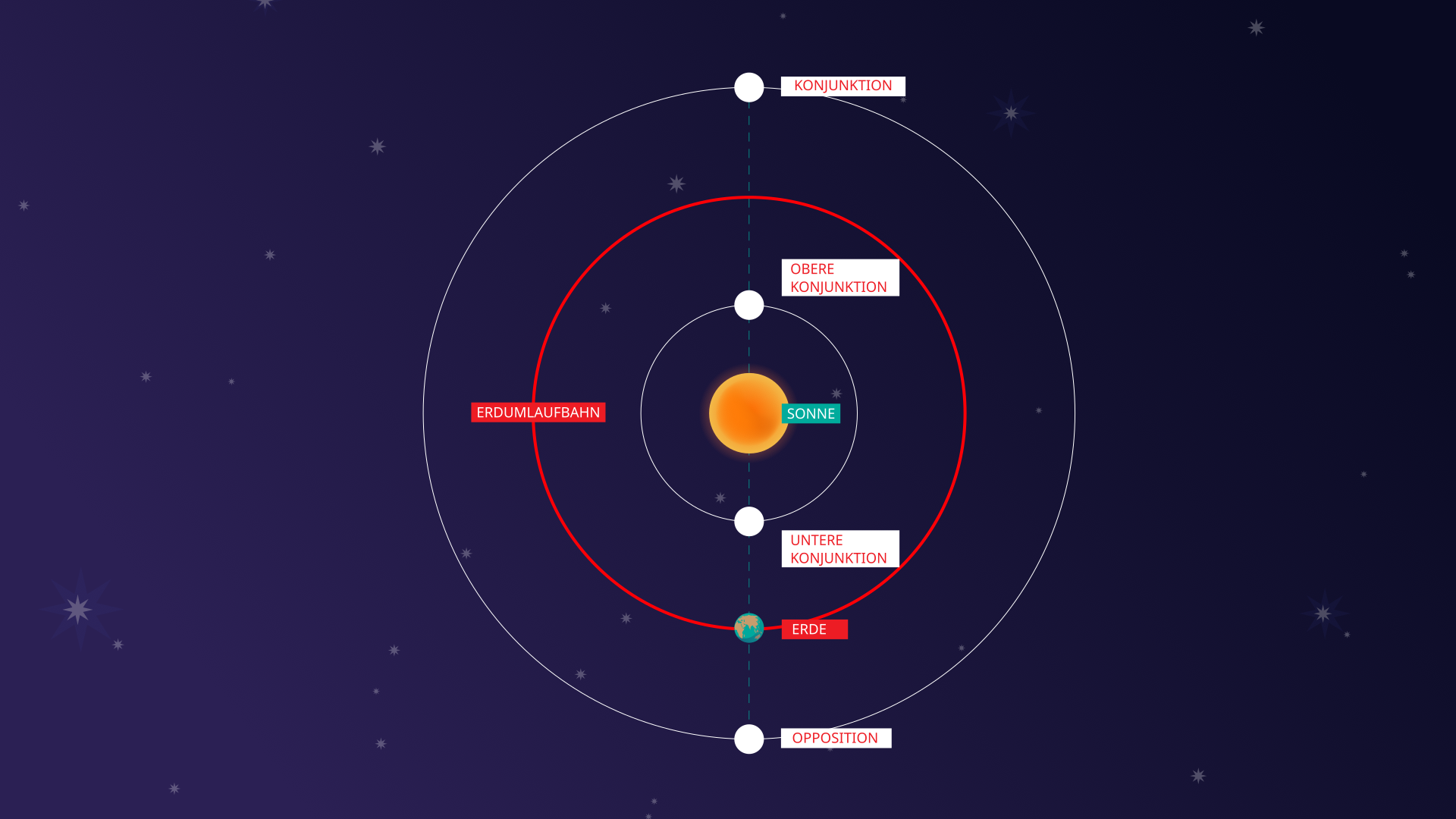
Dieses Diagramm zeigt die Umlaufbahn der Erde um die Sonne sowie die Umlaufbahnen zweier weiterer Planeten, von denen einer außerhalb der Erdumlaufbahn und einer innerhalb um die Sonne kreist. Zu verschiedenen Zeitpunkten der Umläufe dieser beiden Planeten scheinen sich ihre Positionen mit der Erde und der Sonne in einer Linie zu befinden. An diesen Punkten würde jeder Planet von der Erde aus betrachtet nahe an der Sonne stehen. Wenn dies geschieht, sagt man, dass sich der jeweilige Planet in Konjunktion mit der Sonne befindet.
Der Planet, der die Sonne innerhalb der Erdumlaufbahn umkreist, kann während seiner Umlaufbahn zweimal in Konjunktion mit der Sonne stehen: einmal, wenn er sich zwischen Sonne und Erde befindet, und einmal, wenn er sich, von der Erde aus gesehen, hinter der Sonne befindet. Befindet sich der Planet in Konjunktion zwischen Sonne und Erde, spricht man von einer unteren Konjunktion; befindet er sich in Konjunktion auf der der Erde abgewandten Seite der Sonne, spricht man von einer oberen Konjunktion.
Ein Planet, der die Sonne außerhalb der Erdumlaufbahn umkreist, kann sich manchmal auf der entgegengesetzten Seite des Himmels befinden. An diesem Punkt befindet sich die Erde zwischen dem Planeten und der Sonne. In diesem Fall spricht man davon, dass sich der Planet in Opposition befindet.
Oppositionen und Konjunktionen sind nicht nur auf Planeten beschränkt. Auch andere Objekte des Sonnensystems wie Zwergplaneten, Kometen und Asteroiden können sich in Opposition und Konjunktion befinden. Allerdings können sich nur jene Objekte in Opposition befinden, deren Umlaufbahn sie außerhalb der Erdumlaufbahn führt.
Der Begriff „Konjunktion“ wird auch verwendet, um Anordnungen von Planeten des Sonnensystems untereinander am Himmel zu bezeichnen. Wenn beispielsweise Jupiter und Venus von der Erde aus betrachtet sehr nahe beieinander am Himmel erscheinen, sagt man, sie stünden in Konjunktion zueinander.
Quelle Diagramm: Aneta Margraf/IAU OAE.
Diagramm Übersetzungsstatus: Noch nicht bestätigt von einem Rezensenten
Diagramm-Übersetzer: Simon Kraus
Diagramm-Lizenz: Creative Commons Namensnennung 4.0 International (CC BY 4.0) Creative Commons Namensnennung 4.0 International (CC BY 4.0) Symbole
Ähnliche Glossarbegriffe:
Konjunktion
, Opposition
Kategorien:
Astronomie mit bloßem Auge
, Beobachtende Astronomie
, Sonnensystem
Möchtest du deine eigene Übersetzung oder Version dieses Diagrammes erstellen? Dann downloade die SVG
Version dieses Diagrammes auf Englisch (128.98 kB). Du kannst diese Version mit Programmen wie Inkscape (kostenlos) oder Adobe Illustrator (kostenpflichtig) bearbeiten. Bitte verweise dennoch auf den originalen Autor.
Auch in Schwarzweiß verfügbar ( Bild 128.98 kB).
Du kannst Deine eigene Version oder Übersetzung dieses Diagrammes erstellen, indem du einer textlosen Version dieses Diagrammes eigenen Text zufügst.
Downloade einfach eine dieser Dateien:
Download Text-Free File ( Bild 231.72 kB)
Download Text-Free PDF File (PDF file 130.39 kB)
Auch in Schwarzweiß verfügbar:
Download Text-Free File ( Bild 87.72 kB)
Download Text-Free PDF File (PDF file 155.07 kB)
The diagram captions presented on the OAE website were written, translated and reviewed by a collective effort from the OAE, the OAE Centers and Nodes, the OAE National Astronomy Education Coordinators (NAECs) and other volunteers. You can find a full list of credits for our translation project here. All media file captions are released under a Creative Commons CC BY-4.0 license and should be credited to "IAU OAE". The media files themselves may have different licenses (see above) and should be credited as listed above under "credit".
Sollte dir ein Fehler in diesem Diagramm oder seiner Unterschrift auffallen, bitte kontaktiere uns.