Término del glosario: Cúmulo de galaxias
Descripción: Un cúmulo de galaxias es un grupo físico de galaxias unidas gravitacionalmente. Los cúmulos de galaxias pueden variar en tamaño y concentración, conteniendo entre cientos y miles de galaxias. El Cúmulo de Virgo, que es el cúmulo de galaxias más cercano, es un ejemplo de un gran cúmulo que contiene miles de galaxias. Además de galaxias, los cúmulos también contienen plasma y grandes cantidades de materia oscura.
Términos relacionados:
Ver este término en otros idiomas
Estado del término y la definición: La definición original de este término en inglés ha sido aprobada por unastrónomo o astrónoma investigadora y un docente La traducción de este término y su definición aún están pendientes de aprobación
El Glosario multilingüe de la OAE es un proyecto de la Oficina de Astronomía para la Educación de la UAI (OAE) en colaboración con la Oficina de Divulgación de Astronomía de la UAI (OAO). Los términos y definiciones fueron seleccionados, redactados y revisados gracias al esfuerzo colectivo de la OAE, los Centros y Nodos de la OAE, los Coordinadores Nacionales de Educación Astronómica (NAECs) y otros voluntarios. Puedes encontrar una lista completa de créditos aquí. Todos los términos del glosario y sus definiciones se publican bajo la licencia Creative Commons CC BY-4.0 y deben atribuirse a la "IAU OAE".
Si detectas algún error de contenido o de traducción en este término del glosario o en ladefinición, ponte en contacto con nosotros.
En otros idiomas
- Árabe: حشد مجري
- Alemán: Galaxienhaufen
- Inglés: Galaxy Cluster
- Persa: خوشه کهکشانی
- Francés: Amas de galaxies
- Italiano: Ammasso di galassie
- Japonés: 銀河団 (enlace externo)
- Coreano: 은하단
- Portugués de Brasil: Aglomerado de galáxias
- Chino simplificado: 星系团
- Chino tradicional: 星系團
Contenidos relacionados
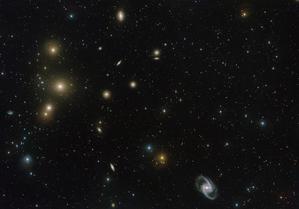
Fornax Galaxy Cluster
Pie de foto: Galaxies can reside in groups, such as our own local group, or in clusters of galaxies. The Fornax Galaxy Cluster is one of the nearest such large groupings of galaxies. Visible in this image taken by the Very Large Telescope Survey Telescope VST (at the European Southern Observatory in Chile) are elliptical galaxies (without defined structures and in a yellow tint) but also spiral galaxies such as NGC 1365 towards the bottom right. This galaxy in particular is classified as a barred spiral galaxy due to its prominent and well-defined bar. The center of the Fornax Cluster is the giant elliptical galaxy NGC 1399, visible as the largest galaxy on the left of the image.
Crédito: ESO. Acknowledgement: Aniello Grado and Luca Limatola
enlace de crédito
License: CC-BY-4.0 Creative Commons Reconocimiento 4.0 Internacional (CC BY 4.0) íconos

The giant elliptical galaxy ESO 325-G004
Pie de foto: The giant elliptical galaxy ESO 325-G004 sits in the Abell S0740 galaxy cluster. This huge galaxy has a mass of approximately a hundred billion solar masses. ESO 325-G004 is brightest in its core with its brightness decreasing further from its center. This galaxy has no visible spiral structure or dust lanes. ESO 325-G004 and many of the smaller galaxies around it are members of the galaxy cluster Abell S0740.
Crédito: Cropped from the original by NASA, ESA, and The Hubble Heritage Team (STScI/AURA); J. Blakeslee (Washington State University)
enlace de crédito
License: PD Dominio público íconos