Término del glosario: Materia oscura
Descripción: La materia oscura es una forma de materia hipotética que tiene masa, pero que es completamente transparente y no emite luz. Se ha postulado como explicación conjunta de diversos fenómenos relacionados con las interacciones gravitatorias.
Las primeras pruebas de la existencia de la materia oscura procedían de galaxias situadas en cúmulos galácticos, de las que se observó que se movían a velocidades relativamente elevadas. Postular una masa adicional sirvió para explicar por qué, a pesar de sus velocidades, las galaxias en cuestión estaban ligadas gravitacionalmente a su cúmulo en lugar de escapar. Las mediciones realizadas por Vera Rubin y otros astrónomos sobre las velocidades a las que orbitan las estrellas y el gas en las galaxias de disco propiciaron una mayor aceptación del concepto de materia oscura: en ese contexto, las leyes habituales de la gravedad requieren la existencia de una masa considerable, además de la materia visible, para explicar las elevadas velocidades de rotación observadas. Más recientemente, las observaciones de lentes gravitacionales han revelado la presencia de una considerable cantidad de masa no luminosa en los cúmulos de galaxias.
En cosmología, la historia de la expansión del Universo apunta a que hay más materia en el Universo de la que se observa en forma de materia luminosa. La explicación más habitual del desarrollo de estructuras en el Universo primitivo también se basa en la presencia de materia oscura. Por estas razones, los modelos cosmológicos estándar se denominan «modelos Lambda CDM», donde CDM significa (por sus siglas en inglés) «materia oscura fría» (de movimiento lento).
La naturaleza de la materia oscura es un tema está siendo objeto de intensa investigación y debate tanto en cosmología como en física de partículas. Las pruebas de la existencia de la materia oscura siguen siendo indirectas, basándose en observaciones de los efectos de la masa de la materia oscura sobre la materia luminosa o la luz. Existen varias hipótesis sobre especies de partículas elementales aún no detectadas que podrían constituir la materia oscura, pero los experimentos diseñados para encontrar pruebas directas de la existencia de dichas partículas candidatas no han tenido éxito hasta ahora. También hay otras explicaciones propuestas que pretenden dar cuenta de las observaciones relevantes sin recurrir a nuevas especies de partículas.
Términos relacionados:
Ver este término en otros idiomas
Estado del término y la definición: La definición original de este término en inglés ha sido aprobada por unastrónomo o astrónoma investigadora y un docente La traducción de este término y su definición aún están pendientes de aprobación
El Glosario multilingüe de la OAE es un proyecto de la Oficina de Astronomía para la Educación de la UAI (OAE) en colaboración con la Oficina de Divulgación de Astronomía de la UAI (OAO). Los términos y definiciones fueron seleccionados, redactados y revisados gracias al esfuerzo colectivo de la OAE, los Centros y Nodos de la OAE, los Coordinadores Nacionales de Educación Astronómica (NAECs) y otros voluntarios. Puedes encontrar una lista completa de créditos aquí. Todos los términos del glosario y sus definiciones se publican bajo la licencia Creative Commons CC BY-4.0 y deben atribuirse a la "IAU OAE".
Si detectas algún error de contenido o de traducción en este término del glosario o en ladefinición, ponte en contacto con nosotros.
En otros idiomas
- Árabe: المادة المظلمة
- Alemán: Dunkle Materie
- Inglés: Dark Matter
- Francés: Matière noire
- Italiano: Materia oscura
- Japonés: ダークマター (enlace externo)
- Coreano: 암흑물질
- Portugués de Brasil: Matéria Escura
- Chino simplificado: 暗物质
- Chino tradicional: 暗物質
Contenidos relacionados
Dark matter
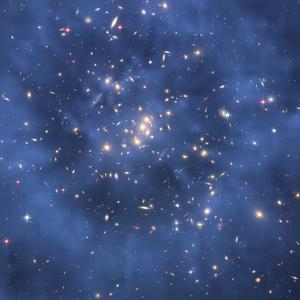
Pie de foto: This image of the galaxy cluster ZwCl0024+1652 is created using mathematical modelling, together with observations from the Hubble Space Telescope (HST).
The Hubble observations were taken in November 2004 by the Advanced Camera for Surveys (ACS). The exquisite resolution of the ACS, allowed very detailed measurements to be made of the gravitational lensing in the cluster. The blue nebulosity is a superimposed ""map"" of the dark matter distribution in the galaxy cluster and is not visible in the observations, but is a mathematical model created based on the gravitational lensing data.
The ""dark matter ring"" the is present in the image is one of the strongest pieces of evidence to date for the existence of dark matter. Observational data provides evidence that Dark matter makes up about 1/4 of the Universe, and is believed to make up the underlying structure of the cosmos. In addition, a large percentage the mass in galaxies and galaxy clusters is dark matter, which is not visible via direct observations.
Crédito: NASA, ESA, M.J. Jee and H. Ford (Johns Hopkins University)
enlace de crédito
License: CC-BY-4.0 Creative Commons Reconocimiento 4.0 Internacional (CC BY 4.0) íconos
SDSS Redshift Map
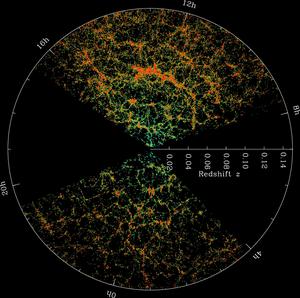
Pie de foto: This image shows a map of the distribution of galaxies and is based on redshift data from the Sloan Digital Sky Survey (SDSS). Redshift measurements provides information on the distances, positions and motions of the galaxies.
The Earth is located at the center of the image, and each dot represents a galaxy. The outer circle represents a ""distance"" of about 2 billion light years. The idea of distance in cosmology is complex because the usual measurement of distance is the separation between two points in space at the same time. However, because of the speed of light, the further a distance, the farther back in time we are observing. The numbers on the outer circle are Right Ascension coordinates mapped onto a flat circle, and provides information on the position of the galaxies on the sky. The colours used represent the ages of the stars in the galaxies, the redder, more strongly clustered points represent galaxies comprising of older stars. The dark wedges that do not contain any dots are regions that were not mapped by the SDSS due to dust from the Milky Way galaxy obscuring the view.
Crédito: M. Blanton and Sloan Digital Sky Survey
enlace de crédito
License: CC-BY-4.0 Creative Commons Reconocimiento 4.0 Internacional (CC BY 4.0) íconos
Actividades relacionadas

Dark matter & dark energy (Part 2) – Understanding the nature of dark matter and dark energy
astroEDU educational activity (links to astroEDU website) Description: Let's investigate the nature of dark matter and energy with gravitational lensing!
License: CC-BY-4.0 Creative Commons Reconocimiento 4.0 Internacional (CC BY 4.0) íconos
Etiquetas:
Experiment
, Invisible
Rango de edades:
12-14
, 14-16
, 16-19
, 19+
Nivel educativo:
Educación no forma
, Educación secundaria
Áreas de aprendizaje:
Aprendizaje por descubrimiento guiado
, Clase interactiva
, Modelización
, Resolución de problemas
Costos:
Coste medio
Duración:
45 minutos
Tamaño del grupo:
Grupo
Competencias:
Elaborar explicaciones
, Desarrollar y utilizar modelos
, Participar en debates basados en pruebas

Dark matter and Dark energy (Part 1) – Discovering the main components of the Universe
astroEDU educational activity (links to astroEDU website) Description: Lets' investigate gravity, dark matter and dark energy with some very simple experiments!
License: CC-BY-4.0 Creative Commons Reconocimiento 4.0 Internacional (CC BY 4.0) íconos
Etiquetas:
Experiment
, Galaxies
Rango de edades:
12-14
, 14-16
, 16-19
, 19+
Nivel educativo:
Educación no forma
, Educación secundaria
Áreas de aprendizaje:
Aprendizaje por descubrimiento guiado
, Clase interactiva
, Modelización
, Basado en la observación
, Otros
, Resolución de problemas
Costos:
Bajo coste
Duración:
45 minutos
Tamaño del grupo:
Grupo
Competencias:
Elaborar explicaciones
, Desarrollar y utilizar modelos
, Participar en debates basados en pruebas
, Planificar y llevar a cabo investigaciones