Término del glosario: Galaxia
Descripción: Una galaxia es un sistema de estrellas y otros componentes materiales, como la materia oscura, el gas y el polvo, unidos por la gravedad, y que suele estar separada de sus vecinas por cientos de miles de años luz. Las galaxias presentan diversas formas y tamaños. Las galaxias más pequeñas pueden tener unos pocos miles de estrellas, mientras que las más grandes pueden llegar a tener decenas de billones. «La Galaxia» o «Galaxia» con mayúscula suele referirse a nuestra galaxia, la Vía Láctea, que cuenta con entre 100 000 y 400 000 millones de estrellas.
Términos relacionados:
- Materia oscura
- Galaxia de disco
- Polvo
- Galaxia enana
- Galaxia elíptica
- Bulbo galáctico
- Centro galáctico
- Disco galáctico
- Halo galáctico
- Cúmulo de galaxias
- Gas
- Zona horaria de Greenwich (GMT)
- Galaxia irregular
- Vía Láctea
- Galaxia espiral
- Estrella
- Barra galáctica
- Galaxia lenticular
Ver este término en otros idiomas
Estado del término y la definición: La definición original de este término en inglés ha sido aprobada por unastrónomo o astrónoma investigadora y un docente La traducción de este término y su definición aún están pendientes de aprobación
El Glosario multilingüe de la OAE es un proyecto de la Oficina de Astronomía para la Educación de la UAI (OAE) en colaboración con la Oficina de Divulgación de Astronomía de la UAI (OAO). Los términos y definiciones fueron seleccionados, redactados y revisados gracias al esfuerzo colectivo de la OAE, los Centros y Nodos de la OAE, los Coordinadores Nacionales de Educación Astronómica (NAECs) y otros voluntarios. Puedes encontrar una lista completa de créditos aquí. Todos los términos del glosario y sus definiciones se publican bajo la licencia Creative Commons CC BY-4.0 y deben atribuirse a la "IAU OAE".
Si detectas algún error de contenido o de traducción en este término del glosario o en ladefinición, ponte en contacto con nosotros.
Contenidos relacionados
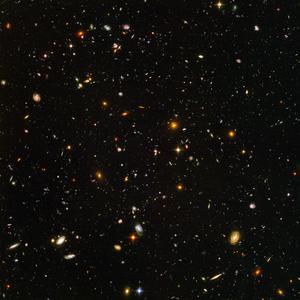
Hubble Ultra Deep Field
Pie de foto: This awe-inspiring image referred to as the Hubble Ultra-Deep Field (HUDF), was obtained using the Hubble Space Telescope (HST), by combining 800 exposures from 400 orbits of the HST, which equates to 11.3 days of total exposure time.
The image shows nearly 10,000 galaxies and was taken in the direction of a patch of sky with the least amount of stars from the Milky Way galaxy in the field of view. The region of sky that the HST observed corresponds to 1/10 the angular size of the Full Moon, which is roughly equal to approximately a 1 millimeter-sized object placed 1 meter away.
Every object in the image, except for the bright points with the crosshairs, are galaxies. As a consequence of the speed of light being a constant in a vacuum, the more distant an object, the further back in time we are observing. Therefore, the light from some of the galaxies in the HUDF image is from when the Universe as only a few hundred million years old. The HUDF image takes us through on a journey through space, and also in time.
Crédito: NASA, ESA, and S. Beckwith (STScI) and the HUDF Team
enlace de crédito
License: CC-BY-4.0 Creative Commons Reconocimiento 4.0 Internacional (CC BY 4.0) íconos
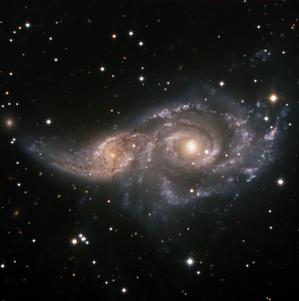
Spiral Galaxy Merger
Pie de foto: This image shows two interacting spiral galaxies located approximately 150 million light-years away. Two spiral galaxies are involved in this dance, creating visible distortions in their spiral arms due to the gravitational pull. What is starting as an embrace in this picture, will end in the merger of those two galaxies into one, most likely elliptical, galaxy.
Crédito: ESO
enlace de crédito
License: CC-BY-4.0 Creative Commons Reconocimiento 4.0 Internacional (CC BY 4.0) íconos
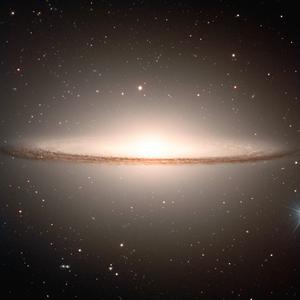
Sombrero galaxy
Pie de foto: This prominent galaxy M 104 is often called the Sombrero galaxy due to its resemblance to the Mexican hat. This look is created by the thin disk oriented nearly edge-on, which appears illuminated by the dominant bulge. Both, the disk and bulge contain stars, but the stars in the bulge tend to be older, while the disk also harbors large amounts of dust and gas creating shadows. M 104 is located in the constellation Virgo approximately 50 light-years away. While some of the dots visible in the picture are foreground stars and others background galaxies, the majority are actually globular clusters, dense massive clusters of stars, associated with the Sombrero Galaxy.
Crédito: ESO/P. Barthel
enlace de crédito
License: CC-BY-4.0 Creative Commons Reconocimiento 4.0 Internacional (CC BY 4.0) íconos

La galaxia lenticular NGC 2787
Pie de foto: La galaxia lenticular NGC 2787. Esta galaxia es una galaxia de disco, pero carece de la estructura dominante de grandes brazos espirales que se observa en los discos de las galaxias espirales. Su núcleo es muy brillante en comparación con el núcleo de una galaxia espiral. En el disco de la galaxia se pueden observar anillos delgados de polvo.
Crédito: NASA/ESA y The Hubble Heritage Team
enlace de crédito
License: CC-BY-4.0 Creative Commons Reconocimiento 4.0 Internacional (CC BY 4.0) íconos
Diagramas relacionados
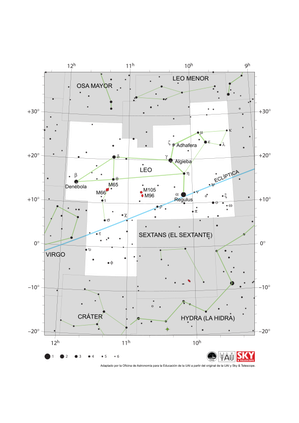
Mapa de la constelación de Leo
Pie de foto: La constelación zodiacal de Leo y las constelaciones que la rodean. Empezando por la parte superior del diagrama y siguiendo el sentido de las agujas del reloj, son Leo Menor, Cáncer, Sextante, Hidra, Cráter, Virgo y Osa Mayor. La estrella más brillante de Leo, Regulus, se encuentra casi exactamente en la eclíptica (mostrada aquí como una línea azul): la trayectoria que el Sol parece seguir a través del cielo en el transcurso de un año. El Sol se encuentra en Leo desde mediados de agosto hasta mediados de septiembre. Los demás planetas del Sistema Solar se encuentran a menudo en Leo.
Leo abarca el ecuador celeste y, por tanto, parte de ella es visible en algún momento del año desde todo el planeta Tierra, con parte de la constelación oscurecida para las regiones más árticas y antárticas del mundo. Leo es más visible por la noche en primavera en el hemisferio norte y en otoño en el hemisferio sur.
Varios objetos pueden verse en Leo, incluyendo M65 y M66 - dos galaxias en el Triplete de Leo, un trío de galaxias incluyendo NGC 3628, no listada aquí. Además, M96, una galaxia espiral, puede verse como un objeto borroso utilizando un telescopio pequeño, y Messier 105, una galaxia elíptica. Cada uno de estos objetos está marcado en el mapa como elipses rojas.
El eje-y de este diagrama está en grados de declinación con el norte hacia arriba y el eje-x está en horas de ascensión recta con el este a la izquierda. El tamaño de las estrellas marcadas aquí está relacionado con la magnitud aparente de la estrella, una medida de su brillo aparente. Los puntos más grandes representan estrellas más brillantes. Las letras griegas indican las estrellas más brillantes de la constelación. Están ordenadas según su brillo: la estrella más brillante se denomina alfa, la segunda más brillante beta, etc., aunque este orden no siempre se sigue con exactitud. Las líneas punteadas marcan los límites de las constelaciones según la UAI y las líneas verdes continuas marcan una de las formas habituales utilizadas para representar las figuras de las constelaciones. Ni los límites de las constelaciones, ni la línea que marca la eclíptica, ni las líneas que unen las estrellas aparecen en el cielo.
Crédito: Adaptado por la Oficina de Astronomía para la Educación de la UAI a partir del original de UAI/Sky & Telescope
License: CC-BY-4.0 Creative Commons Reconocimiento 4.0 Internacional (CC BY 4.0) íconos
Actividades relacionadas
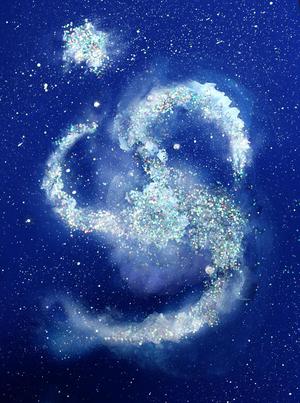
Glitter Your Milky Way
astroEDU educational activity (links to astroEDU website) Description: Explore the Milky Way and characteristics of galaxies using glitter drawing.
License: CC-BY-4.0 Creative Commons Reconocimiento 4.0 Internacional (CC BY 4.0) íconos
Etiquetas:
Art
, Creativity
, Hands-on
, Handcraft
Rango de edades:
6-8
, 8-10
Nivel educativo:
Educación secundaria
, Primaria
Áreas de aprendizaje:
Centrado en las bellas artes
Costos:
Coste medio
Tamaño del grupo:
Grupo
Competencias:
Comunicar información
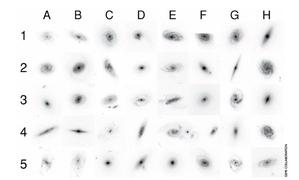
Coma Cluster of Galaxies
astroEDU educational activity (links to astroEDU website) Description: The basics of galaxy classification, using Hubble Space Telescope images.
License: CC-BY-4.0 Creative Commons Reconocimiento 4.0 Internacional (CC BY 4.0) íconos
Etiquetas:
Coma Cluster
Rango de edades:
14-16
, 16-19
, 19+
Nivel educativo:
Secondary
, Universitario
Áreas de aprendizaje:
Aprendizaje por descubrimiento guiado
Costos:
Bajo coste
Duración:
1 hora
Tamaño del grupo:
Grupo
Competencias:
Analizar e interpretar datos
, Comunicar información
, Elaborar explicaciones
, Planificar y llevar a cabo investigaciones
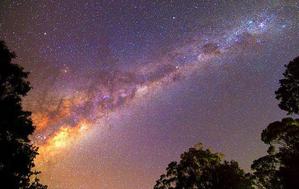
Living in the Milky Way
astroEDU educational activity (links to astroEDU website) Description: Build a model of the Milky Way to discover what our galaxy contains.
License: CC-BY-4.0 Creative Commons Reconocimiento 4.0 Internacional (CC BY 4.0) íconos
Etiquetas:
Hands-on
, Model
Rango de edades:
6-8
, 8-10
Nivel educativo:
Primaria
Áreas de aprendizaje:
Resolución de problemas
, Aprendizaje basado en la investigación estructurada
Costos:
Coste medio
Duración:
1 hora y 30 minutos
Tamaño del grupo:
Grupo
Competencias:
Plantear preguntas
, Comunicar información
, Desarrollar y utilizar modelos

3D Universe: the Milky Way and friends
astroEDU educational activity (links to astroEDU website) Description: Use tactile models printed in 3D to explore our galactic neighborhood.
License: CC-BY-4.0 Creative Commons Reconocimiento 4.0 Internacional (CC BY 4.0) íconos
Rango de edades:
10-12
, 12-14
, 14-16
, 16-19
, 19+
Nivel educativo:
Educación secundaria
, Secondary
, Universitario
Áreas de aprendizaje:
Aprendizaje por descubrimiento guiado
, Clase interactiva
, Modelización
Costos:
Coste medio
Duración:
1 hora
Tamaño del grupo:
Grupo
Competencias:
Analizar e interpretar datos
, Desarrollar y utilizar modelos