Término del glosario: Gigante gaseoso
Descripción: Un gigante gaseoso es un planeta gigante compuesto principalmente por hidrógeno y helio, que son gases en el espacio interestelar e interplanetario, de ahí su nombre. Sin embargo, la mayor parte del hidrógeno y el helio de los gigantes gaseosos se encuentra, en realidad, en estado líquido.
Se cree que los gigantes gaseosos tienen núcleos rocosos rodeados por gruesas capas de hidrógeno y helio. En las partes más profundas del planeta, estos gases se comprimen hasta adoptar forma líquida, y se cree que las capas más profundas contienen un océano de hidrógeno metálico. En las capas externas, el hidrógeno y el helio se encuentran en forma gaseosa. Otros elementos de la atmósfera pueden formar nubes y lluvia. En los gigantes gaseosos más fríos, las nubes de la capa superior pueden estar formadas por vapor de agua o amoníaco. En las capas más profundas y calientes de los gigantes gaseosos más fríos, y en las capas externas de los gigantes gaseosos más calientes, las nubes pueden estar formadas por hierro y minerales que son sólidos a temperatura ambiente.
Los dos planetas más grandes del Sistema Solar, Júpiter y Saturno, son gigantes gaseosos.
Términos relacionados:
Ver este término en otros idiomas
Estado del término y la definición: La definición original de este término en inglés ha sido aprobada por unastrónomo o astrónoma investigadora y un docente La traducción de este término y su definición aún están pendientes de aprobación
El Glosario multilingüe de la OAE es un proyecto de la Oficina de Astronomía para la Educación de la UAI (OAE) en colaboración con la Oficina de Divulgación de Astronomía de la UAI (OAO). Los términos y definiciones fueron seleccionados, redactados y revisados gracias al esfuerzo colectivo de la OAE, los Centros y Nodos de la OAE, los Coordinadores Nacionales de Educación Astronómica (NAECs) y otros voluntarios. Puedes encontrar una lista completa de créditos aquí. Todos los términos del glosario y sus definiciones se publican bajo la licencia Creative Commons CC BY-4.0 y deben atribuirse a la "IAU OAE".
Si detectas algún error de contenido o de traducción en este término del glosario o en ladefinición, ponte en contacto con nosotros.
En otros idiomas
- Árabe: عملاق غازي
- Alemán: Gasriese
- Inglés: Gas Giant
- Francés: Géantes gazeuses
- Italiano: Gigante gassoso
- Japonés: 巨大ガス惑星 (enlace externo)
- Maratí: वायुरुप ग्रह (गॅस जायंट)
- Nepalí: ग्यास जाइन्ट
- Portugués de Brasil: Gigante gasoso
- Chino simplificado: 气态巨行星
- Chino tradicional: 氣態巨行星
Contenidos relacionados
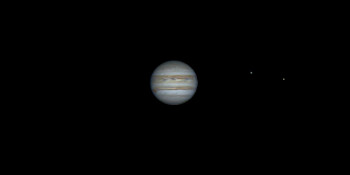
Jupiter's Rotation, by Vishal Sharma, India
Pie de foto: Third place in the 2021 IAU OAE Astrophotography Contest, category Galilean moons: Jupiter’s Rotation, by Vishal Sharma, India.
This time-lapse beautifully shows the rotation of Jupiter and the passage of two Galilean moons on the right side of the frame. Jupiter completes one rotation in just under 10 hours and we see as the Great Red Spot makes its way from left to right. The two moons travel a noticeable fraction of their orbit in this short time. This image was taken in 2020 in the North of India.
Crédito: Vishal Sharma/IAU OAE
License: CC-BY-4.0 Creative Commons Reconocimiento 4.0 Internacional (CC BY 4.0) íconos
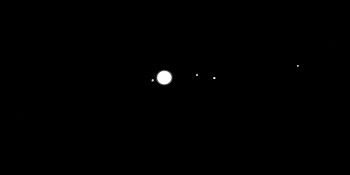
Jupiter Moons Movie2, by Nicolas Hurez, Paul-Antoine Matrangolo, and Carl Pennypacker, United States of America
Pie de foto: Second place in the 2021 IAU OAE Astrophotography Contest, category Galilean moons.
This sequence shows the orbit of the four Galilean moons around the planet Jupiter. Almost two entire orbits of the innermost moon, Io, can be seen, with the other moons (Europa and Ganymede, but in particular Callisto) being further away, orbiting noticeably slower. The images were obtained in 2018 with the Las Cumbres Global Observatory at different locations on Earth, allowing a continuous sequence of images over approximately half a week without gaps during the day. With clear skies and over the course of several nights, the motion of the Galilean moons can also be observed with binoculars (ideally steady your elbows on a surface).
Crédito: Nicolas Hurez, Paul-Antoine Matrangolo and Carl Pennypacker/IAU OAE
License: CC-BY-4.0 Creative Commons Reconocimiento 4.0 Internacional (CC BY 4.0) íconos
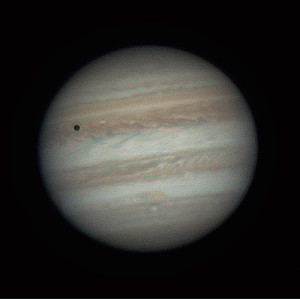
Jupiter, Io and its shadow, by Ralf Burkart, Germany
Pie de foto: First place in the 2021 IAU OAE Astrophotography Contest, category Galilean moons.
This time-lapse of Jupiter taken in 2017 from Germany beautifully illustrates the transit of one of the Galilean moons, Io, in front of Jupiter. As this is simply a moon casting a shadow on a planet it is equivalent to a lunar eclipse on Earth observed from further away. While the shadow of the moon is clearly visible from the beginning, it might be difficult to spot the moon itself against the background of the beautiful atmospheric bands of Jupiter the first time the video is seen. Watching it repeatedly allows appreciating the rapid motion and rotation in this fantastic observation.
Crédito: Ralf Burkart/IAU OAE
License: CC-BY-4.0 Creative Commons Reconocimiento 4.0 Internacional (CC BY 4.0) íconos
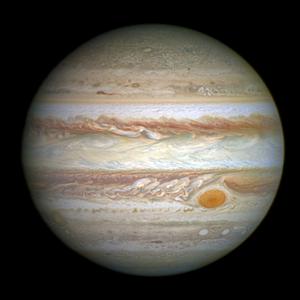
Jupiter
Pie de foto: This full disk view of Jupiter was obtained on 21 April 2014 with Hubble's Wide Field Camera 3 (WFC3). It shows the prominent great red spot, a gigantic cyclone. Cloud ribbons cover the surface, whose colours stem from gases like ammonia and other chemical compounds.
Crédito: NASA, ESA, and A. Simon (Goddard Space Flight Center)
enlace de crédito
License: CC-BY-4.0 Creative Commons Reconocimiento 4.0 Internacional (CC BY 4.0) íconos
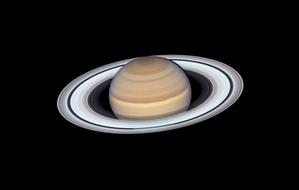
Saturn
Pie de foto: The NASA/ESA Hubble Space Telescope’s Wide Field Camera 3 observed Saturn on 20 June 2019 as the planet made its closest approach to Earth this year, at approximately 1.36 billion kilometres away. The image shows coloured bands of gas on the planet's surface as well as its prominent rings made of ice and rocky material.
Crédito: NASA, ESA, A. Simon (Goddard Space Flight Center), and M.H. Wong (University of California, Berkeley)
enlace de crédito
License: CC-BY-4.0 Creative Commons Reconocimiento 4.0 Internacional (CC BY 4.0) íconos
Actividades relacionadas

Meet our neighbours: Jupiter
astroEDU educational activity (links to astroEDU website) Description: Jupiter, the gas giant of the Solar System in a tactile version.
License: CC-BY-4.0 Creative Commons Reconocimiento 4.0 Internacional (CC BY 4.0) íconos
Rango de edades:
6-8
, 8-10
, 10-12
Nivel educativo:
Primaria
Áreas de aprendizaje:
Actividad lúdica
, Modelización
Costos:
Bajo coste
Duración:
1 hora
Tamaño del grupo:
Grupo
Competencias:
Analizar e interpretar datos
, Desarrollar y utilizar modelos